Pushed for Parliament Dissolution but Faced Impeachment Instead
Resigned After 16 Months... Vice President Succeeds
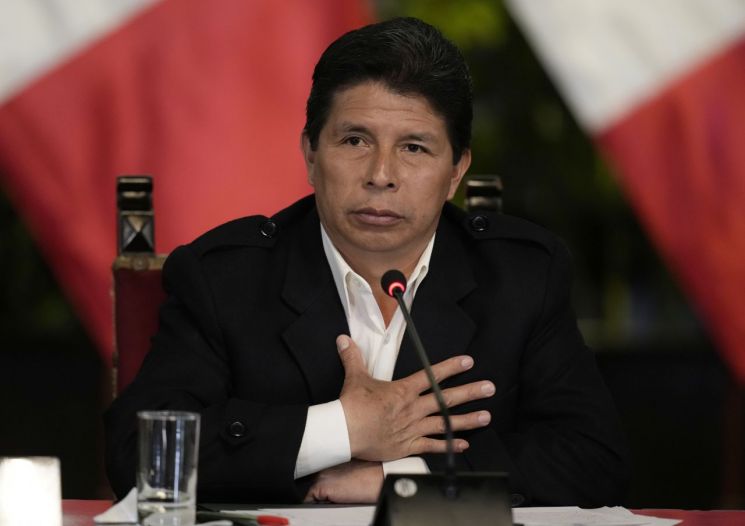
[Asia Economy Reporter Hyunwoo Lee] Pedro Castillo (53), President of Peru, was impeached by the Congress and forced to resign in disgrace just 16 months after taking office. Immediately after his resignation, he was turned into a suspect and promptly arrested by the police, leading to the presidential office being succeeded by current Vice President Dina Boluarte.
According to AFP on the 7th (local time), the Peruvian Congress held a plenary session and passed the impeachment motion with 101 votes in favor, 6 against, and 10 abstentions. The impeachment motion requires the approval of more than two-thirds of the total members (130 members), meaning at least 87 votes are needed to pass. Considering that the ruling party holds 50 seats and the opposition 80 seats, a significant number of ruling party members also supported the impeachment.
As a result, President Castillo was forced to resign in disgrace after about 16 months in office, and was immediately turned into a suspect on charges including bribery and arrested by the police. With this impeachment, the presidency was succeeded by the current Vice President Boluarte.
Previously, President Castillo, who emphasized his background as the son of poor farmers and was highly regarded as the first president in Peru not from political or economic elites but from a farming background, saw his approval ratings plummet due to failures in responding to the economic crisis and involvement in corruption, raising impeachment concerns from early in his term.
Within less than three weeks of the government’s inauguration, the administration faced a crisis with ministers falling from office, and within six months, three prime ministers were ousted and ministers were repeatedly replaced, escalating political instability.
Later, before even reaching eight months in office, Castillo faced two impeachment crises. In October last year, the Peruvian opposition submitted an impeachment motion with the signatures of 28 lawmakers and attempted to pass it two months later, but it was rejected with 46 votes in favor, 76 against, and 4 abstentions. In March this year, another impeachment motion was proposed with 76 votes in favor and 41 against, but after debate, it was again rejected with 55 votes in favor, 54 against, and 19 abstentions.
Additionally, President Castillo himself was plagued by various corruption allegations and became the subject of prosecutorial investigations. He underwent preliminary investigations for allegations of favoring specific companies in national projects, and six possible criminal charges were raised, including plagiarism of his thesis.
The Peruvian prosecution also conducted raids on the presidential palace and the president’s residence, detained and investigated Jennifer Paredes, the president’s sister-in-law, and extended the investigation to First Lady Lilia Paredes. Ultimately, the public perception shifted from viewing him as a 'clean leftist' to a 'corruption suspect,' with his approval ratings recently falling to the 10% range, leaving him isolated.
In response, President Castillo resisted by threatening to dissolve the Congress that was pushing for his impeachment, but this backfired as accusations of suppressing Congress arose, causing even the vice president and cabinet members to turn their backs on him, leading to the collapse of his administration.
© The Asia Business Daily(www.asiae.co.kr). All rights reserved.
![Clutching a Stolen Dior Bag, Saying "I Hate Being Poor but Real"... The Grotesque Con of a "Human Knockoff" [Slate]](https://cwcontent.asiae.co.kr/asiaresize/183/2026021902243444107_1771435474.jpg)
















