Even If a Two-Month Business Suspension Is Replaced by a Fine, Sales Amount Can Be Reclaimed
Lawmaker's Office: "Follow-up Legislation on the Namyang Incident... Comprehensive Food-Related Legislation"
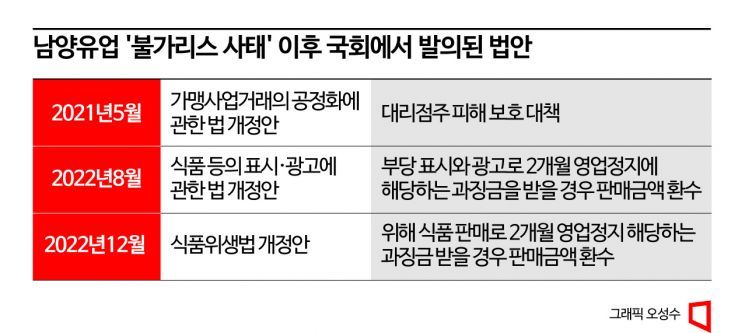
[Asia Economy Reporter Jeon Jinyoung] A bill has been proposed in the National Assembly that allows food manufacturers to pay a fine in lieu of a two-month business suspension and still enables the recovery of the amount earned from selling the relevant food, even if the business suspension is not enforced.
According to political circles on the 8th, Baek Jongheon, a member of the People Power Party, proposed a partial amendment to the Food Sanitation Act based on this content. Currently, under the Food Sanitation Act, when a two-month business suspension is imposed for violating the law, the sales amount of the relevant food is also imposed as a fine. Both the business suspension and the recovery of the amount earned from selling the hazardous food are carried out. However, under the current law, if a fine is paid instead of the two-month business suspension, there is no provision to recover the sales amount of the food. Therefore, the purpose is to create a legal basis to allow the recovery of the sales amount of hazardous food even when a fine is paid.
The proposed bill includes a provision allowing fines to be imposed up to twice the sales amount. This significantly increases the scope of recovering unfair profits from the sale of hazardous food, meaning that fines can be imposed exceeding the sales amount depending on the severity, rather than merely recovering the sales amount.
This bill is a follow-up measure to the ‘Namyang Bulgari Incident.’ Last year, Namyang Dairy Products caused controversy over exaggerated advertising by claiming that their fermented milk product Bulgari had a COVID-19 suppression effect. At that time, they violated the Act on Labeling and Advertising of Foods, etc., but paid about 800 million won in fines instead of a two-month business suspension, leading to public opinion that the punishment was lenient. A staff member from the lawmaker’s office said, “To prevent recurrence of the incident and protect consumers from damage, we have undertaken comprehensive legislation related to food, including the Act on Labeling and Advertising in August and now the Food Sanitation Act.”
The Ministry of Food and Drug Safety has been discussing the bill with the lawmaker’s office, adjusting and compromising on the scope of fines. A ministry official stated, “We agreed with the purpose of the bill, believing it is necessary to raise the level of punishment to prevent consumer damage.” The setting of the fine range up to twice the sales amount was also adjusted by referring to similar legislation such as the Pharmaceutical Affairs Act and the Medical Device Act.
However, regarding concerns that imposing fines and additionally recovering sales amounts may raise issues of fairness, the Ministry of Food and Drug Safety said, “Fines and recovery of sales amounts have different purposes and calculation methods, but if overlapping results occur, we will make adjustments later to prevent that.”
© The Asia Business Daily(www.asiae.co.kr). All rights reserved.
![Clutching a Stolen Dior Bag, Saying "I Hate Being Poor but Real"... The Grotesque Con of a "Human Knockoff" [Slate]](https://cwcontent.asiae.co.kr/asiaresize/183/2026021902243444107_1771435474.jpg)
















