7 Major Legislations of the Democratic Party, 10 Major Legislations of the People Power Party
"Regular Session Processing" Promised... But Stalemate Due to Partisan Tug-of-War
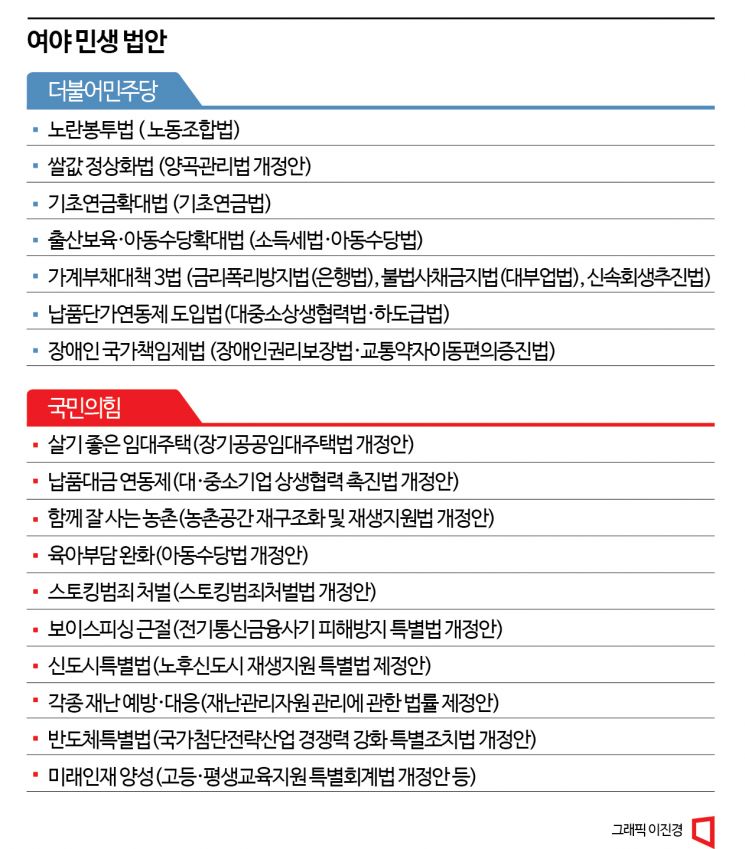
[Asia Economy Reporters Lee Ji-eun and Lee Hyun-joo] As the ruling and opposition parties engage in a power struggle over next year's budget bill, exceeding the legal deadline, the so-called "livelihood policies" they have presented are being pushed to the sidelines. Neither the Democratic Party's 7 major legislative bills nor the People Power Party's 10 major legislative bills have passed the National Assembly, and contentious bills such as the Broadcasting Act remain pending in standing committees, making it inevitable that they will be handled in a special session of the National Assembly.
According to the National Assembly on the 8th, most of the 10 major legislative bills proposed by the ruling party and the 7 major legislative bills proposed by the opposition party are either pending in standing committees or the Judiciary Committee, or have not even been introduced. The only bill that has passed the plenary session of the National Assembly is the delivery price linkage system, a common interest of both parties.
Previously, the opposition party announced 7 major livelihood bills and pledged to "handle them within the regular session," but the flagship bill, the Yellow Envelope Act, is currently pending in the Environment and Labor Committee's subcommittee, and the amendment to the Grain Management Act is stalled in the Judiciary Committee. The Basic Pension Expansion Act has retreated from the original plan to pay all those aged 65 and over, now only pursuing the abolition of the couple reduction provision, and related proposals are currently being discussed in the Pension Reform Special Committee. The Illegal Private Loan Prohibition Act, one of the three household debt countermeasure laws, has been put on hold considering the high-interest rate trend.
The People Power Party responded to the Democratic Party's 7 major legislative bills with 10 major bills of their own, but the situation is similar. A representative example is the Semiconductor Special Act. The proposal by independent lawmaker Yang Hyang-ja has only been submitted to the subcommittee of the standing committee, and the ruling and opposition parties are still wrangling over the tax credit rate. Han Mu-gyeong, the ruling party's floor spokesperson on the National Assembly's Industry, Trade, Small and Medium Enterprises and Venture Businesses Committee, said, "The government and ruling party are pushing to prepare support measures through the Semiconductor Special Act and amendments to the Restriction of Special Taxation Act, but the opposition party opposes provisions related to increasing university admissions in the metropolitan area and tax credits, causing difficulties," adding, "We will have in-depth discussions with the opposition and continuously persuade them to ensure the prompt passage of the bills."
Also, the amendment to the Long-term Public Rental Housing Act, prioritized as a livelihood bill by the ruling party, faced strong opposition from the opposition party and was not even submitted to the subcommittee of the relevant standing committee. Bills such as the amendment to the Special Account Act for Higher and Lifelong Education Support, aimed at nurturing future talents, have been designated as budget-related bills and are expected to be handled together with the budget bill. However, since no agreement has been reached between the ruling and opposition parties, if the matter is decided by a vote in the plenary session, it is highly likely to be rejected due to the opposition party's majority seats. If rejected, the bill must be re-discussed from the beginning after going through subcommittees following its introduction.
The non-contentious Voice Phishing Punishment Act has only recently begun to be discussed because the relevant standing committee, the Political Affairs Committee, did not hold a subcommittee meeting in the first half of the year. However, the bill (proposed by lawmaker Yoon Han-hong) is scheduled to be on the subcommittee agenda on the 13th, making its passage during the regular session unlikely. The Stalking Crime Punishment Act is also being discussed in the subcommittee of the Legislation and Judiciary Committee but is expected to have difficulty passing during the regular session.
Moreover, contentious bills such as the amendment to the Broadcasting Act, which focuses on restructuring the governance of public broadcasting, the amendment to the Freight Truck Transportation Business Act aimed at abolishing the sunset clause of the Safe Freight Rate System, and the so-called "Lee Jae-myung No. 1 Bill," the Privatization Prevention Act (amendment to the Act on the Operation of Public Institutions), have yet to clear the National Assembly hurdle.
With the regular session ending in a day, the delay in handling not only major livelihood bills but also contentious bills means discussions are expected to continue in subsequent special sessions. The Democratic Party has already submitted a request for convening a special session to the National Assembly Secretariat on the 10th. However, since budget discussions may extend into the special session, livelihood bills could again be pushed to a lower priority.
© The Asia Business Daily(www.asiae.co.kr). All rights reserved.
![Clutching a Stolen Dior Bag, Saying "I Hate Being Poor but Real"... The Grotesque Con of a "Human Knockoff" [Slate]](https://cwcontent.asiae.co.kr/asiaresize/183/2026021902243444107_1771435474.jpg)
















