Extramarital Affairs and Premarital Cohabitation Strictly Prohibited... Up to 1 Year Imprisonment
US Government Also Expresses Concern... "Attention to Impact on American Citizens"
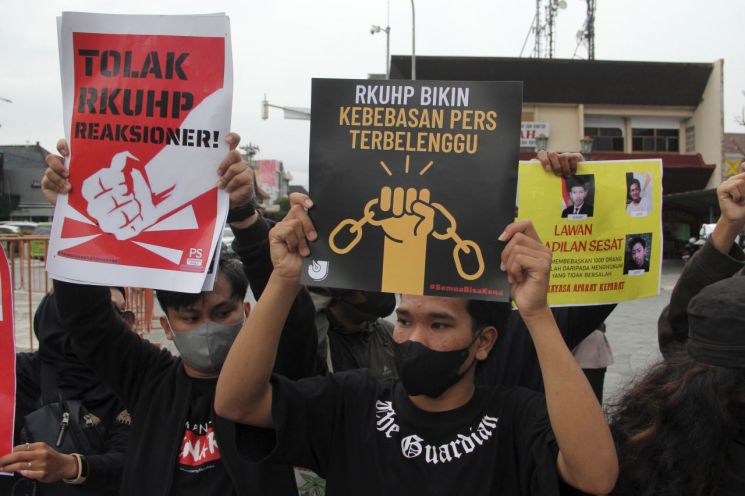 On the 6th (local time), citizens in Yogyakarta, Indonesia, held a protest against the new criminal code announced by the Indonesian parliament. The code stipulates that both nationals and tourists can face up to one year of imprisonment for extramarital sex, and up to six months of imprisonment for cohabitation before marriage. Yogyakarta=AP·Yonhap News Agency
[Asia Economy Reporter Hyunwoo Lee] Indonesia has announced a ban on extramarital sex and premarital cohabitation for both its citizens and tourists through a revision of its criminal law, sparking global controversy. Indonesian citizens and international human rights organizations are protesting, arguing that it excessively restricts personal freedom, and the tourism industry in major destinations such as Bali is expected to suffer significant damage. The U.S. government has also issued a warning, stating it will monitor the impact on its citizens, raising concerns about potential diplomatic disputes.
According to CNN on the 6th (local time), the Indonesian parliament announced the criminal law revision bill on that day. Under this revised criminal law, both Indonesian citizens and foreign tourists can face up to one year of imprisonment for extramarital sex. Not only extramarital sex but also premarital cohabitation is prohibited. Those convicted of premarital cohabitation may face up to six months in prison. Additionally, the bill includes provisions for up to three years of imprisonment for insulting the president or state institutions and expressing views contrary to Indonesia's national ideology.
Originally, this criminal law revision started as a discussion to amend the criminal code created by the Dutch colonial government during the Netherlands' colonial period to better suit Indonesia's circumstances. The parliament planned to pass the draft revision in 2019, but nationwide protests led to a postponement of the vote, and it was only passed this time.
However, the announcement of this revision, seen as excessively outdated and heavily influenced by Islamic law, sparked protests across Indonesia. Indonesia is the largest single-nation Islamic country, with 87% of its 260 million population practicing Islam, but its constitution guarantees freedom of religion.
Especially since the new criminal law applies not only to Indonesian citizens but also to foreign tourists, there is strong opposition not only from the public but also from the business sector. The new law is likely to damage Indonesia's image as an international investment destination.
In particular, the Indonesian industry has expressed concerns that this could pose a potential threat to the tourism industry, which is only just recovering after the COVID-19 pandemic. Sinta Wijaya Sukamdani, Vice Chairman of the Indonesian Employers Association, pointed out, "If the bill passes, it will create legal uncertainty and cause domestic and foreign investors to reconsider investing in Indonesia."
The U.S. government also issued a warning, stating it will monitor the impact on its citizens. Ned Price, spokesperson for the U.S. Department of State, said at a press briefing that day, "The United States is concerned about how such changes will affect human rights and the exercise of fundamental freedoms," and added, "We are closely monitoring how the revised law will affect U.S. citizens who visit and reside there."
International human rights organizations have also criticized the revision as a regressive law. Andreas Harsono, a researcher based in Jakarta for Human Rights Watch (HRW), said, "The criminal law revision will be a huge obstacle to Indonesian democracy," and predicted, "It will disproportionately affect women, and non-Muslims could be prosecuted and imprisoned."
© The Asia Business Daily(www.asiae.co.kr). All rights reserved.

















