5,000 Won Bill Lifespan 5.3 Years, 10,000 Won Bill 11.3 Years
About 0-9 Months Longer Than Last Year
Lifespan Increases as Usage Frequency Decreases
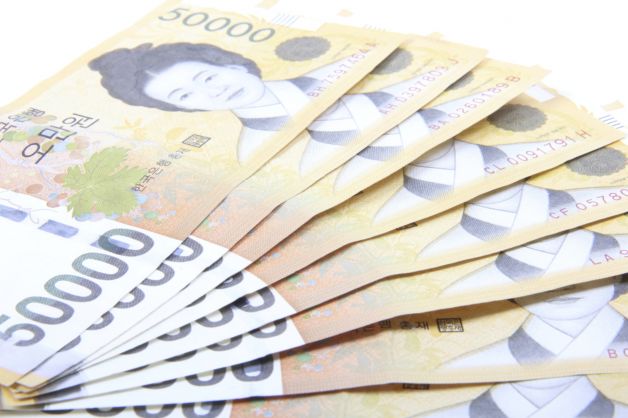
The circulation lifespan of the 50,000 won bill in South Korea was found to be 15 years. In contrast, the lifespan of the 1,000 won and 5,000 won bills was only about 5 years.
According to the banknote circulation lifespan estimation survey released by the Bank of Korea on the 7th, the circulation lifespan by denomination was 70 months (5.8 years) for the 1,000 won bill, 63 months (5.3 years) for the 5,000 won bill, 135 months (11.3 years) for the 10,000 won bill, and 181 months (15.1 years) for the 50,000 won bill.
The circulation lifespan of banknotes refers to the period from when newly manufactured banknotes (new bills) are issued at the Bank of Korea’s counter and circulated in the market until they become so damaged that they are no longer usable and are returned to the Bank’s counter.
The circulation lifespan is generally determined by factors such as the durability of the banknote itself, currency usage habits, and frequency of use. The stronger the physical strength of the paper and the better the currency usage habits or the lower the frequency of use, the longer the circulation lifespan.
In South Korea’s case, low-denomination bills are frequently used mainly for transactions such as purchasing goods and services and giving change, resulting in a relatively shorter circulation lifespan compared to high-denomination bills.
The estimated circulation lifespan this time increased by about 0 to 9 months across all denominations compared to last year. The Bank of Korea explained, "The increase in banknote circulation lifespan is mainly attributed to the expansion of non-cash payment methods and the increase in online transactions, which have reduced the use of cash for transactions."
Compared to other countries, the circulation lifespan of banknotes in South Korea is long for low and medium denominations and moderate for the highest denomination.
The highest denomination, the 50,000 won bill, had a longer lifespan than the Eurozone (142 months) and Japan (54 months), where cash usage is relatively high, but was shorter than the United Kingdom (492 months), the United States (275 months), and countries with different banknote materials such as Australia (polymer, 330 months) and Switzerland (composite, 240 months).
© The Asia Business Daily(www.asiae.co.kr). All rights reserved.
![Clutching a Stolen Dior Bag, Saying "I Hate Being Poor but Real"... The Grotesque Con of a "Human Knockoff" [Slate]](https://cwcontent.asiae.co.kr/asiaresize/183/2026021902243444107_1771435474.jpg)











