China's Maximum Growth of 345% in One Year
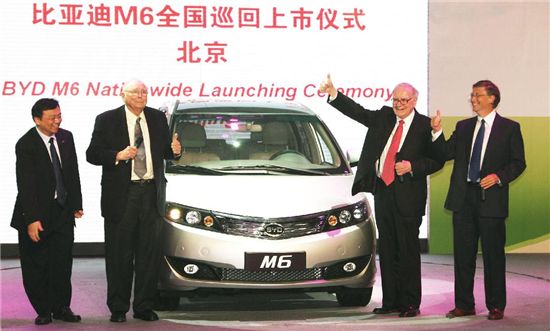 On September 29, 2010, Bill Gates (right), Warren Buffett (second from right), and Wang Chuanfu, Chairman of BYD (left), are posing for a photo in front of a BYD new car. This single photo is regarded as demonstrating China's rapid rise as a powerhouse in electric vehicles.
[Asia Economy Reporter Choi Seoyoon] Korean battery companies are facing fierce challenges from China. The market share gap between the 2nd-ranked Korean and 3rd-ranked Chinese companies has narrowed to an all-time low.
SNE Research announced on the 7th that, based on global electric vehicle battery market share (by usage) from January to October this year, LG Energy Solution, ranked 2nd, recorded 13.8%, while China's BYD, ranked 3rd, recorded 13.2%. Until 2020, the market share gap between Korea and China was over 16 percentage points.
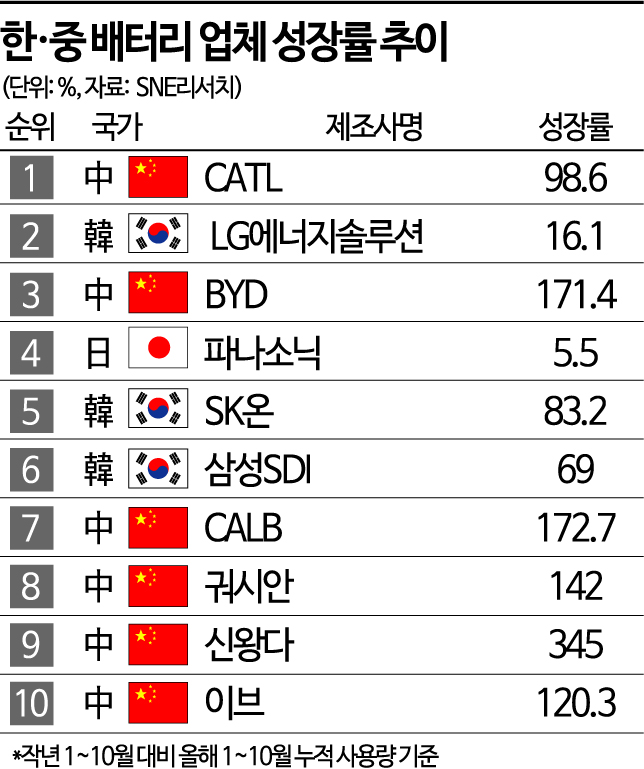
Looking at growth trends, the situation for the Korean battery industry is even more bleak. While LG Energy Solution grew by 16.1%, SK On by 83.2%, and Samsung SDI by 69% over the past year, Chinese companies showed growth rates of up to 300%. Among the top 10 Chinese companies, CATL grew by 98.6%, BYD by 171.4%, CALB by 172.7%, Guoxuan by 142%, and Sunwoda by 345.2%, growing at a frightening pace. Many believe it is only a matter of time before LG Energy Solution is overtaken by BYD.
China is encroaching on the battery market by leveraging vertical integration in automobile manufacturing, material supply chains, and government support. BYD, which has established vertical integration, sold 1.4 million electric vehicles from January to October this year, surpassing Tesla to secure the top spot in the domestic market. They can secure resources cheaply and easily. The dependence of secondary battery parts produced by domestic battery companies on China reaches 85.3% for anode materials, 72.5% for cathode materials, and 54.8% for separators.
The pace of building material supply chains is also steep. Guoxuan announced plans to invest about 4 trillion KRW in establishing battery material factories in the United States and Vietnam. In particular, the investment in the U.S. is a move to respond to the IRA, with expected investment incentives of about 250 billion KRW and additional tax benefits.
Fundraising through initial public offerings (IPOs) is also active. CALB secured about 2 trillion KRW in investment funds by listing on the Hong Kong Stock Exchange last October. SVOLT, which has filed the most patents for solid-state battery technology, is listed on the "China Nasdaq" STAR Market. Its corporate value is in the 11 trillion KRW range.
Massive government support continues. Since 2009, policies have been implemented to provide subsidies for purchasing new energy vehicles, along with the establishment of the "Automotive Power Battery Industry Development Action Plan" and the "New Energy Vehicle Industry Development Plan (2021?2030)" to encourage technological development.
Experts agree that support at the level of major foreign countries is necessary to respond to supply chain securing and technological competition. Professor Park Cheolwan of Seojeong University said, "As the battery industry, which was once centered on Korea, China, and Japan, now attracts interest from the U.S. and Europe, the market is growing day by day, but China is monopolizing the benefits of this favorable market condition. Without proactive investments in supply chains, workforce, and technology to build a battery industry ecosystem, Korea risks losing its leadership."
© The Asia Business Daily(www.asiae.co.kr). All rights reserved.
![Clutching a Stolen Dior Bag, Saying "I Hate Being Poor but Real"... The Grotesque Con of a "Human Knockoff" [Slate]](https://cwcontent.asiae.co.kr/asiaresize/183/2026021902243444107_1771435474.jpg)
















