ADAS·DMS Lens 2 Types
First Plastic Application in ADAS
DMS Lens Mass Production Imminent
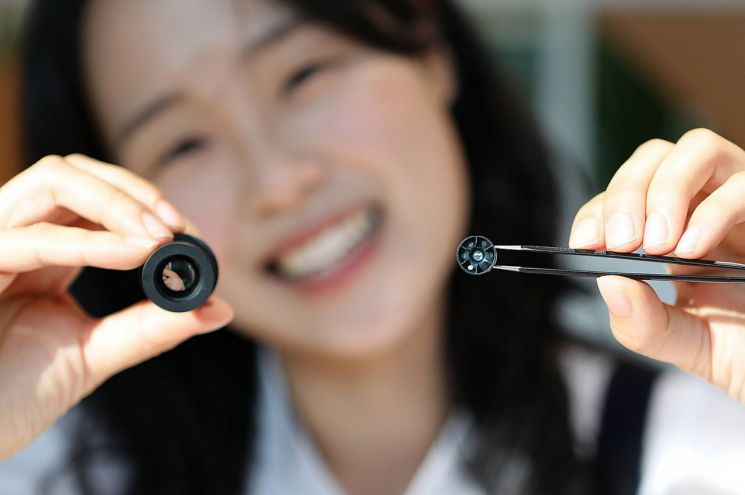 'High-Performance Hybrid Lens for Autonomous Driving' developed by LG Innotek. From the left, lenses for Advanced Driver Assistance System (ADAS) and Driver Monitoring System (DMS).
 (Photo by LG Innotek)
[Asia Economy Reporter Moon Chaeseok] LG Innotek has succeeded in developing the world's first plastic advanced driver-assistance system (ADAS) lens. It reduced the thickness by about 20-30% compared to the existing fully glass products used in autonomous vehicles, which is expected to help customers implement vehicle designs more broadly. With this development, LG Innotek is expected to gain an advantage in the global autonomous driving camera module market.
On the 7th, LG Innotek announced that it had developed two types of lenses: the world's first plastic ADAS lens and a driver monitoring system (DMS) lens. These products reduce size and increase price competitiveness by using plastic lenses.
According to LG Innotek, camera lenses for autonomous driving are key components necessary for driving assistance and driver movement recognition, and demand is rapidly increasing both domestically and internationally. In Europe, it is even recommended that all vehicles be equipped with DMS after 2025.
The two lenses developed by LG Innotek were made by alternately applying thin plastic and glass inside the lens. Previously, lenses were made only of glass. If deformation occurs due to temperature or external force, it can cause safety issues for the driver. Therefore, lenses had to be made only of glass.
The two lenses developed by LG Innotek reduced thickness by about 20-30% compared to existing fully glass products. As the level of autonomous driving increases, more sensors need to be installed in the vehicle, so reducing the size of components is necessary to reduce the vehicle body. Recently, automakers have been reluctant to expose parts on the vehicle body except for the dashboard. Demand for smaller parts is inevitably increasing. As the size decreases, customers are expected to reduce raw material costs and increase interior flexibility.
It is explained that the lenses secured performance comparable to fully glass products. They maintain consistent performance regardless of temperature and accurately recognize objects. Plastic expands and contracts more frequently than glass, making it vulnerable to heat and pressure. It is difficult to make a durable lens. It was considered unsuitable as a vehicle lens that must operate in any environment such as deserts, extreme cold, or extreme heat. LG Innotek overcame these limitations.
Price competitiveness was also improved because plastic is cheaper than glass. LG Innotek explained, "Vehicle parts and automakers can install more cameras for the same cost, thereby enhancing autonomous driving sensing performance."
LG Innotek plans to actively target the global vehicle camera module market with these two lenses. They are actively promoting to customers in Korea as well as in the United States, Europe, and Japan. Global automakers and vehicle parts companies are also expanding autonomous driving functions. Accordingly, they are actively adopting parts related to DMS and ADAS solutions.
Currently, LG Innotek is preparing for mass production of camera modules equipped with DMS lenses. They have also completed development of camera modules equipped with ADAS lenses and are ready to launch in the market next year.
Kang Minseok, Vice President and Chief Technology Officer, said, "Successfully developing lenses, which require complicated design and verification, in a short period is a great achievement for customer experience innovation," and added, "LG Innotek's 'high-performance hybrid lens,' which overcomes the limitations of plastic with innovative technology, will make a significant impact on the market."
According to the global market research firm Strategy Analytics, the global autonomous driving camera market is expected to grow from 4.2 trillion KRW last year to 7.9 trillion KRW by 2025, with an average annual growth rate of nearly 17%.
© The Asia Business Daily(www.asiae.co.kr). All rights reserved.

















