Comforting the Hard Lives of Ordinary People with 'Lotto'
'Recession-Type Products' Sell Better as the Economy Worsens
Big and Small Disputes Over the '1st Prize Winnings'
Lottery Funds Are Used for Public Projects Like the Housing and Urban Fund and Support for Families of Adopted Children
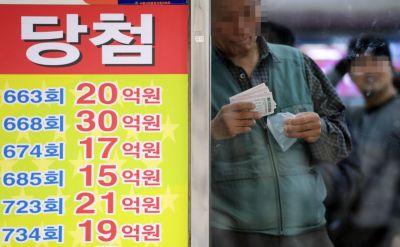 There is a place where the footsteps of citizens seeking an escape from their harsh lives pause. It is the Lotto hotspot. The photo shows a Lotto sales store in Seoul.
[Asia Economy Reporter Han Seung-gon] "Please let me win the lotto just once...", "Ancestors, please appear in my dreams"
The lotto (online lottery), which brings a week of excitement to struggling commoners, has marked its 20th anniversary this year. Over 20 years, about 7,800 people have won first prize, receiving a total of 16 trillion won.
According to the Ministry of Strategy and Finance's Lottery Commission on the 7th, a total of 1,043 draws have been held from the first lotto draw on December 7, 2002, to November 26 of this year. A total of 7,803 people have won first prize, and the total prize money awarded to first prize winners amounts to 15.9 trillion won.
The average prize money per person is about 2.038 billion won. The average number of winners per draw is 7.5. On June 11 this year (draw 1019), there were as many as 50 first prize winners, resulting in a relatively smaller prize per person.
The draw with the largest prize money per person was on April 12, 2003 (draw 19). At that time, there was only one first prize winner who received 40.723 billion won. On the other hand, the draw with the smallest prize money per person was on May 18, 2013 (draw 546). With 30 first prize winners, the prize per person was 406 million won.
Lotto Jackpot Life Turnaround? ... Legal Battles and Attempted Murder
The so-called 'life turnaround' lotto often involves various disputes. In April 2007 in Daegu, seven people playing poker bought 14 lotto tickets with part of their gambling money and divided them two tickets each, agreeing that "the winner will take half of the prize money, and the other six will share the remaining half."
Then, Mr. A won first prize and received about 5.2 billion won. Mr. A claimed, "The distribution of prize money from lottery tickets purchased with gambling funds, which is a criminal act, is an antisocial legal act and invalid." Eventually, the other six filed a lawsuit for prize money distribution, and both the first and appellate courts sided with them. In 2009, the Daegu High Court ruled, "The agreement to share the lottery prize money cannot be considered invalid for violating good morals and social order."
After tax deductions, the actual amount received from the 5.2 billion won was 3.57 billion won. According to the agreement, each could have received 300 million won, but considering the low chance of winning the lawsuit, they filed a suit demanding 150 million won per person and received that amount.
On the other hand, there have been cases where lotto winnings led to family breakdowns. In May 2020, in a city in Gyeongnam, Mr. B won first prize in the lotto. Then, his wife Ms. C demanded a divorce. After receiving part of the prize money through their daughter, Ms. C moved into a separate house, and their adult children supported the divorce.
Eventually, harboring resentment, Mr. B went to his estranged wife's house and stabbed her multiple times with a weapon he had prepared in advance. Even when his wife collapsed to the floor, Mr. B did not stop. Fortunately, someone nearby intervened, and the wife barely survived. This is a tragic outcome caused by winning the lotto first prize.
 The Lotto lottery is paradoxically thriving during the economic downturn. A citizen is purchasing a Lotto ticket with a bright expression.
There have also been legal battles over assets formed from lotto winnings during divorce proceedings. In 2014, the Busan Family Court ruled to exclude about 2.2 billion won won by the husband in the 2011 lotto from the property division in a divorce case of a couple married in 1993. The wife claimed, "My husband said he would give me half if he won the lotto, and they bought the lotto tickets as joint property." However, the court stated, "The lotto winnings were acquired by the defendant's own luck and cannot be considered property jointly built through the couple's cooperation," and "Unless there are special reasons, it is the defendant's separate property."
Property division requires recognition of contribution to property formation during marriage, and lotto winnings are generally considered to have no contribution from the other party, so they are not subject to division. However, cases where property division applies are limited to situations where the other party paid for the lotto tickets, informed the winning numbers, contributed to the purchase and winning, or promised distribution.
Lotto sales tend to increase as the economy worsens, making it a so-called 'recession-type product.' Lotto sales, which were nearly 4 trillion won in 2003 after its launch in December 2002, decreased to 2 to 3 trillion won in the 2010s but surpassed 5 trillion won for the first time last year. About 3.1 trillion won was sold by the end of July this year. It is expected that sales will reach about 5.5 to 6 trillion won by the end of December. This is interpreted as influenced by COVID-19 and economic recession.
Under the Income Tax Act, lottery winnings are classified as 'other income.' No tax is withheld for amounts up to 50,000 won, but a 20% income tax is imposed on amounts exceeding 50,000 won, and the tax rate rises to 30% for amounts exceeding 300 million won. An additional 10% of the income tax is levied as local income tax.
The lottery fund, formed from lotto sales, is used as resources for the Housing and Urban Fund, Veterans Fund, Cultural Arts Promotion Fund, and public interest projects such as support for adoptive families and scholarships for low-income groups. The Lottery Commission announced that on the 20th anniversary of lotto issuance, it will prepare institutional reform plans through policy discussions to enable the lottery fund to contribute more to public welfare.
© The Asia Business Daily(www.asiae.co.kr). All rights reserved.
![Clutching a Stolen Dior Bag, Saying "I Hate Being Poor but Real"... The Grotesque Con of a "Human Knockoff" [Slate]](https://cwcontent.asiae.co.kr/asiaresize/183/2026021902243444107_1771435474.jpg)

















