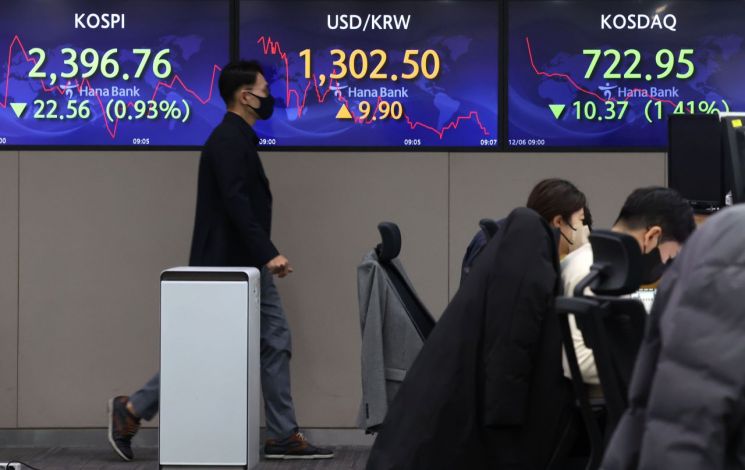
The won-dollar exchange rate surged by more than 26 won on the 6th, rising to the 1,310 won level. This was due to the dollar strengthening amid expectations that the U.S. Federal Reserve's (Fed) tightening monetary policy could intensify, following better-than-expected U.S. economic indicators. As concerns about the Fed's tightening continue to spread, the won-dollar exchange rate is expected to experience significant fluctuations around the 1,300 won level for the time being.
In the Seoul foreign exchange market, the won-dollar exchange rate closed at 1,318.8 won, up 26.2 won from the previous trading day's closing price. It is the first time in four days since the 30th of last month (1,318.8 won) that the exchange rate has recorded the 1,310 won level at closing. Recently, the won-dollar exchange rate showed a downward trend, dropping to the 1,280 won level during the day following Fed Chair Jerome Powell's remarks about slowing the pace of rate hikes, but it has risen again, surpassing the 1,300 won level.
This is because the dollar is strengthening amid expectations that the Fed may raise the terminal interest rate level again. According to the U.S. Institute for Supply Management (ISM), the non-manufacturing (services) Purchasing Managers' Index (PMI) for last month was 56.5, exceeding market expectations of 53.7. October U.S. factory orders also increased by 1% compared to the previous month, surpassing Wall Street's forecast of 0.7%. As U.S. economic indicators show unexpectedly robust performance, concerns have emerged that the Fed's rate hike trend could continue for some time, increasing preference for the dollar. The Wall Street Journal (WSJ) reported on the 5th (local time) that "inflation is expected to generally ease," but also noted that "due to wage increases and price rises in the labor-intensive service sector, the Fed could raise the benchmark interest rate to above 5% next year."
The Chinese yuan's return to a weak trend is also a factor driving the rise in the won-dollar exchange rate. In the offshore market, the yuan exchange rate is rising to around 6.99 yuan per dollar. As the dollar strengthens, the Hong Kong Hang Seng Index and the Taiwan Weighted Index fell by 1.13% and 1.68%, respectively, causing the Chinese stock market to falter. The domestic stock market also widened its losses amid increased preference for safe assets. With foreign investors selling 96 billion won and the selling trend continuing, the KOSPI index fell 1.08% that day.
The won-dollar exchange rate is expected to continue its upward trend for the time being as market participants watch the decisions of the U.S. Federal Open Market Committee (FOMC). Gong Dong-rak, a researcher at Daishin Securities, said, "In recent days, expectations that the Fed's benchmark interest rate hike trend might weaken have led to strength in major currencies including the won, but the recent rise in the won-dollar exchange rate seems to reflect renewed expectations that the U.S. terminal interest rate could rise further. It appears the upward trend will continue at least until the FOMC meeting." Researcher Gong explained, "The exchange rate will fluctuate around the mid-1,300 won level through this year and then decline further after the first quarter of next year."
© The Asia Business Daily(www.asiae.co.kr). All rights reserved.
![Clutching a Stolen Dior Bag, Saying "I Hate Being Poor but Real"... The Grotesque Con of a "Human Knockoff" [Slate]](https://cwcontent.asiae.co.kr/asiaresize/183/2026021902243444107_1771435474.jpg)











