Daejeon and Chungnam Declare Indoor Mask Mandate Lifted
Health Authorities: "High Vaccination Rates Needed to Reduce Fatality for Lifting"
'Vaccination Targets: Half of Elderly and 60% of Vulnerable Facilities'
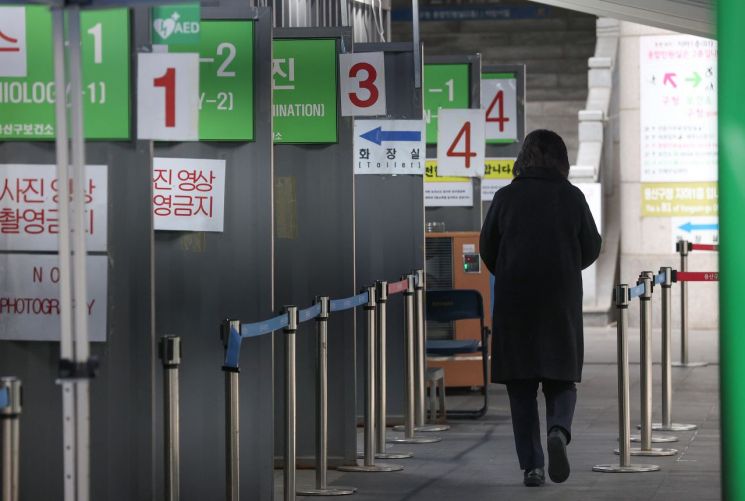 On the morning of the 6th, a citizen visiting the screening clinic set up at Yongsan-gu Public Health Center in Seoul is moving for testing. Photo by Yonhap News
[Asia Economy Reporter Park Hyun-joo] Voices demanding the lifting of the indoor mask mandate continue, but the COVID-19 vaccination rate remains at a low level. Experts point out that ultimately, increasing the vaccination rate is the key to finding a solution to the resurging COVID-19 problem.
Discussions about lifting the indoor mask mandate have emerged mainly in some local governments such as Daejeon and Chungnam. On the 6th, Lee Jang-woo, mayor of Daejeon, announced that from January next year, the city will independently lift the indoor mask mandate. At an expanded executive meeting held that day, the mayor stated, "Considering the level of public and citizen awareness regarding COVID-19, it is time to move towards voluntary prevention," and added, "Whether to wear a mask indoors should be left to the discretion of the public and citizens."
Earlier, Kim Tae-heum, governor of Chungnam, also declared that he would independently promote voluntary indoor mask-wearing. He argued, "Among OECD countries, it seems that only South Korea has a mandatory mask-wearing policy," and questioned, "How effective this really is in preventing COVID-19 is doubtful."
In addition, Kwon Seong-dong, a member of the People Power Party, supported the call for lifting the indoor mask mandate. Through Facebook, he said, "South Korea should immediately prepare to lift the indoor mask mandate," and added, "At the very least, by the end of January (next year), we should move towards implementation rather than just reviewing the lifting of the mandate and prepare countermeasures accordingly."
He emphasized, "Since the COVID-19 outbreak in 2020, our citizens have been the most dedicated in cooperating with government quarantine measures," and continued, "They have endured not only inconveniences in daily life but also economic losses. It is now only right to return the freedom of daily life to them."
However, health authorities have expressed concerns. They say that discussing the lifting of the indoor mask mandate while the winter COVID-19 wave is ongoing is premature. The authorities expect that discussions about lifting the indoor mask mandate may be possible around the end of January next year.
Jung Ki-seok, chairman of the National Infectious Disease Crisis Response Advisory Committee, also judged that it is too early to lift the indoor mask mandate. On the 6th, on MBC Radio's "Kim Jong-bae's Focus," he said, "In the middle of winter, influenza is rampant and COVID-19 is not stabilized, with about 50 deaths per day," and criticized, "I believe this is not a decision based on science." He stressed that in the twin-demic situation where COVID-19 and influenza are simultaneously spreading, the quarantine vigilance should not be relaxed.
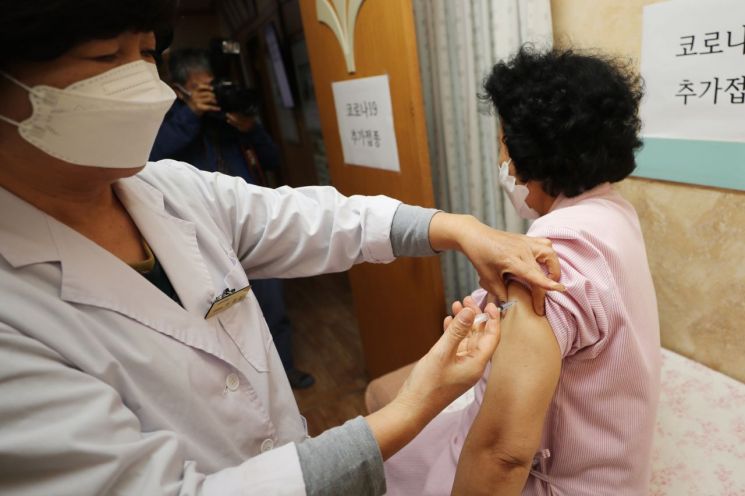 On October 11th, a COVID-19 updated vaccine was administered at an internal medicine clinic in Buk-gu, Gwangju. Photo by Yonhap News
The key is the 'vaccination rate.' In a briefing the day before, Chairman Jung listed the conditions for lifting the indoor mask mandate as ▲ at least 50% of all people aged 60 and over ▲ at least 60% of residents and workers in vulnerable facilities receiving the updated vaccine.
Chairman Jung believed that if the fatality rate among high-risk groups decreases through vaccination and treatment prescriptions, masks can be lifted. He explained, "Although the fatality rate of the disease has decreased to one-fortieth or one-fiftieth due to mutations, there are still about 50 deaths per day," and added, "The updated vaccine coverage must be at least half or more, and those aged 70 and over must be prescribed treatment drugs unconditionally to reduce the fatality rate." However, he added that this decision should not be influenced by public opinion or pressure but should be based on COVID-19 infection-related statistics and indicators.
However, the vaccination rate is falling short of the authorities' target. Two months after the start of the winter additional vaccination campaign, the vaccination rate among those aged 18 and over eligible for the winter additional COVID-19 vaccination is only 8.5%. Among them, the additional vaccination rate for the elderly aged 60 and over is 22.5% (2,783,068 people), and the vaccination rate for residents and workers in vulnerable facilities is 31.1% (235,230 people).
© The Asia Business Daily(www.asiae.co.kr). All rights reserved.


















