Court Rules "SK Co., Ltd. Shares Are Chairman Choi's Personal Property"... Excluded from Division Targets
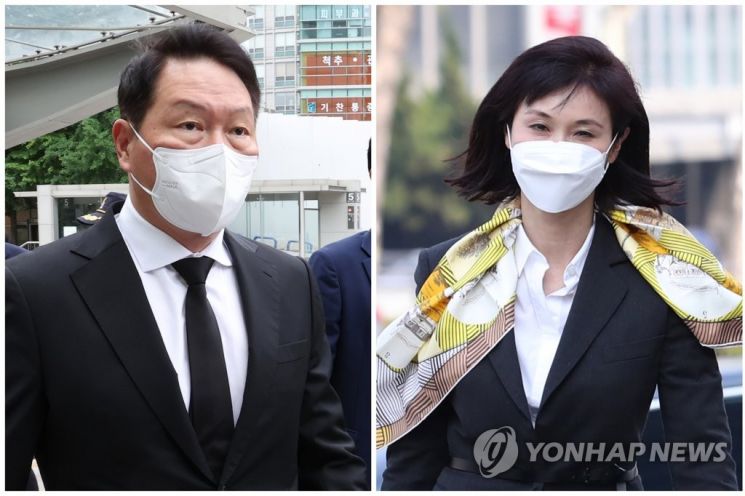
[Asia Economy Reporter Choi Seok-jin, legal affairs specialist] SK Group Chairman Chey Tae-won and Art Center Nabi Director Noh So-young, a married couple, have received a divorce judgment after more than 34 years of marriage.
Regarding the most closely watched issue of property division, the court ruled that the SK Inc. shares held by Chairman Chey are his separate property and thus excluded them from the division. Instead, the court designated some affiliate stocks, real estate, retirement pay, deposits held by Chairman Chey, and Director Noh’s assets as subject to division, ordering Chairman Chey to pay Director Noh 66.5 billion KRW in cash.
The Family Division 2 of the Seoul Family Court (Presiding Judge Kim Hyun-jung) held the first trial verdict session for the divorce lawsuit between Chairman Chey and Director Noh on the afternoon of the 6th and ruled their divorce. The court also ordered Chairman Chey to divide 66.5 billion KRW in assets to Director Noh and pay 100 million KRW in alimony.
In its ruling, the court stated, "By counterclaim, the plaintiff (Chey Tae-won) and the defendant (Noh So-young) are divorced."
Additionally, the court ordered Chairman Chey to pay Director Noh 100 million KRW in alimony along with delayed damages at an annual interest rate of 5% from December 2019 until the date of the first trial verdict, and a higher interest rate thereafter until full payment is made. December 2019 marks the time when Director Noh filed a counterclaim against Chairman Chey’s divorce lawsuit.
The court also stated, "The plaintiff’s main divorce claim and the defendant’s remaining counterclaim for alimony are dismissed."
This means the court dismissed Chairman Chey’s initial divorce claim and rejected the portion of Director Noh’s alimony claim exceeding 100 million KRW out of the 300 million KRW requested.
Finally, the court decided, "The plaintiff shall pay the defendant 66.5 billion KRW as property division." It also ordered payment of delayed interest calculated at an annual rate of 5% from the date the judgment is finalized.
According to the court, Director Noh claimed property division for SK Inc. shares held by Chairman Chey, affiliate stocks, real estate, and retirement pay.
In particular, Director Noh requested division of half of the 12,975,472 SK Inc. shares held by Chairman Chey, amounting to 6,487,736 shares.
However, the court found it difficult to conclude that Director Noh substantially contributed to the formation, maintenance, or value increase of the SK Inc. shares held by Chairman Chey, ruling them as his separate property and excluding them from the property division.
The court then designated some affiliate stocks, real estate, retirement pay, deposits held by Chairman Chey, and Director Noh’s assets as subject to division. Considering the course and duration of the marriage, the circumstances of the formation of the divisible assets, and other relevant factors comprehensively, the court ordered Chairman Chey to pay Director Noh a total of 66.5 billion KRW in cash as property division.
If neither Chairman Chey nor Director Noh appeals, the first trial judgment will be finalized as is. However, if either party appeals, the case will proceed to a second trial, and depending on circumstances, may be finalized after a Supreme Court appeal.
Chairman Chey and Director Noh were married in September 1988 at the Blue House during the first year of the late President Roh Tae-woo’s administration and had three children, but their marriage ended in divorce.
Chairman Chey publicly revealed the existence of an extramarital child in 2015 and announced his intention to divorce Director Noh. In July 2017, he filed for divorce mediation, initiating formal legal proceedings. After mediation failed, a formal lawsuit began in February 2018.
Director Noh, who opposed the divorce, filed a counterclaim against Chairman Chey in December 2019, requesting 300 million KRW in alimony and division of half of the 12,975,472 SK Inc. shares held by Chairman Chey, amounting to 6,487,736 shares.
Director Noh also applied for a provisional injunction to prohibit the disposal of the shares until the divorce and property division lawsuit was concluded. In April, the court partially accepted Director Noh’s application and prohibited Chairman Chey from disposing of 3.5 million shares.
Throughout the trial, Chairman Chey’s side argued that the shares originated from SK affiliate shares gifted or inherited from his late father, former Chairman Chey Jong-hyun, and thus should be considered separate property.
Separate property refers to assets owned by one spouse before marriage or acquired in their name during marriage, which are generally excluded from property division.
On the other hand, Director Noh’s side argued that for couples married a long time, assets gifted or inherited by a spouse should be regarded as joint property. They contended that since Chairman Chey became the largest shareholder of SK Inc. through a merger with SK C&C (formerly Korea Telecom) after marriage, the shares should be considered assets formed during the marriage.
The Supreme Court views a divorced spouse’s claim for property division as having a supportive character to maintain the other party’s livelihood after divorce, but fundamentally aims to settle joint property formed through mutual cooperation during marriage.
Furthermore, even if the property is based on inherited wealth, if it is recognized that the spouse’s domestic labor and support contributed to its acquisition and maintenance, it can be subject to property division.
© The Asia Business Daily(www.asiae.co.kr). All rights reserved.
![Clutching a Stolen Dior Bag, Saying "I Hate Being Poor but Real"... The Grotesque Con of a "Human Knockoff" [Slate]](https://cwcontent.asiae.co.kr/asiaresize/183/2026021902243444107_1771435474.jpg)
















