Establishment of Talent Policy Office and Digital Education Bureau
Reorganization of University Regulation Reform Bureau as Separate Bureau
From 'Institution'-Centered to 'Function'-Centered Organization
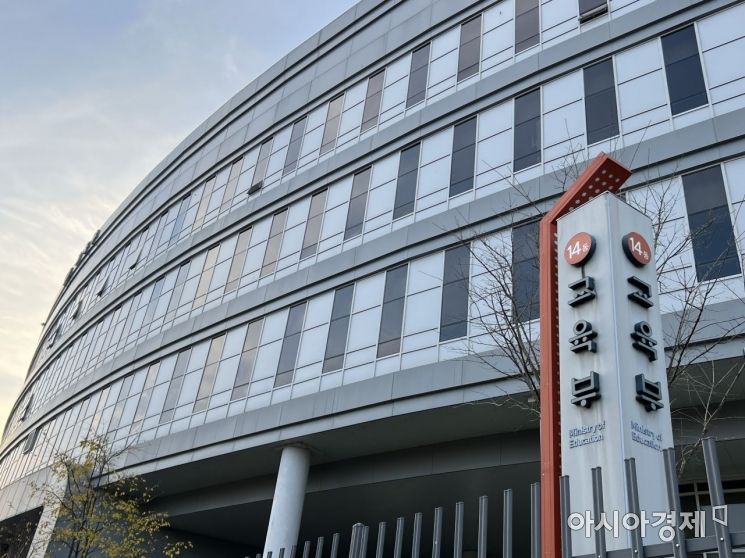
[Asia Economy Reporter Han Jinju] The Ministry of Education is undertaking a major organizational restructuring for the first time in over a decade. The Higher Education Policy Office, which was responsible for university regulation and support, will be abolished, and a new 'Talent Policy Office' will be established to take charge of talent development support. Traditional university policies and higher education regulatory relief tasks will be handled by the 'University Regulation Reform Bureau.'
On the 6th, the Ministry of Education announced plans to implement an organizational restructuring to promote national agenda tasks and education reform. This is a response to social and demographic changes such as the Fourth Industrial Revolution, digital transformation, low birth rates, and aging population.
The Ministry of Education has completed the legislative notice for revising the enforcement rules of the organizational system and will implement the new system starting January 1 of next year. The restructured organization will consist of one first vice minister, three offices, fourteen bureaus/departments, fifty divisions, and two autonomous agencies. While maintaining the current staffing levels, personnel have been reallocated focusing on key areas such as national agenda tasks.
The core of the Ministry of Education’s organizational restructuring is shifting from an 'institution'-centered organization, such as elementary, secondary, or higher education, to a 'function'-centered one. The Ministry is transforming from a regulation-focused body into a policy and support agency, emphasizing the transition from managing educational institutions to becoming a talent development platform. Functions related to national and regional talent development, national education responsibility, digital education transformation, and university deregulation will be significantly strengthened.
The key points of the restructuring are the establishment of the 'Talent Policy Office' and the 'Digital Education Bureau.' The Talent Policy Office will be responsible for nurturing national core talents and fostering regional universities and talents in response to the decline in the working-age population. This is significant as the traditional 'University Office/Bureau,' which had controlled university regulation policies since the Ministry of Education and Science and Technology was reorganized into the Ministry of Education in 2013, will disappear.
An official from the Ministry of Education explained, "The traditional University Policy Office has been abolished, and traditional university policy tasks have been transferred to the University Regulation Reform Bureau. Through cooperation with local governments, the approach has shifted to support on an equal footing. The Talent Policy Office will abandon existing regulatory measures and proceed with talent development policies, and the University Regulation Reform Bureau is established as a separate bureau, not under the Talent Policy Office."
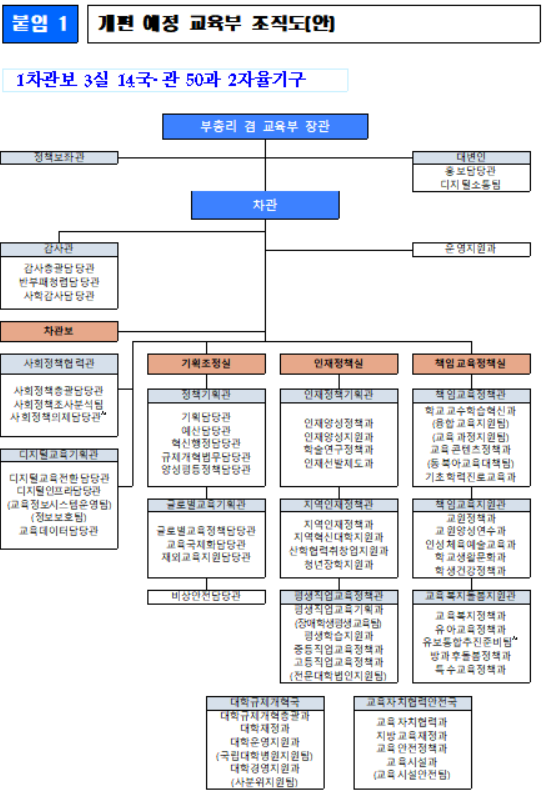
University policy-related tasks will be handled by the newly established 'University Regulation Reform Bureau.' The University Regulation Reform General Division will establish and promote strategies for improving regulations across universities, comprehensively support key elements of university operations such as finance, faculty, academics, and corporations, and improve related regulations. Previously, tasks were handled by institution type, such as national and private universities, but tasks related to private university corporations will be managed by the University Management Support Division.
The Digital Education Planning Officer is a strategic organization that integrates digital education functions previously dispersed across the Education Safety Information Bureau, Future Education System Transition Promotion Team, and Lifelong Vocational Education Bureau. The Digital Education Planning Officer will establish legal and institutional foundations for digital transformation in education, support the educational use of EdTech, expand digital infrastructure (Digital Infrastructure Officer), and strengthen the use of data in the education sector (Education Data Officer).
The 'School Innovation Support Office,' which led improvements in elementary and secondary education systems during the Moon Jae-in administration, will be reorganized into the Responsibility Education Policy Office. It will be responsible for strengthening national responsibility for basic academic skills, early childhood education, and care, and ensuring equal starting points through customized education and reducing educational disparities. The Responsibility Education Policy Officer will promote individualized customized education through classroom instruction and educational content innovation, and the Basic Academic Skills and Career Education Division will advance policies to strengthen basic academic skills guarantees. The Responsibility Education Support Officer will support teacher capacity building and autonomous innovation.
The Education Welfare and Care Support Officer will handle tasks related to reducing educational disparities and strengthening early childhood education and care. To promote the integration of childcare and early childhood education, one of the national agenda tasks, the Ministry of Education is discussing with the Ministry of the Interior and Safety the expansion of the current Childcare and Early Childhood Education Integration Promotion Team into a bureau-level organization. It will be reorganized into a system with separate staffing in the future.
The newly established Education Autonomy Cooperation and Safety Bureau will play a role in partnership, communication, and cooperation with educational stakeholders and support student safety. The bureau will be responsible for cooperation with various educational stakeholders such as metropolitan and provincial offices of education and teachers, school safety policies, and strengthening the management of educational facility safety. Existing temporary organizations such as the Green Smart Future School Team and the COVID-19 Response School Situation General Division will be dissolved.
The establishment of an organization related to investigating university entrance exam corruption, which was one of President Yoon Seok-yeol’s campaign promises, is not included in this organizational restructuring. A Ministry of Education official stated, "Entrance exam corruption and fairness in university admissions are the most important issues, and we expect to address them together during discussions on improving the university admissions system."
© The Asia Business Daily(www.asiae.co.kr). All rights reserved.


















