Cho Tae-yong, South Korean Ambassador to the US, "Close Trilateral Cooperation Among South Korea, US, and Japan on North Korean Provocations"
Tomita, Japanese Ambassador to the US, Emphasizes the Need to Improve Japan-South Korea Relations
[Asia Economy Reporter Yoo In-ho] The ambassadors of South Korea and Japan to the United States emphasized the need to strengthen trilateral cooperation among South Korea, the United States, and Japan to respond to global issues such as North Korea's military provocations.
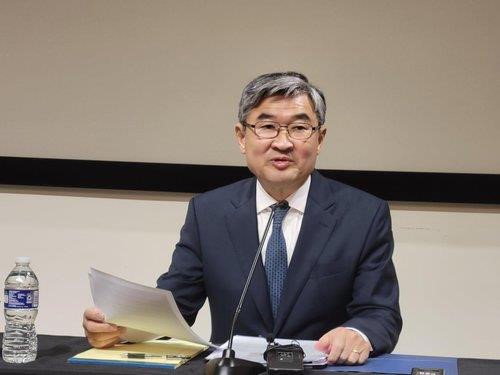
Cho Tae-yong, South Korea's ambassador to the U.S., on the 5th (local time), in a speech at the ‘Trans-Pacific Dialogue’ hosted by the Choi Jong-hyun Academy held at the Salamander Resort near Washington DC, stated, “to address various urgent challenges such as North Korean provocations and supply chain recovery, South Korea, the U.S., and Japan must cooperate closely.”
Ambassador Cho said, “The Yoon Seok-yeol administration is ready to strengthen our contribution to trilateral cooperation among South Korea, the U.S., and Japan,” adding, “I hope this will have a significant impact on establishing a rules-based order in the Indo-Pacific region, where the three countries have major shared interests.”
He welcomed the recent joint anti-submarine warfare exercises conducted by South Korea, the U.S., and Japan immediately following North Korea's provocations such as the intercontinental ballistic missile (ICBM) launch, saying, “This is a natural outcome of increasingly aligned threat perceptions,” reiterating trilateral cooperation on North Korea.
Koji Domita, Japan's ambassador to the U.S., also at the same event, referred to North Korea's repeated provocations as a serious threat and emphasized the necessity of trilateral cooperation among South Korea, the U.S., and Japan to address this issue and other global challenges.
Ambassador Domita said, “North Korea continues its repeated provocations,” and added, “I am afraid that the increasing provocations by North Korea will continue in the future.”
He also expressed encouragement over the achievements made this year, stating, “The South Korean and Japanese leaders met twice last year, and measures to strengthen mutual engagement, including responses to North Korea?a traditional trilateral alliance issue?have continued.”
They also mentioned the need to improve South Korea-Japan relations. Ambassador Cho said, “The relationship between Japan and us (South Korea) is one of the most important puzzle pieces,” and added, “President Yoon has advocated correcting bilateral issues and normalizing relations since his presidential campaign.”
He further emphasized, “President Yoon views the ‘Kim Dae-jung?Obuchi Declaration’ as a framework that can present a comprehensive and reciprocal direction for both countries,” and said, “This guarantees an agreement for better relations and enables a complete and comprehensive resolution of bilateral issues through mutual trust restoration.”
Earlier, President Yoon and Japanese Prime Minister Fumio Kishida held their first summit on the 13th in Phnom Penh, Cambodia, where they discussed ways to normalize bilateral relations.
Ambassador Domita also said, “Opportunities to enhance South Korea-Japan bilateral relations are expanding,” and added, “Instead of fixating on bilateral differences, the two countries need to take a step back and broadly respond to issues in a global context.”
Ambassador Domita cited three main areas for South Korea-Japan cooperation: security issues, expanding supply chain flexibility, and forming an international community that shares principles.
He stated, “Security remains a core agenda,” and expressed hope to deepen policy dialogues on security issues.
Ambassador Domita continued, “Progress is being made bilaterally between the U.S. and Japan, and between South Korea and the U.S., on measures to enhance economic flexibility, including supply chain resilience,” suggesting that trilateral dialogue can create synergy for these efforts.
He added, “Our free countries must build a community of nations that share principles,” and emphasized, “Strengthening cooperation with regional partners is key to this.”
© The Asia Business Daily(www.asiae.co.kr). All rights reserved.

















