Direct Rebuttal from the Bank of Korea
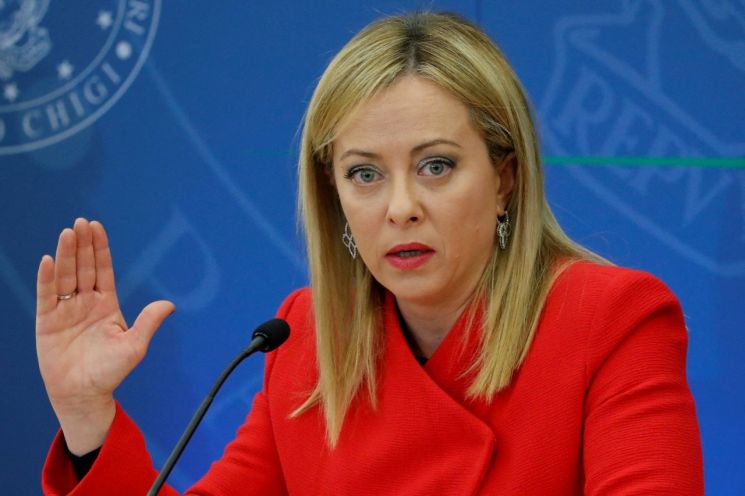
[Asia Economy Reporter Yujin Cho] The Bank of Italy has expressed concerns that the Giorgia Meloni government's policy encouraging cash usage may run counter to the European Union (EU)'s digital transition trend.
On the 5th (local time), according to major foreign media, Fabrizio Balassone, head of economic analysis at the Bank of Italy, made these remarks at the 2023 budget hearing jointly hosted by the budget committees of the upper and lower houses.
The Italian government, led by Prime Minister Meloni, proposed in the 2023 budget to allow self-employed individuals to refuse card payments up to 60 euros (approximately 82,710 KRW).
Currently, in Italy, owners can refuse card payments for amounts under 30 euros (approximately 41,200 KRW) at restaurants or stores.
The Italian government also plans to implement a tax 'amnesty' of up to 1,000 euros for tax arrears before 2015 and raise the cash transaction limit from the previous 1,000 euros to 5,000 euros.
Prime Minister Meloni has repeatedly introduced policies that go against the global trend of decreasing cash usage, arguing that card payments impose unfair fees on business owners. He also countered claims that cash usage promotes tax evasion as false.
Regarding this, Balassone, head of economic analysis, pointed out, "A series of measures related to cash payments and tax reductions risk conflicting with Italy's electronic modernization efforts and the ongoing need to reduce tax evasion through the EU's National Recovery and Resilience Plan (NRRP), which supports COVID-19 recovery funds."
He added, "Raising the cash payment limit will activate the underground economy and hinder the fight against tax evasion."
Italy will receive 191.5 billion euros in COVID-19 recovery funds from the EU by 2026. The EU, providing the largest amount among member states to Italy, has demanded that the Italian government accelerate its transition to a digital economy.
Balassone highlighted the risk that the government's 'encouragement of cash usage' may conflict with the EU's digitalization demands.
Prime Minister Meloni, in a video posted on her Facebook the day before, acknowledged that the upper limit for refusing card payments could face resistance from the EU and suggested that during negotiations with the EU, the limit might be lowered from 60 euros.
Meloni added, "Since the issue of electronic payments is one of the points in the EU's COVID-19 recovery fund, we need to see how discussions with the EU will conclude."
Italy's underground economy was estimated at 183 billion euros (about 90 billion euros of which is tax evasion) as of 2019, accounting for approximately 11.3% of its gross domestic product (GDP).
© The Asia Business Daily(www.asiae.co.kr). All rights reserved.
![Clutching a Stolen Dior Bag, Saying "I Hate Being Poor but Real"... The Grotesque Con of a "Human Knockoff" [Slate]](https://cwcontent.asiae.co.kr/asiaresize/183/2026021902243444107_1771435474.jpg)
















