4 out of 10 Processed Foods Increase by Over 10% in Price... Milkflation Likely to Further Fuel Inflation
[Asia Economy Sejong=Reporter Kwon Haeyoung] Although the soaring consumer price inflation has slowed down, more than 40% of processed food items have surged by over 10% last month, showing a fierce increase. The rise in international raw material prices is the cause, and processed foods have pushed up overall prices more than electricity, gas, and water charges, which rose 23.1% in one year.
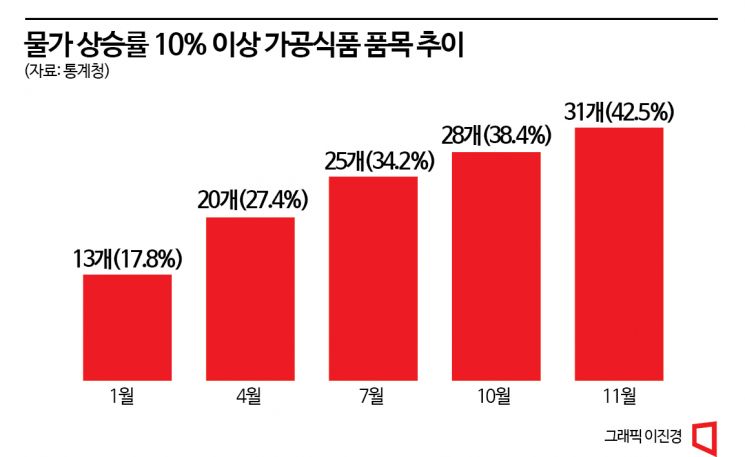
According to Statistics Korea on the 6th, among the 73 processed food items surveyed for consumer prices last month, 31 items (42.5%) increased by more than 10% compared to the same month last year. This accounts for 42.5% of all items, close to half.
The number of items whose prices rose more than 10% compared to a year ago has steadily increased from 13 in January to 20 in April, 25 in July, and 28 in October.
This month, prices of 70 out of 73 processed food items increased. Looking at individual items, cooking oil rose the most at 43.3%, followed by flour (36.1%), cheese (35.9%), cereal (29.1%), and pancake mix (28.5%). Noodles (28.1%), starch syrup (27.3%), kimchi (22.4%), dressing (20.6%), curry (20.5%), and jam (20.1%) also surged over 20%.
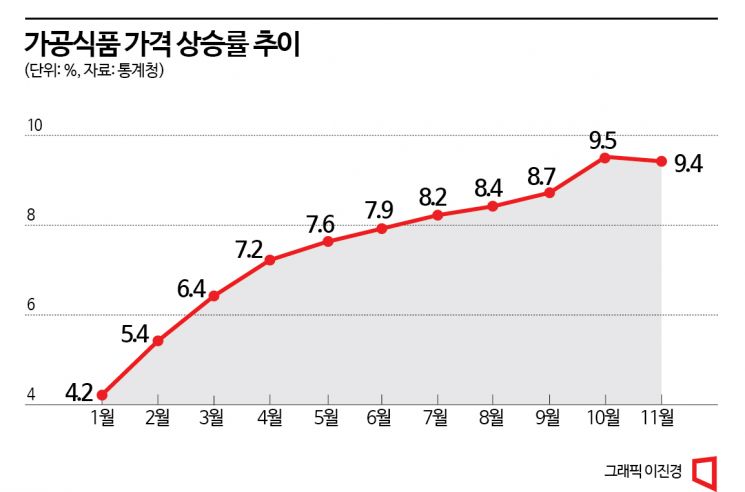
The domestic consumer price inflation rate peaked at 6.3% in July, fluctuated in the 5% range, and slowed to 5.0% in November. However, processed foods rose from 4.2% in January to 8.2% in July when overall prices peaked, and then sharply increased to 9.5% in October and 9.4% in November. Although the increase last month fell by 0.1 percentage points from the previous month, it still remained in the 9% range.
Processed foods contributed 0.81 percentage points to the overall price increase of 5.0% last month. Electricity, gas, and water charges rose 23.1% compared to a year ago, pushing overall prices up by 0.77 percentage points, which is lower than the contribution from processed foods. In October, processed foods contributed 0.83 percentage points to the overall inflation rate (5.7%), stimulating prices more than electricity, gas, and water charges (0.77%).
The problem is that processed food prices tend to be rigid downward once they rise. The prices of processed foods are being driven up by rising international raw material prices such as grains, palm oil, and raw milk. Due to the Ukraine war reducing grain exports, the global food price index also hit a record high of 159.7 in March.
Moreover, the Dairy Promotion Board decided to raise the raw milk price by 49 won per liter this year, raising concerns about 'milkflation'?a situation where prices of processed foods mainly made from milk, such as milk itself, cheese, bread, and ice cream, are rising consecutively. The Bank of Korea also noted the rise in processed food and dining-out prices and expects additional increases in related items such as milk and bread.
The slowdown in overall inflation last month is partly due to a base effect from a year ago when prices rose sharply, so it is premature to conclude that the inflation trend has been broken at this point.
Oh Woonseon, the Economic Trend Statistics Officer at Statistics Korea, said, "Last month's consumer prices rose due to continued high increases in processed foods, industrial products, dining-out services, and electricity, gas, and water charges," adding, "Considering the recent raw milk price hike, the continued increase in processed food factory prices could act as an upward factor for inflation."
© The Asia Business Daily(www.asiae.co.kr). All rights reserved.


















