Automobile Industry Association Publishes Next Year's Industry Outlook Report
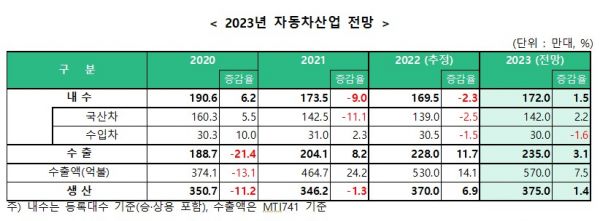
[Asia Economy Reporter Kiho Sung] It is analyzed that this year’s automobile export value will reach $53 billion, setting a new record high. Additionally, it is forecasted that both domestic sales and exports will increase next year, leading to a slight rise in production.
The Korea Automobile Manufacturers Association (KAMA) announced on the 5th the “2022 Automobile Industry Evaluation and 2023 Outlook” report, which assesses this year’s domestic automobile industry and forecasts next year’s industry conditions.
According to the report, the global automobile market (January to October) this year was approximately 84.32 million units, down 0.7% from the previous year due to semiconductor shortages and various supply chain disruptions. The U.S. market decreased by 10.8%, Western Europe by 9.8%, and Japan by 7.2%. Eastern Europe, including Russia, saw a sharp decline of 29.1%, but the domestic market managed relatively well with a smaller decrease of 4.2%.
In global sales, Hyundai Motor Group (Hyundai, Kia, Genesis) maintained its third place globally with an 8.1% market share, continuing from last year.
This year, the domestic automobile industry frequently experienced production disruptions due to consecutive global adversities such as the Russia-Ukraine war starting early in the year, supply chain disruptions caused by China’s COVID-19 lockdowns, and semiconductor shortages. Furthermore, supply decreased relative to domestic and international automobile demand, but with semiconductor supply improving in the second half, production increased, resulting in a simultaneous recovery in both domestic sales and exports.
Domestic sales recorded high waiting demand due to supply decreases despite the popularity of eco-friendly vehicles and SUVs, resulting in a 2.3% decrease from the previous year to 1.695 million units. Exports increased by 11.7% to 2.28 million units, driven by strong sales of domestic eco-friendly vehicles and SUVs as well as favorable exchange rates. Export value is also expected to set a record high at $53 billion, up 14.1%, due to increased exports of higher-priced vehicles.
Production faced disruptions in the first half of the year due to ongoing semiconductor and parts supply shortages caused by various global adversities, but showed strong recovery in the second half, estimated to increase by 6.9% to 3.7 million units.
Next year, a slight growth is expected as vehicle semiconductor supply recovers and accumulated demand is deferred. However, a global economic recession is anticipated due to the tightening of monetary policies worldwide after the pandemic, and high inflation and high interest rates are expected to partially limit new demand.
Domestic sales are expected to grow by 1.5% to 1.72 million units, as accumulated waiting demand is resolved and the low base effect from last year’s poor performance takes effect. However, reduced household disposable income due to economic recession and high interest rates will limit new demand.
Exports are forecasted to increase by 3.1% to 2.35 million units despite adverse factors such as the global economic recession, export disruptions of electric vehicles caused by the U.S. Inflation Reduction Act (IRA), and suspension of exports to Russia. This is due to the high competitiveness of domestic vehicles and sustained high exchange rates securing price competitiveness.
Production is expected to increase by 1.4% to 3.75 million units if stable domestic and international demand continues and supply of raw materials and semiconductors proceeds smoothly.
Gang Nam-hoon, chairman of the Korea Automobile Manufacturers Association, stated, “Despite the expansion of protectionism centered on national interests due to U.S.-China hegemonic competition, semiconductor shortages, and consecutive global supply chain disruptions, domestic automakers and parts manufacturers expanded production, and government efforts to resolve supply chain issues contributed to achieving a record export value of $53 billion, becoming a pillar of the national economy.” He added, “To continuously expand exports in the future, additional efforts are needed to minimize damage from the U.S. IRA, resolve export logistics difficulties, and secure export competitiveness.”
He also emphasized, “The domestic market next year is expected to grow slightly due to the base effect of two consecutive years of decline, but there are concerns that consumption capacity for durable goods like automobiles may shrink due to economic recession and high interest rates. Various consumption supports and incentives, such as extending individual consumption tax reductions, are necessary to prevent worsening management conditions in the automobile industry ecosystem, which is already facing limits due to COVID-19 and supply chain disruptions, from being aggravated by domestic demand contraction.”
He continued, “The next 10 years are a time when new investments are needed for future car transitions such as electrification, autonomous driving, and robotics. Enactment of a special law for future cars is necessary to support smooth transition to future vehicles. High domestic labor costs and rigid labor flexibility reduce incentives for domestic production and investment. To secure production competitiveness and respond to automobile demand with smooth production expansion, institutional improvements for labor flexibility, such as flexible application of the 52-hour workweek system, should be considered.”
© The Asia Business Daily(www.asiae.co.kr). All rights reserved.

















