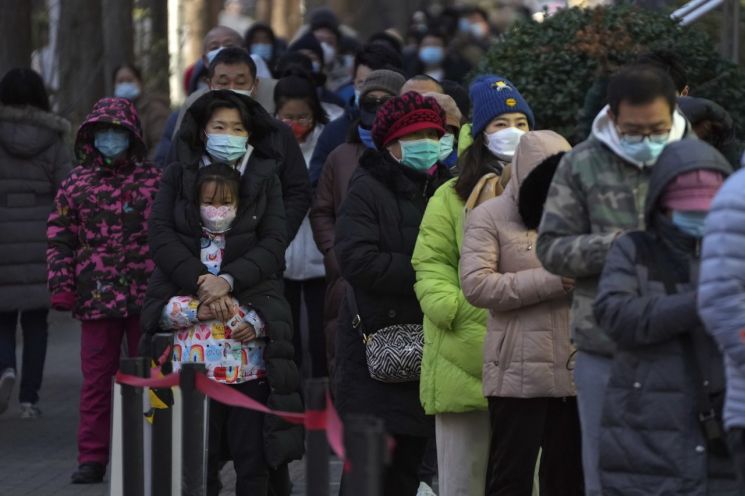
[Asia Economy Beijing=Special Correspondent Kim Hyunjung] Last month, China's private service sector indicators showed contraction for the third consecutive month due to the implementation of stringent 'Zero-COVID' measures.
On the 5th, economic media Caixin, together with market research firm IHS Markit, announced that the November Services Purchasing Managers' Index (PMI) recorded 46.7. This figure not only fell short of the market forecast (48.0) and the previous month's figure (48.4) but also marked the lowest level in six months.
This index, which reflects the service sector economy, is interpreted as expansion when above the baseline of 50 and contraction when below it. Due to city lockdowns amid the spread of COVID-19, the index plunged to 36.2 in April, then rebounded to show expansion for three consecutive months from June, but fell below the baseline again starting in September.
Looking at the details, service production and demand decreased for three consecutive months, and the service employment index plummeted to its lowest level since the index began in November 2005. Respondents to the Caixin survey attributed this to travel restrictions in some areas due to COVID-19 prevention and control measures, bans on employees returning to work, and a simultaneous decline in labor demand.
Caixin stated, "Due to rising raw material costs, transportation costs, and labor costs, service sector input costs continue to increase," adding, "The input price index in November slightly contracted from expansion, transmitting cost pressures to supply as well." Market confidence was also hit, with the November service sector outlook index falling to its lowest level in eight months, consistently below the long-term average. Respondents expected production to improve again once the COVID-19 spread subsides and operations normalize, but uncertainty remains regarding the impact on demand.
Wang Zhe, Chief Economist at Caixin, diagnosed, "China is currently facing its third wave of COVID-19 spread since early 2020 and the first half of 2022, and the pandemic continues to negatively affect the economy," adding, "Currently, demand and supply constraints appear weaker than in the previous two waves, but the employment market is worse." He also stated, "Balancing epidemic prevention and control with economic development has once again become crucial," emphasizing, "Promoting employment and stabilizing domestic demand are particularly urgent." He further added, "At the policy level, coordination between fiscal and monetary policies should be strengthened, and efforts should be made to expand domestic demand and increase incomes for low-income groups."
© The Asia Business Daily(www.asiae.co.kr). All rights reserved.

















