[Asia Economy Reporter Kang Nahum] Naver Webtoon has unveiled artificial intelligence (AI) technology that helps visually impaired people enjoy webtoons. Until now, webtoons have been very difficult content for the visually impaired to use, but this technology is expected to lower the barrier to enjoying image-based content overall.
At the ‘10th 2022 Neolly Seminar: Beyond Now, Access to the New World’ webinar held on the 5th, which shared information accessibility technology and know-how, Naver Webtoon revealed a technology that provides alternative text for webtoons using AI technology.
As Naver Webtoon becomes the first in the industry to launch a ‘Barrier Free’ webtoon service, it is expected to make a significant contribution to the spread of barrier-free content. Barrier free is a movement to break down physical and institutional barriers to create a society where the elderly and people with disabilities can live comfortably.
Naver Webtoon plans to apply alternative text to about 180,000 completed and ongoing episodes and start a beta service of barrier-free webtoons in January next year, reflecting users’ feedback to improve the service. The beta service for barrier-free webtoons will initially be available only in Korean, with plans to gradually expand the service languages in the future.
Yoon Seungseop, a planner at Naver Webtoon, who gave a presentation titled ‘A Small but Significant Progress for Visually Impaired People’s Webtoon Enjoyment’ on the day, explained the service planning intention: “We continued to think from the perspective of all users without dividing disabled and non-disabled users, and as a result, we made the difficult decision to try.”
To deliver webtoon information to the visually impaired, it is necessary to convert the webtoon’s image information into text information and then convert it into auditory information. Naver Webtoon focused on finding a way to quickly convert the image information of thousands of completed works and hundreds of newly added episodes every week into text information, and after about a year of research, developed the ‘AI-based automatic provision of alternative text for webtoons’ technology. The process of converting text information into auditory information can be realized through smartphone operating system (OS) built-in functions such as ‘VoiceOver’ or ‘TalkBack.’
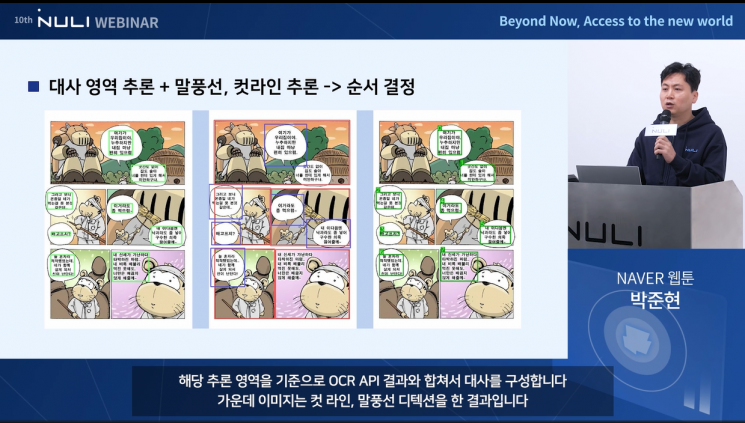
The automatic provision of alternative text for webtoons is completed through four main steps: ▲cut division ▲dialogue area inference ▲dialogue extraction ▲dialogue order determination. The technologies used by Naver Webtoon are optical character recognition (OCR) and ‘Webtoon Object Detection’ technology.
Since webtoons are mostly provided in a vertically long scroll format, the image size of one episode is very large. Therefore, before inferring the dialogue area and extracting text, the cut division work must be performed first. In particular, during this process, cuts must be divided carefully so that dialogues, speech bubbles, and cut lines are not damaged, allowing the dialogues to be arranged in order later. To solve this, Naver Webtoon developed a webtoon-specialized object detection technology called ‘Webtoon Object Detection’ that infers cuts, speech bubbles, and dialogue areas.
Naver Webtoon has set long-term goals to develop a speaker inference function that can identify who spoke the dialogue and a function that provides alternative text even for cuts without dialogue.
Kim Daesik, AI leader at Naver Webtoon, said, “Providing alternative text is part of the technological efforts to uphold the value of ‘diversity,’ which Naver Webtoon considers important,” adding, “Naver Webtoon will fulfill its responsibility and efforts as the world’s number one story tech platform to build an environment where anyone can create and enjoy webtoons without barriers such as disability or language.”
© The Asia Business Daily(www.asiae.co.kr). All rights reserved.
![Clutching a Stolen Dior Bag, Saying "I Hate Being Poor but Real"... The Grotesque Con of a "Human Knockoff" [Slate]](https://cwcontent.asiae.co.kr/asiaresize/183/2026021902243444107_1771435474.jpg)
















