280,000 Illegal Entries by October
1.8 Times Increase Compared to Same Period Last Year
Refugees Rise Due to Food Shortage and Price Inflation
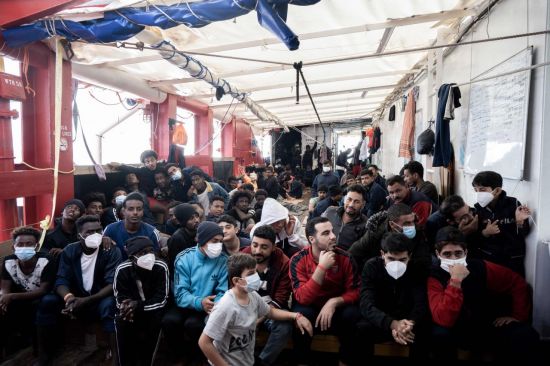
[Asia Economy Reporter Lee Ji-eun] The number of illegal entrants heading to the European Union (EU) this year has nearly doubled compared to a year ago. The food crisis and rising prices triggered by Russia's invasion of Ukraine have led to a surge in border crossings from the Middle East and Africa, intensifying conflicts within the EU over refugee acceptance.
On the 5th, Nihon Keizai Shimbun cited data from Frontex, the European Border and Coast Guard Agency, reporting that the number of illegal entrants recorded in the EU from January to October reached 280,000, a 77% increase compared to the previous year. This is the largest scale since 2015-2016, when a massive influx of refugees occurred due to the Syrian civil war. Notably, in October alone, 36,500 people were recorded crossing the EU border illegally.
According to statistics, excluding 5 million refugees from Ukraine, illegal entries via the Central Mediterranean and Western Balkan routes, including Afghanistan and Iraq, have increased the most. The number of illegal entrants entering through the Western Balkan route reached 128,000, 2.7 times higher than the previous year, while those entering via the Central Mediterranean route numbered 85,000, a 1.5-fold increase.
Among illegal entrants, Egyptians accounted for the largest number. According to data from the International Organization for Migration (IOM) on illegal entry routes by country, 18,000 people entered from Egypt alone, more than doubling compared to last year. The number of illegal entrants via Syria and Afghanistan increased by 2.6 times and 1.3 times, respectively.
The surge in illegal entrants to the EU this year is analyzed to be due to the worsening food crisis caused by the Russia-Ukraine war. Germany's Kiel Institute for the World Economy explained, "Countries like Egypt and Tunisia, which heavily depend on grain imports from Ukraine and Russia and are experiencing a food crisis, have seen a large influx of illegal entrants," adding, "Global food shortages and rising prices appear to be the main causes of the sharp increase in refugees."
The explosion in illegal entrants has once again sparked diplomatic conflicts among EU countries over refugee acceptance. In early last month, Italy faced criticism from EU countries after refusing entry to a rescue ship carrying 234 refugees that was drifting at sea.
In response, France allowed the rescue ship "Ocean Viking," which had been stranded near Sicily for nearly three weeks, to enter on the 10th of last month and agreed to share the migrants among EU member states. France decided to withdraw its plan to accept 3,500 migrants from Italy, viewing Italy's actions as a violation of the agreement made in June by 12 EU member states to distribute refugees.
The British daily The Guardian expressed concern over the conflict between Italy and France, stating, "There is a possibility of a recurrence of the 'refugee conflict' within the EU, triggered by the clash four years ago between President Macron and populist Italian Interior Minister Matteo Salvini, who refused to accept refugees."
Major foreign media outlets predict that the number of refugees heading to the EU will increase further as the Russia-Ukraine war prolongs. Nihon Keizai stated, "Russia is targeting Ukraine's power plants and electrical grids, so the number of refugees is likely to increase in the future," and forecasted, "This war could lead the EU to face the largest refugee crisis since World War II."
© The Asia Business Daily(www.asiae.co.kr). All rights reserved.

















