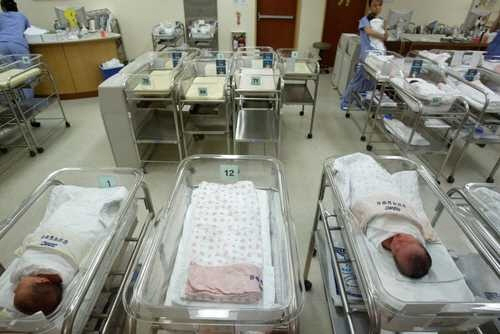
[Asia Economy New York=Special Correspondent Joselgina] Despite South Korea's successive governments investing a staggering $200 billion (approximately 260 trillion won), concerns have been raised that these efforts remain insufficient to solve the low birthrate problem. Analysts suggest that there is a need to move beyond the current one-dimensional financial support and adopt a different approach.
On the 4th (local time), CNN reported from Seoul under the headline "South Korea spent $200 billion but it was not enough to encourage people to have children." South Korea's total fertility rate in the third quarter (July-August) was 0.79, setting a new record for the world's lowest birthrate. This figure falls far short of the 2.1 needed for stable population maintenance and is even lower compared to other advanced countries with low birthrates such as the United States (1.6) and Japan (1.3).
CNN conveyed the atmosphere by stating, "The baby fair season has returned in South Korea, but the industry is shrinking and the customer base is decreasing." It also pointed out that South Korea's low birthrate issue "causes problems in supporting pension systems in an aging country facing a shortage of labor."
In particular, CNN identified economic factors such as high real estate prices, education costs, and economic insecurity as the background behind this low birthrate problem, which prevent young people from starting families. It further noted, "No matter how much money is invested, it has been proven that this issue goes beyond what the government can solve."
Earlier in September, President Yoon Seok-yeol, during a visit to a daycare center, acknowledged that about $200 billion had been invested over the past 16 years to address this demographic cliff problem. However, CNN criticized that since its inauguration in May, the Yoon administration has produced few ideas to solve this issue beyond forming committees similar to past governments and promising financial support for newborns. Rather, it pointed out that President Yoon’s awkward messages during visits to daycare centers have only strengthened skepticism about whether he truly understands the problem better than his predecessors.
There were also criticisms that the government's financial support methods are too one-dimensional. Many experts suggest that what is currently needed is continuous support throughout a child's life. Through interviews with visitors to the baby fair, CNN reported, "The problem they face is that couples cannot afford private childcare and are unable to work after the birth of their first child."
Social prejudices against single-parent families and adoption in de facto relationships were also mentioned. CNN criticized, "Having a baby in South Korea is expected of married couples," adding, "Korean society still shows prejudice against single-parent families." It further stated, "Couples in non-traditional relationships face discrimination," noting that "same-sex marriage is not recognized and adoption by unmarried mothers is strictly regulated."
Additionally, the article included content about husbands who want to be more involved in childcare facing difficulties due to Korean corporate culture. Although parental leave on paper has increased, very few feel comfortable fully utilizing it. Moreover, there is a workplace atmosphere where one must neglect family to get promoted. CNN pointed out, "In South Korea, work does not end even when the office door closes," and added, "If you do not participate in after-work 'team-building' culture, you are looked down upon."
Earlier this year, CNN also cited data from an investment bank to highlight South Korea's low birthrate phenomenon, mentioning the excessive burden of childcare costs as a background factor. At that time, CNN introduced the proportion of the cost of raising a child to age 18 relative to per capita Gross Domestic Product (GDP) by country, reporting that South Korea ranked first.
© The Asia Business Daily(www.asiae.co.kr). All rights reserved.
![Clutching a Stolen Dior Bag, Saying "I Hate Being Poor but Real"... The Grotesque Con of a "Human Knockoff" [Slate]](https://cwcontent.asiae.co.kr/asiaresize/183/2026021902243444107_1771435474.jpg)















