Station 'Tiangong' Successfully Docks Final Launch Spacecraft Ahead of Completion by Year-End
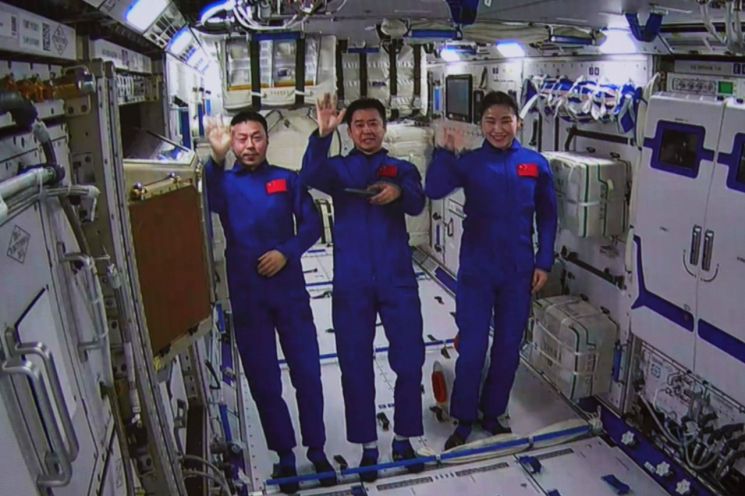 Astronauts of the manned spacecraft 'Shenzhou 14' waving their hands inside the space station laboratory module. Photo by Xinhua and Yonhap News
[Asia Economy Reporter Bang Je-il] The astronauts sent to space for the construction of China's independent space station "Tiangong" (天宮) have safely returned to Earth. It has been 183 days since they boarded the Long March-2F Yao-14 rocket at the Jiuquan Satellite Launch Center in Gansu Province on June 5.
The China Manned Space Agency (CMSA) announced that the Shenzhou 14 return capsule carrying three astronauts?Tian Dong, Liu Yang, and Cai Xuzhe?successfully landed at the Dongfeng landing site in Inner Mongolia, China, at around 8:10 p.m. on the 4th. Earlier, CMSA reported that at 11:01 a.m. that day, the return capsule separated from the space station assembly and was preparing for re-entry.
These three astronauts departed for space on October 16 last year and, like the Shenzhou 13 astronauts who returned on April 16, stayed in space for 183 days while carrying out their mission. They conducted core technology tests related to the assembly and construction of Tiangong, installed various devices necessary for Tiangong's construction, and performed scientific experiments. They also conducted multiple spacewalks and numerous scientific and technological experiments.
Based on their return, China plans to complete the Tiangong space station project by the end of this year. The launch of manned spacecraft is the final stage in China's ambitious effort to build its independent space station "Tiangong." China has continuously competed with the United States in manned spacecraft launches.
On November 16, NASA in the United States also succeeded in launching the manned spacecraft "Orion" for the manned lunar exploration project "Artemis." Less than two weeks after the successful launch of Orion, China succeeded in launching the Shenzhou 15 manned spacecraft. Especially with the safe return of the astronauts who boarded Shenzhou 14, the space hegemony competition between the U.S. and China is expected to intensify further.
Shenzhou 15 is the last spacecraft launched ahead of Tiangong's completion at the end of this year. The three astronauts aboard replaced the Shenzhou 14 astronauts who have been conducting various operations on Tiangong since June. These three will also stay on Tiangong for the next six months, conducting over 40 experimental studies in various fields such as space science and space medicine.
Tiangong, meaning "Palace in the Sky," is 37 meters long and weighs 100 tons. With the construction of Tiangong virtually complete, the moment is near when China will become the only country to independently own a space station. The only currently operational space station is the International Space Station (ISS), jointly operated by 15 countries including the United States and Russia since 1998.
So far, the United States has opposed China's participation in the ISS citing security threats. The U.S. plans to extend the ISS's usage period from the originally designated 2024 to 2030, but the situation changed after Russia's invasion of Ukraine in February this year. Russia declared it would withdraw from the ISS after 2024, making the extension uncertain.
China plans to send at least two manned spacecraft and two cargo spacecraft to Tiangong annually to support space development activities. In 2030, it plans to launch a spacecraft to retrieve soil samples from Mars and land astronauts on the Moon. By 2035, China aims to develop reusable rockets similar to SpaceX, the space company founded by Elon Musk, and by 2040, it plans to build a nuclear-powered space shuttle.
© The Asia Business Daily(www.asiae.co.kr). All rights reserved.

















