COVID-19 Spread Slows but Severe Cases and Deaths Remain High
Following Omicron This Spring, General Deaths Also Surge During Rebound in August-September
Increased Indoor Crowding in Winter Raises Concerns Over Flu and Respiratory Infection Outbreaks
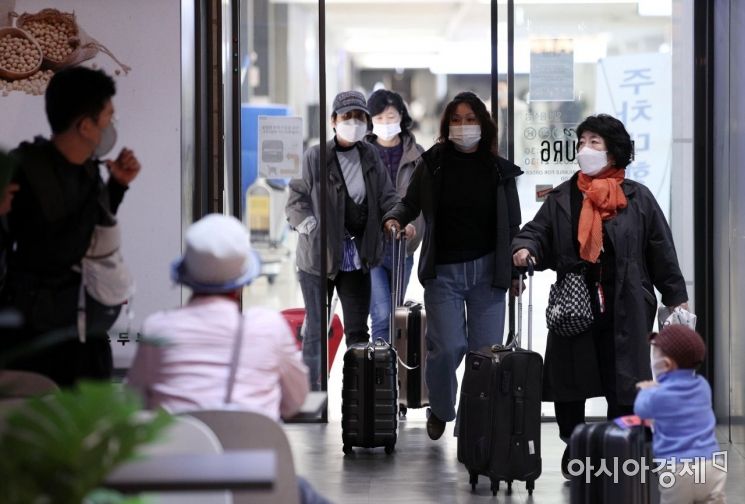
[Asia Economy reporters Jo In-kyung and Byun Seon-jin] The number of deaths due to COVID-19 nearly doubled within a month. Although the spread of the winter resurgence is showing signs of stagnation, the number of COVID-19 critically ill patients hospitalized is approaching 500 daily, and more than 45 deaths occur each day, keeping health authorities on high alert. Regarding Daejeon City's move to lift the 'indoor mask-wearing mandate,' authorities have expressed a negative stance, saying it is still premature.
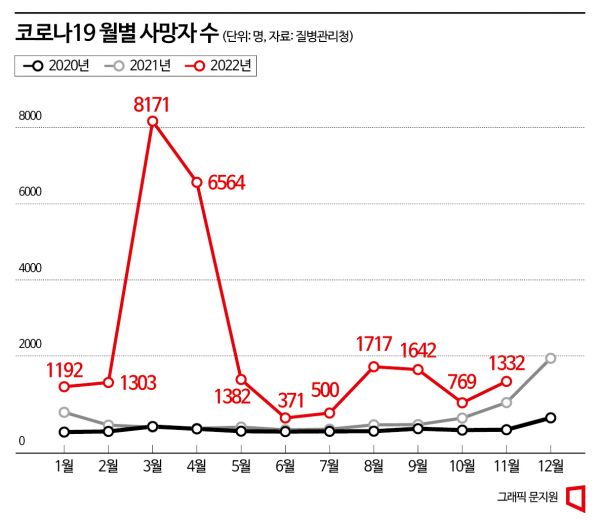
According to the Korea Disease Control and Prevention Agency (KDCA) on the 5th, the total number of COVID-19 deaths in November (based on reporting dates) was 1,332, a 73.2% increase compared to 769 in October. The number of deaths in the recent week (November 28 to December 4) was 360, a 66.7% increase compared to 216 from a month earlier (October 31 to November 6). On December 3 alone, 60 people died.
During the summer resurgence, the number of new confirmed cases in August was 3,470,458, with 1,717 deaths. Compared to November's 1,541,589 new confirmed cases, the number of cases has decreased by more than half (-55.6%), but deaths remain at about 80%. Experts believe that based on these figures, a significant number of 'hidden infections' exist, where people avoid testing despite symptoms or pass through asymptomatically.
As the summer resurgence subsided, the number of critically ill patients, which had dropped below 200 in late October, exceeded 400 again on November 14, and approached 500 on the 28th and 29th, maintaining over 400 for 16 consecutive days recently.
General Patient Harm Also Increases During COVID-19 Pandemic
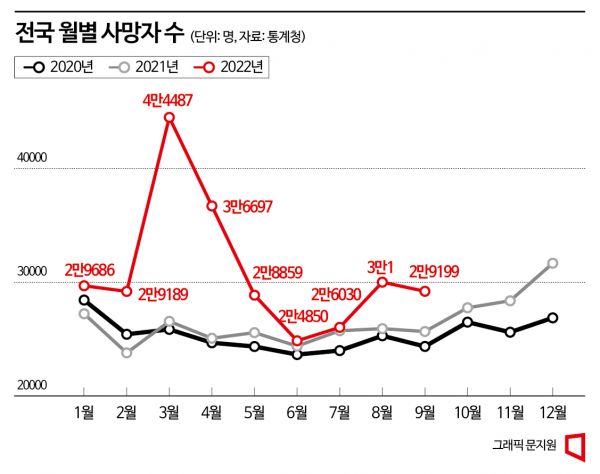
The number of COVID-19 deaths is directly linked to the overall population mortality in South Korea. In August and September, when the summer resurgence peaked and its effects continued, COVID-19 deaths were 1,717 and 1,642 respectively. During this period, the total number of deaths nationwide, as reported by Statistics Korea, was 30,031 and 29,199, marking a record high with increases of 15.8% and 13.8% compared to the same period last year. Earlier, during the Omicron pandemic in spring, COVID-19 deaths surged to 8,171 in March and 6,564 in April, with total deaths also rising sharply to 44,487 and 36,697 respectively, increases of 67.5% and 46.4% year-on-year.
Analysis also shows that during rapid COVID-19 spread periods, more than 2,000 excess deaths per month occurred?deaths that would not have happened without the infectious disease pandemic.
According to Kim Young-sam, Research Director at the Korean Society of Critical Care Medicine and Professor of Respiratory Medicine at Yonsei University College of Medicine, from October last year when the Delta and Omicron variants circulated, more than 2,000 excess deaths per month were observed. Furthermore, from the first COVID-19 case to May this year, the predicted excess deaths totaled 47,516, of which 49.2%, or 22,356, were non-COVID patients not diagnosed with COVID-19. This means that during the infectious disease pandemic, not only COVID-19 patients but also general patients suffered significant harm.
Increased Indoor Activities in Winter... Concerns Over Rising Cases
Health authorities are maintaining a cautious stance, withholding judgment despite some experts' views that the winter resurgence has passed its peak. On December 2, Kwon Jun-wook, Deputy Head of the Central Disease Control Headquarters (CDCH), said in a briefing, "The cold wave has begun, and indoor crowding is expected to increase significantly," adding, "We need to confirm the peak of the resurgence a bit more."
Regarding Daejeon City's announcement to independently lift the indoor mask-wearing mandate?the first among local governments nationwide?health authorities have effectively put the brakes on the move, emphasizing a 'single quarantine system.'
The CDCH stressed, "At the regular Central Disease Control Headquarters meeting chaired by the Prime Minister on October 29 last year, it was decided that local governments could implement strengthened quarantine measures, including masks, but any relaxation of measures must be coordinated through prior consultation with the Central Accident Response Headquarters and reporting to the Central Disease Control Headquarters."
Experts also view that lifting the indoor mask mandate may be premature, especially as critically ill patients could increase from December to January due to COVID-19 and other respiratory infections like influenza.
Professor Eom Jung-sik of the Department of Infectious Diseases at Gachon University Gil Medical Center said, "Major quarantine decisions are more reasonable when coordinated with the central government and other local governments rather than made unilaterally by a local government," adding, "It is necessary to confirm whether there is no risk of further increases in critically ill and death cases and whether there has been sufficient consultation with regional medical institutions that must handle the increased disease burden."
© The Asia Business Daily(www.asiae.co.kr). All rights reserved.



















