[Asia Economy Reporter Jeong Dong-hoon] The Korea Chamber of Commerce and Industry announced on the 4th that it has published the "Large-Medium-Small Win-Win Smart Factory Best Practices Collection," which contains the achievements of companies participating in the Win-Win Smart Factory Construction Support Project. This best practices collection was created to introduce the smart factory support project to companies and to share project outcomes and exemplary company cases.
The Large-Medium-Small Win-Win Smart Factory Construction Support Project is a program where the government partially supports construction costs when large corporations and their small and medium-sized or mid-sized partner companies jointly build smart factories. When small and medium-sized or mid-sized companies build smart factories that apply advanced technologies such as ICT to automate and digitize the entire process from product planning and design to production, distribution, and sales, more than 70% of the total project cost is supported to these companies through a combination of large corporation contributions and government subsidies.
Contributing companies such as Hyundai Motor Company, Kia Motors, Hyundai Mobis, LG Electronics, POSCO, Doosan, Korea Midland Power, Korea Western Power, and Korea Gas Corporation have been supporting the construction of Large-Medium-Small Win-Win Smart Factories since 2019 in collaboration with the Ministry of SMEs and Startups and the Korea Chamber of Commerce and Industry to promote co-growth between large and small-medium enterprises and enhance manufacturing innovation capabilities.
Until last year, the Korea Chamber of Commerce and Industry raised a project fund of 29.3 billion KRW, including 17.5 billion KRW from large corporations and 11.8 billion KRW in government support, supporting the construction of smart factories in 690 companies through the three-year project. Currently, in the ongoing fourth year, the project scale is 16.5 billion KRW (9.7 billion KRW from large corporations and 6.8 billion KRW from the government), supporting 215 companies.
#1 Shinsung Delta Tech Co., Ltd., developed laser welding automation technology with LG Electronics, reducing defect rate from 10,000 PPM to 1,500 PPM
Shinsung Delta Tech Co., Ltd., located in Changwon, Gyeongnam, participating in the Large-Medium-Small Win-Win Smart Factory Construction Project, pursued automation of the welding process for the dryer drum of washing machines. The existing plasma method relied 100% on operator skill, resulting in many defects. They investigated whether laser-based welding automation equipment existed domestically or abroad but found none. Eventually, they collaborated with LG Electronics. Within less than a month after forming a task force, they implemented an unprecedented automatic welding technology. The welding defect rate, which had reached 10,000 PPM, dropped to 1,500 PPM, leading to a 305% increase in productivity. The automated equipment system developed through cooperation between Shinsung Delta Tech and LG Electronics was later installed on LG Electronics’ dryer manufacturing line in Tennessee, USA.
#2 Cheongmyeong Co., Ltd., built an automated data management system with support from Hyundai Motor Company, reducing defect rate by 32% and increasing production by 10%
Cheongmyeong Co., Ltd., based in Seosan, Chungnam, specializing in processing automotive transmissions and DIFF CASE (a component controlling the rotation ratio of car wheels), faced significant quality management challenges due to inaccurate data relying on manual records and operator memory. Since 2019, they have participated in the Large-Medium-Small Win-Win Smart Factory Construction Project funded by Hyundai Motor Company, establishing a ‘raw material and intermediate product management system’ and this year further advanced their MES and POP systems. By annually replacing equipment, they now identify improvements based on automatically extracted data. These efforts have resulted in a 32% reduction in defect rate and a 10% increase in hourly production. Automated data also helped overcome communication issues with foreign workers. Currently, Cheongmyeong’s factory automation rate has reached 70-80%, and they believe it is now time to fully establish a smart factory. CEO Kim Dae-yeol states that comparing before and after smart factory construction, the company has become ‘completely different inside, even if it looks similar outside.’
#3 Youngjin Mold Co., Ltd., introduced T-mold (3D mold design system) with POSCO support, increasing operating rate by 43% and reducing defect rate by 35%
Youngjin Mold, located in Incheon, produces molds necessary for manufacturing automotive and electrical/electronic products by processing special steel according to customer product shape requests. Mold production involves numerous processes, and 3D mold design was essential to improve design efficiency through organic linkage between these processes. Through the Large-Medium-Small Win-Win Smart Factory Construction Project and support from the parent company, they introduced [T-mold - NC machine tools (automated machine tools combined with numerical control devices) - real-time monitoring system], resulting in a 43% increase in equipment operating rate and a 35% decrease in defect rate. CEO Park Sung-hyun emphasized that smart factory systems are even more necessary for small companies that must maximize efficiency with fewer personnel.
'Smart Factory Construction Support' Achieves High Productivity Improvements... Greatly Contributes to SMEs’ Digital Transformation (DX)
The Korea Chamber of Commerce and Industry stated that smart factory construction support projects, including the Large-Medium-Small Win-Win model, have been effective in improving quality and productivity of small and medium-sized enterprises, significantly contributing to their digital transformation (DX).
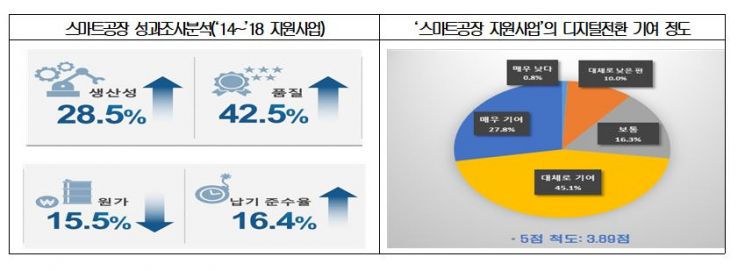
According to the Smart Manufacturing Innovation Promotion Team (under the Ministry of SMEs and Startups), which oversees the smart factory construction support project, the productivity of participating companies improved by 28.5% and quality by 42.5% as a result of the smart factory dissemination support project initiated in 2014 (Dec 2020, Smart Factory Performance Survey and Analysis 2014-18).
Meanwhile, a recent survey conducted by the Korea Chamber of Commerce and Industry among field guidance experts showed that 72.9% positively evaluated the impact of the government’s smart factory construction support project on the digital transformation of domestic SMEs.
Woo Tae-hee, Executive Vice Chairman of the Korea Chamber of Commerce and Industry, said, "With visible effects from the smart factory support project over the past four years, it is now time for SMEs to accelerate their digital transformation. The Large-Medium-Small Win-Win Smart Factory Construction Support Project, which effectively practices corporate social responsibility through co-growth with partner companies, is expected to accelerate SMEs’ DX."
He also added, "Since we possess world-class digital infrastructure across society, we hope the government will continue active support and investment not only to spread digital transformation (DX) but also to lead the data ecosystem."
© The Asia Business Daily(www.asiae.co.kr). All rights reserved.
![Clutching a Stolen Dior Bag, Saying "I Hate Being Poor but Real"... The Grotesque Con of a "Human Knockoff" [Slate]](https://cwcontent.asiae.co.kr/asiaresize/183/2026021902243444107_1771435474.jpg)
















