1st and 2nd Instance Courts Forfeit Voice Phishing Proceeds Not Included in Indictment
Supreme Court: "Forfeiture Sentencing Must Relate to Charged Facts and Forfeiture Requirements"
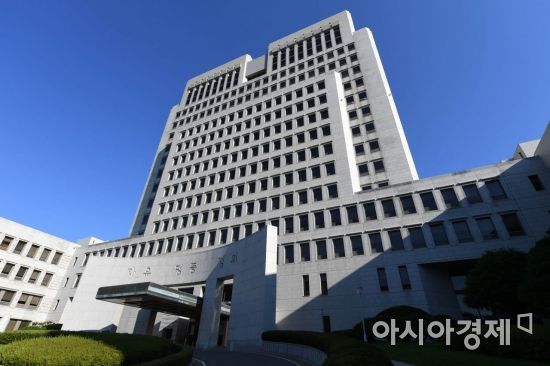
[Asia Economy Reporter Heo Kyung-jun] The Supreme Court has ruled that the confiscation and collection of criminal proceeds from crimes such as voice phishing (telephone financial fraud) are only possible for the criminal facts for which prosecution has been initiated.
The Supreme Court's First Division (Presiding Justice Park Jeong-hwa) overturned the lower court's ruling that ordered the confiscation of cash from A, an intermediary in a voice phishing criminal organization, and remanded the case to the Seoul Eastern District Court, announcing this on the 4th.
A was prosecuted on charges of delivering 196 million KRW in criminal proceeds to the voice phishing organization.
Both the first and second trials found A guilty and sentenced him to 2 years and 6 months in prison, while also ordering the confiscation of cash that was not directly related to A’s charges.
The issue arose because the second trial confiscated criminally obtained property not related to the crimes prosecuted in this case. The second trial, based on Article 49 of the Criminal Act, held that cash believed to be proceeds from voice phishing crimes could be confiscated even if it was not included in A’s charges.
Article 49 of the Criminal Act stipulates that "even if the perpetrator is not convicted, confiscation may be ordered if the conditions for confiscation are met."
However, the Supreme Court’s judgment differed. The Supreme Court held that to order confiscation under Article 49, the prosecution’s charges and the conditions for confiscation must be related.
The court stated, "The criminal facts that are the basis for confiscation and collection are limited to the prosecuted criminal facts, and ‘criminally obtained property’ is limited to property acquired from the victim of the prosecuted criminal facts or property obtained through the possession or disposal of such property. Confiscation and collection are only permitted when it is recognized that the victim’s recovery of damages is extremely difficult."
© The Asia Business Daily(www.asiae.co.kr). All rights reserved.

















