KIST-Dongguk University Develop Nano Composite Filter Material from Coffee Grounds to Remove Heavy Metals
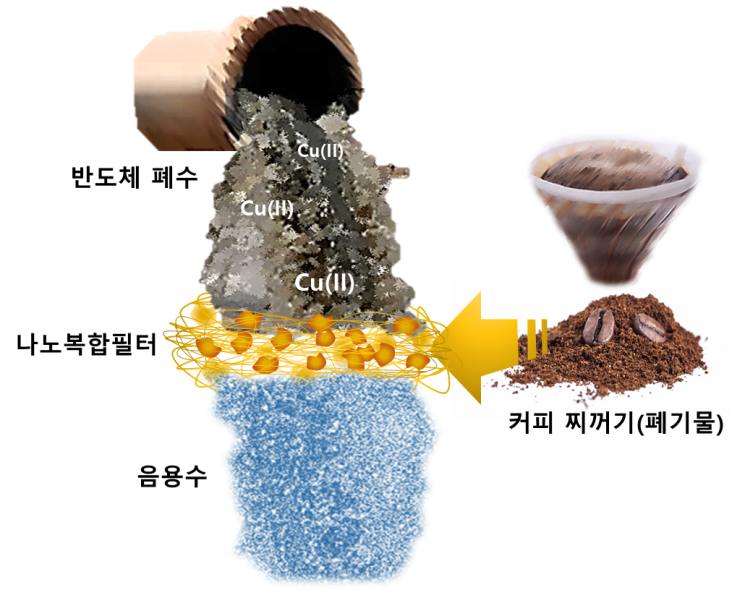 Schematic of a nanocomposite filter purifying heavy metals using coffee grounds. Image provided by KIST.
[Asia Economy Reporter Kim Bong-su] A technology to purify semiconductor wastewater using 'troublesome' coffee grounds has been developed.
The Korea Institute of Science and Technology (KIST) announced on the 4th that Dr. Lee Min-wook's research team at the Structural Composite Materials Research Center, in collaboration with Professor Kim Young-kwan's team at Dongguk University, succeeded in developing a nano-composite filter for copper ion removal by combining coffee grounds, which are discarded as household waste, with biodegradable polymers.
Only 0.2% of coffee beans used to brew a cup of coffee become the coffee we drink, while the remaining 99.8% of the grounds are discarded, amounting to about 150,000 tons annually in South Korea alone. When landfilled, greenhouse gases are generated, and incineration produces a large amount of carbon.
The surface of coffee grounds is not only porous but also composed of various functional groups carrying a negative charge. Therefore, they have been used to adsorb positively charged heavy metals in wastewater. Heavy metals in semiconductor wastewater can cause fatal damage to major human organs such as the kidneys, liver, and brain, and their discharge has increased recently due to the growth in semiconductor production. This underscores the necessity for purification technology that can effectively remove heavy metals, including copper, from semiconductor wastewater.
The problem was that the coffee grounds were dispersed in water, requiring the collection of used coffee grounds again.
The research team utilized composite material technology possessed by KIST Jeonbuk Branch to collect coffee grounds from commonly used capsule coffee without any separate pretreatment processes such as washing or impurity removal, and uniformly composite them with the biodegradable plastic PCL (Poly Capro Lactone) in a solvent. Then, by electrospinning, they manufactured a nano-composite filter composed of very dense and uniform coffee grounds and biodegradable polymer. The material produced achieved over 90% heavy metal removal efficiency within 4 hours from wastewater with an initial concentration of 100μM (micromolar), meeting drinking water standards. It is possible to produce a nano-composite filter that can purify about 10 liters of wastewater using one capsule coffee (approximately 5g).
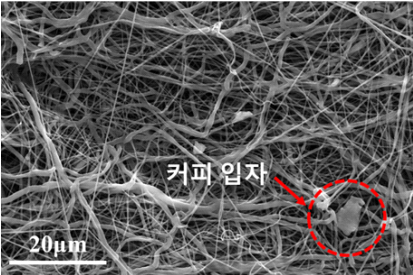 Microscopic image of a nano-composite filter for heavy metal purification made from coffee grounds. Provided by KIST
Dr. Lee Min-wook of KIST said, “This research is meaningful in that it developed an economical and eco-friendly water treatment technology by simply converting waste, which causes environmental pollution, into composite materials,” and added, “In the future, we plan to develop various filters that are eco-friendly and high-performance by surface-treating coffee grounds or exploring other natural materials.”
The research results were published online in the latest issue of the international journal in the water treatment field, Journal of Water Process Engineering (IF: 7.34, top 7.5% in JCR category).
© The Asia Business Daily(www.asiae.co.kr). All rights reserved.
![Clutching a Stolen Dior Bag, Saying "I Hate Being Poor but Real"... The Grotesque Con of a "Human Knockoff" [Slate]](https://cwcontent.asiae.co.kr/asiaresize/183/2026021902243444107_1771435474.jpg)












