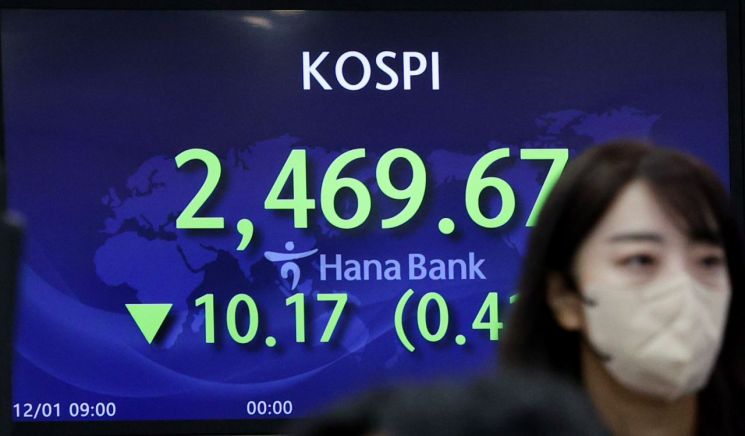
[Asia Economy Reporter Lee Seon-ae] This week (5th to 9th), the KOSPI is expected to show a pattern of consolidation again. With the coexistence of expectations for the U.S. Federal Reserve's (Fed) slowing pace of interest rate hikes and concerns over an economic recession due to sluggish exports, it is judged that the index will find it difficult to establish a clear direction.
On the 4th, the securities industry forecasted that the KOSPI would fluctuate around 2480 points this week. NH Investment & Securities projected the weekly KOSPI range to be between 2420 and 2540 points. While expectations for a Fed policy pivot are an upward factor, domestic export sluggishness and valuation burdens were pointed out as downward factors.
Kim Young-hwan, a researcher at NH Investment & Securities, said, "If the U.S. inflation rate in November does not significantly exceed expectations, it is highly likely that optimistic forecasts regarding Fed policy will be maintained for the time being," but added, "Sluggish Korean exports and valuation burdens will act as downward factors."
Jang Hyun-chul, a researcher at Korea Investment & Securities, explained, "Despite the continued downward revisions of corporate earnings forecasts, the Korean stock market has escaped the oversold zone thanks to the stability of the won-dollar exchange rate, and among major global stock markets, it is the only one with valuations higher than the past 10-year average," adding, "Considering that exports have entered a contraction phase and that the semiconductor market turnaround will require time, we have entered a zone where valuation burdens can be felt."
Korea's export amount in November was $51.9 billion, down 14% year-on-year, marking a negative growth rate for two consecutive months. The annual trade deficit reached $42.6 billion, the largest on record. Lim Hye-yoon of Hanwha Investment & Securities said, "Due to the global demand slowdown, export prices of major items are falling, and exports to China are also decreasing, intensifying Korea's export sluggishness," and predicted, "Considering the global economic slowdown and base effects, exports in the first half of next year are likely to decrease by more than 10% compared to this year, and the export sluggishness of semiconductors and petrochemicals, which led last year's export boom, will deepen."
The fact that the ISM Manufacturing Purchasing Managers' Index (PMI) in the U.S. fell below the baseline of 50 for the first time in 30 months is also a concern. Seo Jeong-hoon, a researcher at Samsung Securities, said, "Since one of the reputable economic indicators has officially signaled a recession, the stock market, which has rebounded relying solely on expectations of passing the peak of high inflation, is likely to reflect on itself."
Accordingly, the domestic stock market is expected to unfold a battle between upward and downward forces. Although Fed Chair Jerome Powell's remarks that he does not want excessive tightening have raised expectations for a slowdown in the pace of rate hikes, expectations for easing have already been priced into the market to a certain extent. Moreover, signals of a global economic recession are being found in various places, unsettling investor sentiment.
Due to the anticipated challenging market conditions, advice has emerged to establish a cautious investment strategy. Large-cap growth stocks, which experienced excessive declines due to interest rate effects, and domestic consumer and industrial goods sectors that could benefit from China's reopening have emerged as areas of interest. Over the past month, foreign buying inflows were observed, but sectors with limited gains included distribution, defense, shipbuilding, hardware, and chemicals. Researcher Seo advised, "In times of recession concerns, it may be reasonable to focus on sectors whose earnings forecasts have already been revised downward."
There is also advice to pay attention to neglected sectors and assets. Yang Hae-jung, a researcher at DS Investment & Securities, said, "Interest rates are gradually entering a predictable range, which means uncertainty is decreasing, allowing for responses in asset or stock investments," and predicted, "There will be a process of identifying sectors and stocks according to sensitivity to interest rates, and initially, there will be a rebound in the weakest sectors and assets."
© The Asia Business Daily(www.asiae.co.kr). All rights reserved.
![Clutching a Stolen Dior Bag, Saying "I Hate Being Poor but Real"... The Grotesque Con of a "Human Knockoff" [Slate]](https://cwcontent.asiae.co.kr/asiaresize/183/2026021902243444107_1771435474.jpg)
















