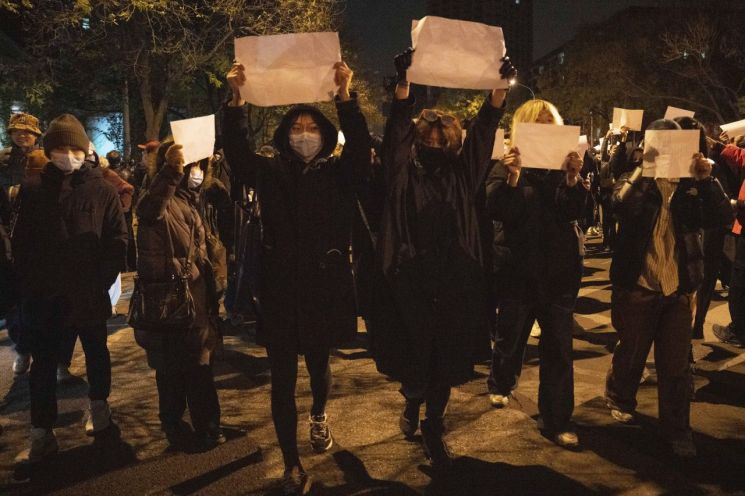
[Asia Economy Reporter Jo Yujin] Chinese authorities have decided to switch COVID-19 testing from polymerase chain reaction (PCR) tests to rapid antigen tests in some areas, including the capital Beijing and Guangzhou. Easing of quarantine measures is spreading, such as reopening commercial facilities in Urumqi, which became a decisive flashpoint for the 'blank paper protests' opposing the strict lockdown policies.
According to the Hong Kong South China Morning Post (SCMP) on the 2nd, Beijing authorities exempted patients visiting hospitals from submitting a PCR negative certificate obtained within 48 hours. Instead, patients visiting hospitals must take a rapid antigen test and can enter different areas within the hospital depending on the results. PCR testing is exempted for infants under 2 years old, and the test results of their guardians are accepted instead.
This measure follows Beijing's earlier announcement that it would not require frequent PCR tests for those who do not regularly engage in external social activities, such as the elderly, infants, and telecommuters.
Until now, in China, a PCR negative certificate obtained within 24 to 48 hours was required for attending school, going to work, shopping, dining out, etc., and in case of infections, PCR mass testing was conducted for tens of millions of people.
Guangzhou in Guangdong Province also announced the day before that it would stop PCR mass testing for all residents in districts. Instead, close contacts subject to quarantine will be precisely classified, and only those in high-risk groups will undergo regular testing.
Chengdu in Sichuan Province also abolished the mandatory presentation of PCR negative results when residents enter public places such as public transportation.
SCMP reported, "After Chinese authorities announced 20 precise epidemic prevention measures last month on the 11th to minimize lockdowns in COVID-19 affected areas and reduce disruptions to economic and social activities, some major cities decided to reduce PCR testing."
It added, "Following protests across the country last weekend, Chinese authorities are accelerating fine-tuning of zero-COVID policies to comply with these 20 measures."
Since the blank paper protests opposing zero-COVID occurred in various regions and universities across China from the 25th to 27th of last month, local governments have been announcing lockdown lifts and other easing measures one after another.
In Urumqi, which sparked the protests, quarantine measures are also being eased. On this day, Urumqi epidemic prevention authorities stated, "As epidemic prevention and control continue to improve, commercial activities in low-risk areas will be orderly resumed."
Authorities plan to sequentially reopen commercial facilities in low-risk areas, such as shopping centers, large supermarkets, hotels, restaurants, and ski resorts, under the condition of complying with epidemic prevention rules. They also decided to accelerate the return of personnel and resumption of operations at production facilities by blocking external contact.
Additionally, 45 high-risk areas were reclassified as low-risk areas. Earlier, on the 28th of last month, small supermarkets selling daily necessities reopened, airports normalized, and from the 1st, public transportation such as city buses and taxis, as well as some train routes, resumed operation.
© The Asia Business Daily(www.asiae.co.kr). All rights reserved.

















