Increasing Electric Vehicle Charging Speed
Expanding Investment in Artificial Graphite
Additional 128.1 Billion Won Beyond Plan
New North American Factory Planned
[Asia Economy Reporter Jeong Dong-hoon] POSCO Chemical has expanded its investment scale in artificial graphite, which can increase the charging speed and lifespan of electric vehicles. It also plans to establish a new anode material factory in North America within this year, aiming to drive the anode material market.
According to the electronic disclosure system on the 2nd, POSCO Chemical recently submitted a correction disclosure to expand the scale of the anode material factory built in the Blueberry National Industrial Complex, Donghae-myeon, Pohang, from the originally planned 16,000 tons in 2024 to 18,000 tons in 2025. The company decided to invest 345.8 billion KRW for the expansion of the Pohang factory. This is an increase of about 128.1 billion KRW from the initially planned investment of 217.7 billion KRW.
In December last year, POSCO Chemical completed the first phase of its artificial graphite anode material factory, the first of its kind in Korea, and began full-scale production. The factory was planned to be built on a 78,535㎡ site with an annual production capacity of 16,000 tons, aiming for comprehensive completion in 2023. However, with the recent expansion decision, the production capacity of anode materials will increase to 18,000 tons. The amount of anode material required per electric vehicle is about 38 kg, which can supply approximately 460,000 electric vehicles with a 60kWh battery capacity. A POSCO Chemical official stated, "This investment decision aims not only to expand production capacity but also to reduce production costs through facility investment." POSCO Chemical is also targeting the establishment of an anode material factory in North America in response to the growth of the North American electric vehicle market following the implementation of the Inflation Reduction Act (IRA). Especially, as the demand for artificial graphite anode materials increases, the expanded Pohang factory may serve as a 'pilot plant' to enhance manufacturing completeness.
Anode material is one of the core materials of batteries. Depending on the raw materials, it is divided into artificial graphite-based, natural graphite-based, and silicon-based types. Artificial graphite anode materials can increase crystallinity through high-temperature manufacturing processes, resulting in a more uniform and stable internal structure compared to natural graphite products. Due to these characteristics, they offer advantages such as long lifespan and fast charging, which are essential for electric vehicle batteries.
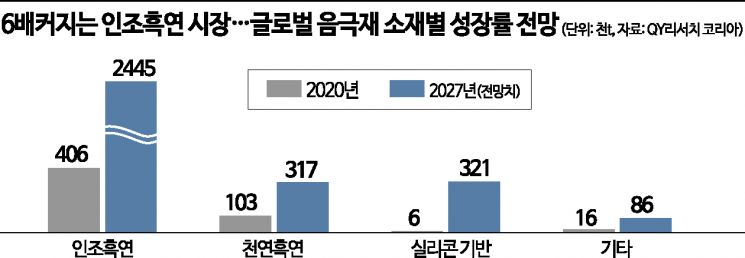
The anode material market is experiencing explosive growth. According to QY Research Korea's 'Global Lithium-ion Battery Anode Material Market Report 2021,' the global lithium-ion battery anode material market size recorded 3.2 billion USD (approximately 4.1574 trillion KRW) in 2020. It is expected to grow at an average annual rate of 20.2%, reaching 14.1 billion USD (approximately 18.3187 trillion KRW) by 2027. In terms of volume, it is projected to increase from 530,000 tons in 2020 to 3.17 million tons in 2027, growing at an average annual rate of 29.1%. The growth rate forecast by anode material type until 2027 shows silicon-based anode materials leading with an average annual growth rate of 76.6%, followed by artificial graphite at 29.2%, and natural graphite at 17.4%.
© The Asia Business Daily(www.asiae.co.kr). All rights reserved.

















