This Year’s Hot Water and Heating Fees Up 38%... Winter Heating Costs 'Emergency'
Insulation Sheets Popular Due to Heating Cost Surge... 'Bbokbbok-i' Sales Soar
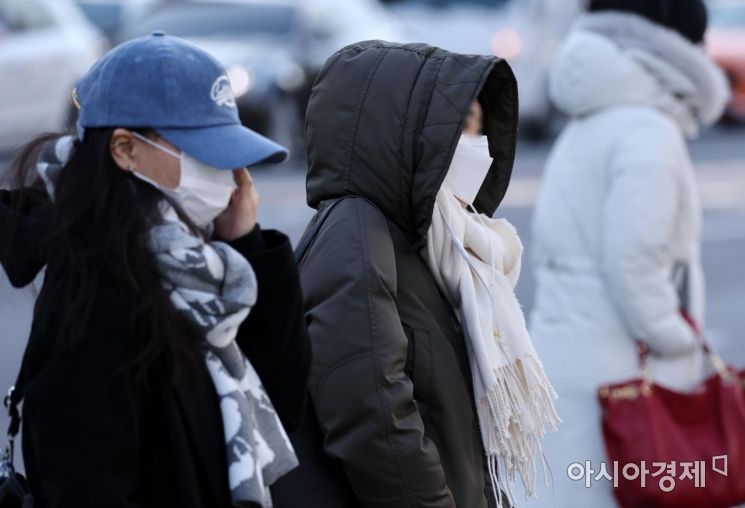 On the 1st, citizens dressed in thick clothing are walking to work around Gwanghwamun, Seoul. Photo by Kim Hyunmin kimhyun81@
[Asia Economy Reporter Heo Midam] # Kim Hyowon (26), an office worker living alone in Mapo-gu, Seoul, is deeply worried about heating costs this winter. Recently, with rising prices increasing living expenses, heating bills have also surged significantly. Kim said, "These days, I endure with just an electric blanket rather than turning on the heating," adding, "After deducting rent, maintenance fees, and transportation costs from my salary, life is already tight, so the rise in heating costs is worrying."
As the severe cold wave has begun in earnest, citizens' concerns about heating charges (hot water and heating fees) are growing. With prices already up, heating charges have surged nearly 40% this year, increasing the financial burden on ordinary households.
Recently, posts expressing the burden of soaring heating costs have been appearing one after another on online communities. One netizen said through a mom caf? in Yeongdeungpo-gu, Seoul, "The city gas usage was similar to last month, but the bill was three times higher," adding, "I usually don’t run the boiler much, but this winter I might have to endure with sleep pants."
According to Korea District Heating Corporation on the 2nd, this year’s residential heating charges rose three times: from 66.98 won per 1 megacalorie (Mcal) in April to 74.49 won in July, and then to 89.88 won in October. Compared to the end of March before the increase (65.23 won), this is a 37.8% rise. Gas prices also increased. Gas fees rose by 2.7 won per megajoule (MJ, a unit of gas heat energy) in October. For a family of four, this means a 5,400 won (15.9% compared to the previous month) increase in gas charges.
The sharp rise in heating charges is largely due to the surge in international energy prices caused by the war between Russia and Ukraine. Russian President Vladimir Putin has weaponized energy by cutting gas supplies to Western countries supporting Ukraine, prompting countries worldwide to secure energy sources such as liquefied natural gas (LNG) and crude oil. In this process, gas prices, a major heating fuel, have risen significantly.
The spot price of natural gas in the Northeast Asia region (JKM) surged from $10 per mmbtu (heat unit) in the first quarter of last year to $47 in the third quarter of this year. Recently, the exchange rate has also soared, continuing the rise in import costs. The domestic LNG import price (spot basis) jumped from $571.15 per ton in September last year to $1,465.16 per ton in September this year. Accordingly, gas prices have risen more than 30% this year.
Especially since South Korea relies entirely on LNG imports, when LNG prices rise, heating and gas charges inevitably increase.
The problem is that the rapid increase in heating charges this year has heightened the economic burden on ordinary citizens. As a result, people are preparing for the cold by purchasing insulation sheets called 'Bbokbbok-i' and draft stoppers.
According to Gmarket, from the 12th of last month to the 13th of this month, sales of 'Bbokbbok-i' increased by 80% compared to the same period last year. In addition, sales of insulation films (96%), heating tents (93%), draft stoppers (80%), and windproof vinyl/windproof curtains (64%) also rose.
Meanwhile, the government supports heating costs for vulnerable groups through the Energy Voucher system. The Energy Voucher is a government-supported program that helps energy-vulnerable households (including elderly, infants, and disabled persons among basic livelihood security recipients) purchase electricity, city gas, district heating, kerosene, LPG, coal briquettes, and more.
© The Asia Business Daily(www.asiae.co.kr). All rights reserved.

















