Defeating Germany and Spain, Top of the 'Group of Death' to Advance to Round of 16
First Asian Team to Reach Round of 16 Twice in a Row
Coach Moriyasu Hajime's Substitution Strategy Wins Again After Germany Match
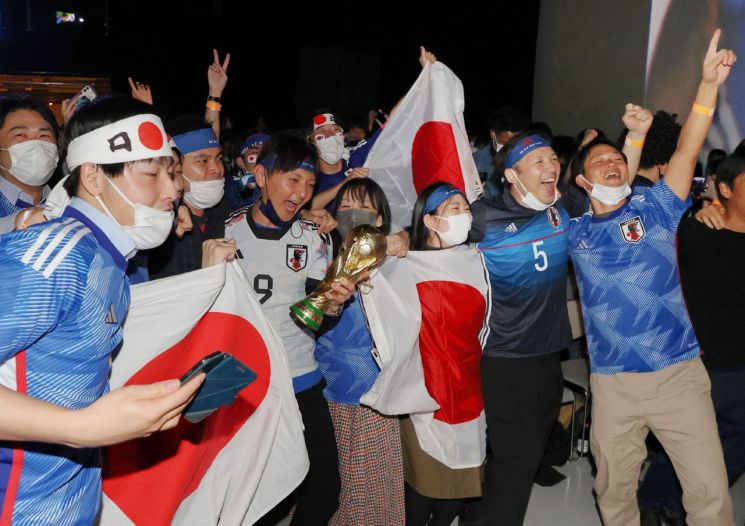 On the 2nd (local time) in Tokyo, Japan, citizens are cheering as their national soccer team secured a victory against Spain and advanced to the Round of 16 in the 2022 Qatar World Cup. Photo by Yonhap News
[Asia Economy Reporter Han Seung-gon] Japan defeated the "Panzer Army" Germany and then the "Invincible Armada" Spain. With this, Japan succeeded in advancing to the Round of 16 in the World Cup for the second consecutive time following the 2018 Russia World Cup. This is the first record for an Asian country, and the "Samurai Blue" Japanese soccer team has once again amazed the world.
Led by head coach Moriyasu Hajime, the Japanese national soccer team secured a 2-1 come-from-behind victory against Spain in the final third group stage match of Group E at the 2022 Qatar World Cup, held at Khalifa International Stadium in Al Rayyan, Qatar, at 4 a.m. (Korean time) on the 2nd. The goals came consecutively from Doan Ritsu (Freiburg) and Tanaka Ao (D?sseldorf).
In the match, Spain relentlessly pressed Japan, dominating ball possession at an 8 to 2 ratio. In response, Coach Hajime took a substitution gamble. He took off right winger Kubo Takefusa and left wing-back Nagatomo Yuto, bringing in forward Doan Ritsu and Mitoma Kaoru. Just three minutes after the substitution in the second half, Doan scored the equalizer. Boosted by confidence, Japan scored the go-ahead goal three minutes later. Doan delivered a pass from the right side of the penalty area, which Mitoma connected, and Tanaka finished with a shot to make it the winning goal.
Some interpret this as another shining example of Coach Hajime’s tactical prowess. In the match against Germany on the 23rd of last month, Hajime used all three substitution cards within 10 minutes of the second half. He then made two more substitutions at the 28th minute of the second half, exhausting all substitution options. Although a retrospective evaluation, Hajime’s so-called "substitution gamble" was successful. Right after the match, he said, "You never know the result unless you play the game. Considering world soccer so far, today’s victory might be called a 'surprise,' but the level of Japanese soccer is getting closer to the world," emphasizing that the win against Germany was not a coincidence but a demonstration of skill.
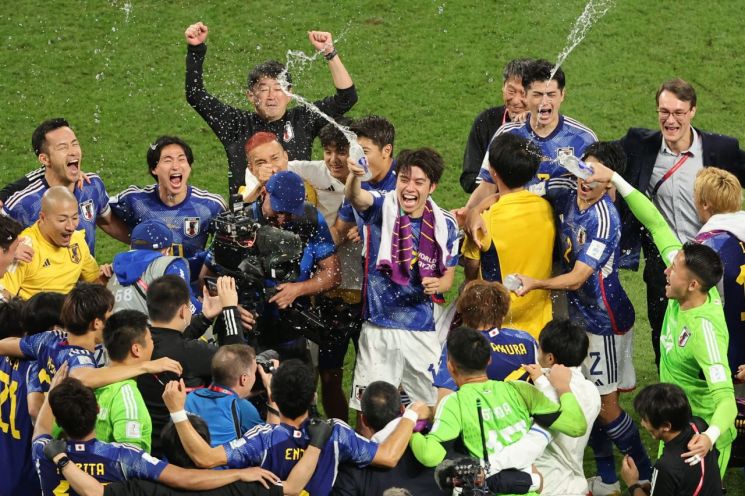 On the afternoon of the 1st (local time), the Group E third match of the 2022 Qatar World Cup between Japan and Spain was held at Khalifa International Stadium in Al Rayyan, Qatar. Japanese players, who defeated Spain and advanced to the round of 16 as the top team in the group, are cheering. Photo by Yonhap News Agency
Following the traditional European powerhouse Germany, Japan also defeated Spain, advancing as the top team from Group E, known as the "Group of Death," to the Round of 16. However, Japan’s past records were poor. Japanese soccer emerged on the world stage starting with the launch of the J.League in 1990. In their first appearance at the 1998 France World Cup, Japan lost all three group stage matches. Since then, Japan alternated between group stage eliminations and Round of 16 qualifications. In 2006, they finished last in their group without a single win. In 2010, they reached the Round of 16 but were eliminated in a penalty shootout. In 2014, they earned only one point, and in the 2018 Russia World Cup, Japan was on the verge of reaching the quarterfinals but failed to maintain a 2-0 lead against Belgium, ultimately losing 2-3.
At that time, the coach was Hajime, who faced national criticism but retained his position thanks to the full support of Japan Football Association Chairman Toshima Gozo. Chairman Gozo explained the reason for appointing Hajime, saying, "It is necessary to bring out 'Japan-ness' by leveraging Japan’s strengths."
With this trust, Coach Hajime is evaluated to have perfected the Japanese style of soccer in this Qatar World Cup. Japanese soccer, known worldwide for its fast mobility, passing, and pressing forward to create scoring opportunities, is a well-known tactic. However, combined with unexpected player substitutions and tactical maneuvers, Japan achieved the record of advancing to the Round of 16 for two consecutive times for the first time among Asian countries.
In fact, Hajime’s dramatic tactical moves are not new. Starting his coaching career at J.League’s Sanfrecce Hiroshima, according to FIFA, he alternated between 4-3-3 and 5-4-1 formations. After becoming the national team coach, he operated a 4-2-3-1 formation or a 4-4-2-like formation where the team ace joins the front attack line. His strategies are praised for being flexible and effective in responding to opponents’ tactics. After the victory against Germany, he said in a media interview, "I entered the game with several plans in mind. I was also prepared for things going wrong. I thought it could be a one-goal difference game. Calmly, I changed the game management in the second half to create a situation where I could gamble on the outcome."
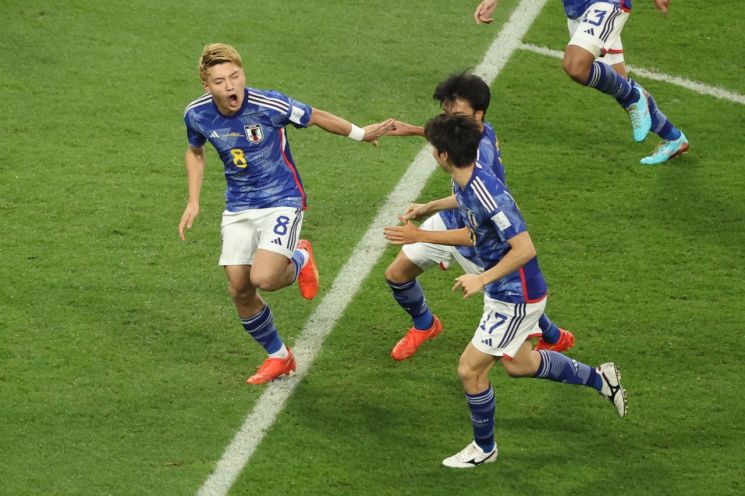 On the afternoon of the 1st (local time), the Group E third match of the 2022 Qatar World Cup between Japan and Spain was held at Khalifa International Stadium in Al Rayyan, Qatar. Doan Ritsu of Japan, who scored the equalizing goal, and his teammates are celebrating. Photo by Yonhap News Agency
Additionally, another gamble?boldly reducing the number of overseas-based players as a kind of generational change?was also successful. The so-called "passing soccer," well known as Japan’s style, requires multiple players cooperating in attack and maintaining organic harmony. However, overseas players inevitably become star players during matches, which could cause problems in team cohesion, according to Coach Hajime’s thinking. Acting on this idea, he selected players primarily tested in evaluation matches since his appointment ahead of this Qatar World Cup. In an interview with a media outlet, he stated, "I considered the condition aspects and generational change to younger players." Based on this criterion, Asano Takuma, selected by Coach Hajime, was substituted in at the 37th minute of the second half against Germany and scored the go-ahead goal with a powerful right-footed shot.
Currently, the Japanese archipelago is in a festive mood. Prime Minister Kishida Fumio personally called Coach Hajime to congratulate him on the victory. Prime Minister Kishida said, "I called Coach Moriyasu and told him, 'The people gained courage and energy. I sincerely congratulate you on the victory,'" and introduced the conversation, saying, "Coach Moriyasu replied, 'I am very happy to be able to deliver courage and energy to all Japanese people.'"
Meanwhile, Japan will compete for a spot in the quarterfinals against Croatia, who advanced to the Round of 16 as the second place in Group F.
© The Asia Business Daily(www.asiae.co.kr). All rights reserved.
![Clutching a Stolen Dior Bag, Saying "I Hate Being Poor but Real"... The Grotesque Con of a "Human Knockoff" [Slate]](https://cwcontent.asiae.co.kr/asiaresize/183/2026021902243444107_1771435474.jpg)


















