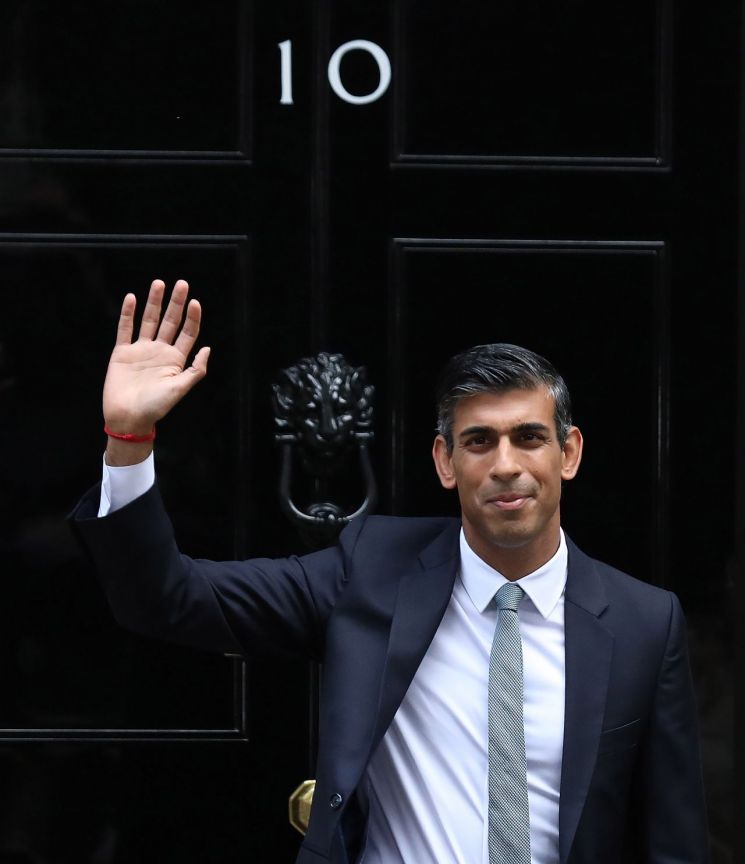
[Asia Economy Reporter Yujin Cho] One day after UK Prime Minister Rishi Sunak announced a tough stance against China, British Members of Parliament visited Taiwan. China strongly opposed the visit, calling it 'interference in internal affairs,' raising tensions between the two countries.
According to major foreign media including the BBC on the 1st (local time), members of the UK House of Commons Foreign Affairs Committee visited Taiwan for a 3-night, 4-day trip starting on the 29th of last month. The MPs met with Premier Su Tseng-chang on the day of their arrival, and a meeting with President Tsai Ing-wen is scheduled for the 2nd.
The UK government described the visit as a review of its diplomatic policy in the Indo-Pacific region, but foreign media interpreted it as a visit to support Taiwan's democracy rather than for pragmatic purposes.
Since US House Speaker Nancy Pelosi, the third highest-ranking official in the US power hierarchy, visited Taiwan in early August, the visit by the delegation of the Inter-Parliamentary Alliance on China (IPAC), formed recently to check China, to Taiwan on the 1st of last month reflects a consistent flow of support for Taiwan.
The BBC reported that the UK Foreign Affairs Committee discussed the increasing threat from China and domestic and international issues during this visit.
The visit by UK MPs came just one day after Prime Minister Sunak announced a strong China containment policy in his first major foreign policy speech since taking office. In his speech on the 28th of last month, Sunak declared, "The so-called golden era with China, accompanied by the naive belief that trade would lead to social and political reforms, is over."
He referred to China as a "systematic challenge" to the UK's values and interests and emphasized, "Short-term attitudes or hopeful thinking are not enough in the face of such challenges. We will make an evolutionary leap in our approach." This has been widely interpreted as viewing China no longer as an economic cooperation partner but as a potential threat.
China immediately reacted strongly. The Chinese Embassy in the UK stated that the visit by British MPs to Taiwan is a comprehensive interference in China's internal affairs and that it will respond strongly to anything that damages China's interests.
In a statement on the day, the Chinese Embassy said that despite China's firm opposition, the British MPs' visit to Taiwan blatantly violates the 'One China' principle and sends a seriously wrong signal to forces seeking Taiwan independence.
The two countries have clashed repeatedly over issues such as the Hong Kong National Security Law, Xinjiang Uyghur matters, and Taiwan. Amid China's enforcement of the Hong Kong National Security Law and the rise of anti-China sentiment triggered by COVID-19, tensions escalated during Boris Johnson's premiership when intelligence agencies suggested reviewing cooperation with China.
Recently, when a BBC journalist covering anti-zero COVID protests in China was detained and assaulted, the UK Foreign Office summoned the Chinese ambassador to protest strongly, further intensifying the confrontation.
© The Asia Business Daily(www.asiae.co.kr). All rights reserved.
![Clutching a Stolen Dior Bag, Saying "I Hate Being Poor but Real"... The Grotesque Con of a "Human Knockoff" [Slate]](https://cwcontent.asiae.co.kr/asiaresize/183/2026021902243444107_1771435474.jpg)











