NYT Highlights Low Wages of Myanmar Workers Producing World Cup Merchandise
Workers Demand Wage Increase, Suppressed by Military Forces... 26 Workers Also Fired
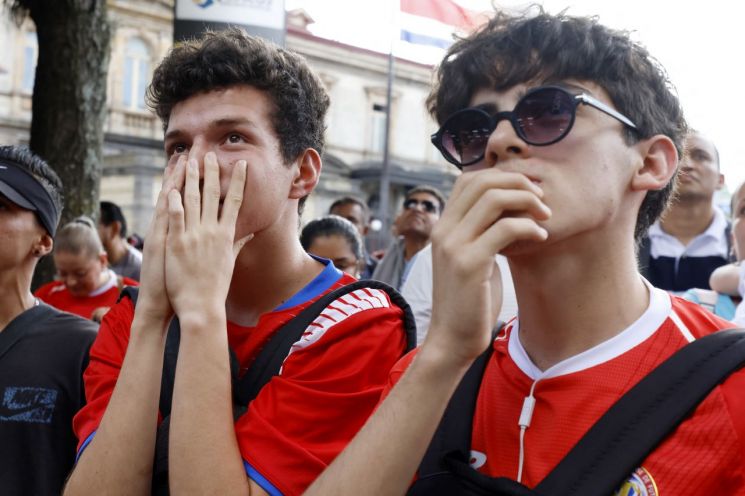 Fans dressed in soccer uniforms cheering for the Qatar World Cup. [Image source=Reuters Yonhap News]
[Asia Economy Reporter Kim Sung-wook] Reports have emerged that Myanmar workers producing products related to the Qatar World Cup are working for low wages of about 3,000 won per day. A single sports brand uniform top worn by soccer fans worldwide typically costs between $90 and $150 (approximately 118,000 to 196,000 won).
According to the New York Times (NYT) on the 1st (local time), as the Qatar World Cup opened last week and demand for soccer-related products surged, workers at the Pu Chen Group factory in Yangon, Myanmar, who are demanding improved working conditions, are facing harsh environments. About 7,800 workers supplying Adidas soccer shoes at this site reportedly receive a daily wage of 4,800 kyat (approximately 2,967 won). In Myanmar, where rice is a staple food, prices have soared since last year's coup, with the price of rice rising from 1,000 kyat per kilogram (about 707 won) to recently around 1,600 kyat (about 1,130 won).
These workers went on strike demanding better working conditions ahead of the World Cup but were forcibly suppressed by military forces. In October, 2,000 workers requested their daily wage be raised to about 4,941 won, but this resulted in the dismissal of 26 people, including 16 union leaders. Some workers told the NYT, "The Myanmar military government is exploiting opportunities at the factory to punish workers who joined the union during a time when it is trying to dismantle democratic structures."
Regarding the strike, Pu Chen Group told the NYT, "We comply with local laws and respect workers' collective bargaining rights." Adidas also stated, "Adidas strongly opposes these dismissals as violations of our workplace standards and workers' freedom of association," adding, "We are investigating whether the supplier's actions are lawful and are urging the immediate reinstatement of the dismissed workers."
Issues involving Southeast Asian garment workers producing soccer products have occurred before. At a garment factory in Cambodia, about 2,800 workers produce uniforms for Adidas and the British soccer team Manchester United. After forming a union in 2020 to improve working conditions, eight workers were dismissed. At that time, the factory management said they would reinstate four of them only if the union agreed not to fight for the reinstatement of other workers or for unpaid wages. Ultimately, the union reportedly signed an agreement relinquishing their rights.
Although the World Cup is a global festival, exploitation of workers repeatedly occurs behind the scenes. Earlier, in the host country Qatar, reports surfaced that more than 6,500 migrant workers involved in building World Cup stadiums lost their lives due to poor working conditions. Of Qatar’s 2.8 million population, only 380,000 are native Qataris, with the rest being migrant workers from India, Pakistan, Bangladesh, and other countries. Nevertheless, these workers reportedly suffered from low wages, wage arrears, and long working hours during the World Cup preparation period.
Tulsi Narayanasami, director of the Labor Rights Consortium, emphasized, "While there have been reports on the situation faced by migrant workers in Qatar, there has been a complete lack of focus on the severe human rights violations of garment workers producing World Cup products," adding, "Workers collectively standing up in factories to obtain better working conditions is a fundamental human right."
© The Asia Business Daily(www.asiae.co.kr). All rights reserved.

















