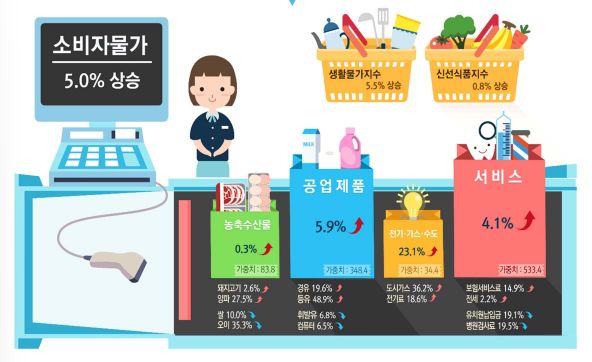
[Asia Economy Sejong=Reporters Kim Hyewon and Kwon Haeyoung] Last month, the consumer price inflation rate recorded 5%. Although it fell by 0.7 percentage points compared to the previous month, easing the upward trend, it still maintained a high inflation rate above 5%. The price increases of petroleum products and agricultural, livestock, and fishery products, which had driven inflation, slowed down.
According to the 'November Consumer Price Trends' released by Statistics Korea on the 2nd, the consumer price index last month was 109.10 (2020=100), rising 5.0% compared to the same period last year. This is the lowest inflation rate since April (4.8%).
The consumer price inflation rate rose to 6.3% in July, the highest since the foreign exchange crisis, then decreased to 5.7% in August and 5.6% in September, before increasing again to 5.7% in October.
Excluding October, which was affected by increases in electricity and gas charges, the inflation trend appears to have eased since peaking in July. However, it remains an unusual high inflation situation with the consumer price inflation rate exceeding 5% for seven consecutive months since May (5.4%).
By item category, prices of agricultural, livestock, and fishery products rose by 0.3%, significantly slowing from the previous month’s 5.2% increase. Agricultural products fell by 2.0%. This is the first time since May (-0.6%) that agricultural product prices have declined compared to a year ago. Vegetables also dropped by 2.7%.
Livestock products increased by 1.1%, and fishery products rose by 6.8%. The overall contribution of agricultural, livestock, and fishery products to the total inflation rate decreased from 0.46 percentage points in October to 0.03 percentage points.
Industrial products rose by 5.9%, continuing a slowdown from the previous month’s 6.3%. Petroleum products increased by 5.6%, and processed foods rose by 9.4%. The inflation rate for petroleum products has been declining from a peak of 39.6% in June to 35.1% in July and 10.7% in October.
Electricity, gas, and water prices rose by 23.1%, the same as the previous month (23.1%). The inflation rate for electricity, gas, and water reached the highest level since January 2010, when statistics began to be compiled following public utility fee hikes in October.
The inflation rate for personal services was 6.2%, slowing from 6.4% in the previous month. Dining out increased by 8.6%, and other personal services excluding dining out rose by 4.5%.
The core inflation rate, which excludes agricultural products and petroleum products and reflects the underlying inflation trend, remained at 4.8%, the same as the previous month, maintaining the highest level since February 2009 (5.2%).
Another core inflation indicator, the index excluding food and energy, rose by 4.3%, the highest since December 2008 (4.5%). The living cost index, which is composed mainly of frequently purchased items and closely reflects perceived inflation, increased by 5.5%, slowing from 6.5% in the previous month.
Oh Woonseon, Director of Economic Trend Statistics at Statistics Korea, said, "Industrial products such as processed foods, personal services including dining out, and electricity, gas, and water prices continued to rise sharply. However, the price increases of agricultural, livestock, and fishery products such as vegetables and industrial products like petroleum have significantly slowed, reducing the overall inflation rate compared to the previous month."
© The Asia Business Daily(www.asiae.co.kr). All rights reserved.

















