US and Europe Dominant 'BQ Siblings' Still at 1-3% in Korea
BA.5 Leading 6th Wave Now Driving 7th Wave
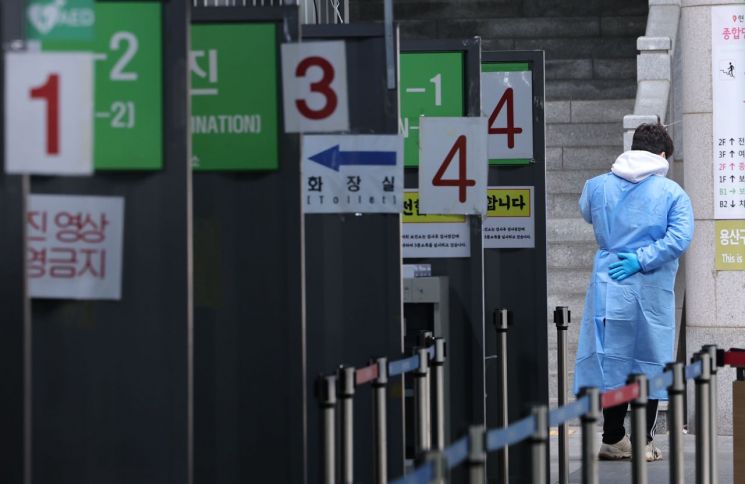
[Asia Economy Reporter Byun Seon-jin] This winter's 7th wave of COVID-19 shows a smaller scale and a shorter period to reach its peak compared to the previous summer wave. Analysts attribute this to the absence of newly dominant variants like BQ.1 and BQ.1.1, which have recently become prevalent in the US and Europe, while BA.5, which led the 6th wave, still maintains its presence domestically.
According to the Central Disease Control Headquarters on the 2nd, 57,079 new COVID-19 cases were reported the previous day. This is 2,003 cases (3.4%) fewer than the 59,082 cases reported a week earlier on the 24th of last month. For four consecutive days since the 28th, the number of new cases has been lower compared to the previous week. The infection reproduction number has remained above 1 for six consecutive weeks since the third week of October (16?22), but dropped to 1.01 in the fourth week of November (20?26), marking the lowest since the 7th wave began. A reproduction number above 1 indicates the spread of the epidemic.
Meanwhile, some analyses suggest that the 7th wave has reached or passed its peak within a month of its onset. According to the COVID-19 Mathematical Modeling Task Force (TF), Kwon Oh-gyu, head of the Public Data Analysis Team at the National Institute for Mathematical Sciences, predicted on the 30th of last month that the number of new cases, which was 67,415, would decrease by about 63% to 25,000 two weeks later (December 14). The research team led by Professor Lee Chang-hyung from the Department of Mathematical Sciences and Biological Mathematics Lab at Ulsan National Institute of Science and Technology (UNIST) forecasted that new cases would drop to 50,400 on the 7th and further decrease to 48,401 on the 14th. Professor Shim Eun-ha’s team from Soongsil University’s Department of Mathematics expects the numbers to plateau for a week before slightly declining, while Professor Jung Eun-ok’s team from Konkuk University anticipates a plateau lasting about a month.
This contrasts with the 6th wave, where new cases rose from 10,000?20,000 in early July to a peak of 180,000 on August 17. If the 7th wave is considered to have started at the end of October with new cases in the 30,000 range, it reached its highest point on the 22nd of last month with 72,860 cases and has since fluctuated below that level. The peak period has shortened by nearly a month, and the scale has decreased by over 100,000 cases.
Experts attribute the smaller scale of this winter wave, which is prone to 3Cs (closed spaces, crowded places, close-contact settings), to the absence of new dominant variants. Professor Jung Jae-hoon from Gachon University’s Department of Preventive Medicine explained, “All six previous waves were accompanied by the spread of new variant viruses. However, the 7th wave is still dominated by Omicron BA.5, which led the 6th wave.” According to the detailed lineage detection rate of Omicron in the fourth week of November (20?26), BA.5, although steadily declining, remains the dominant strain at 77.5%. The second most prevalent variant is BN.1, a new variant that emerged in September, accounting for 7.7%, while the 'BQ siblings' BQ1 and BQ1.1, which raised concerns about spread, remain at 1.2% and 3.8%, respectively.
The health authorities expect the threat of the COVID-19 epidemic to gradually decrease if this trend continues. The currently administered updated vaccines are designed to respond to BA.5, the dominant strain driving the wave. Since the start of the intensive winter vaccination period from the 21st of last month to the 18th of this month, vaccination rates have steadily increased. As of the 1st, the additional vaccination rates for those aged 60 and over and residents of infection-vulnerable facilities rose by 13.1 and 22.7 percentage points over the past month, reaching 20.5% and 26.7% of the target population, respectively.
The health authorities are increasing conveniences related to vaccination to raise the vaccination rates among those aged 60 and over and residents of infection-vulnerable facilities to 50% and 60%, respectively. For example, when presenting vaccination certificates at national and public facilities such as Bukhansan and Jirisan, visitors can receive a 30?50% discount on entrance and experience fees. Additionally, for residents of nursing hospitals and nursing facilities, legal representatives can now send photos for vaccination pre-screening forms without visiting the facility in person, facilitating vaccination.
© The Asia Business Daily(www.asiae.co.kr). All rights reserved.
![Clutching a Stolen Dior Bag, Saying "I Hate Being Poor but Real"... The Grotesque Con of a "Human Knockoff" [Slate]](https://cwcontent.asiae.co.kr/asiaresize/183/2026021902243444107_1771435474.jpg)
















