Easing Controls Amid Public Discontent... Lockdowns Only in High-Risk Areas
Sun Chunlan Urges Smooth Implementation of 'Optimized Epidemic Prevention'
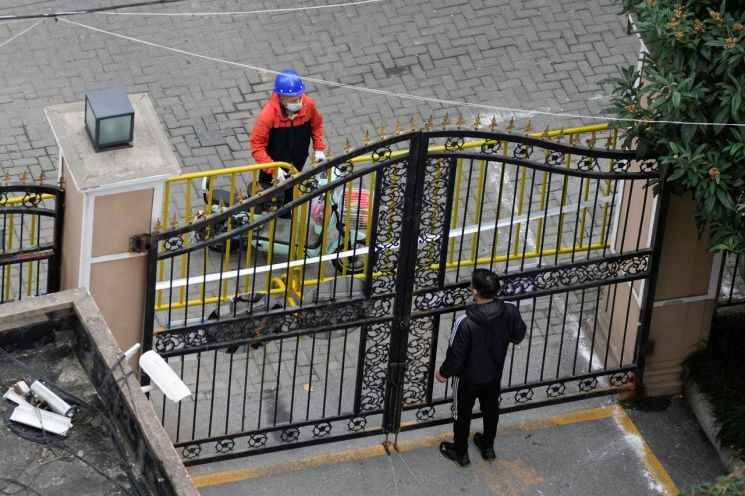 Citizens of Shanghai, China, talking across their gates during the COVID-19 lockdown. Photo by Yonhap News
[Asia Economy Reporter Lee Gyehwa, Intern] Major Chinese cities such as Guangzhou and Chongqing have begun easing COVID-19 lockdown measures. According to China's state-run Xinhua News Agency on the 1st, temporary COVID-19 controls that had been implemented in several areas including Guangzhou's Haizhu District, Tianhe District, and Panyu District have been lifted. Only buildings with confirmed COVID-19 cases are locked down as high-risk areas to minimize controlled zones, and lockdowns are lifted in low-risk areas that meet certain conditions.
Close contacts of confirmed cases subject to quarantine are being precisely classified, and citywide PCR testing for all residents will no longer be conducted. Most of the quarantine barriers installed on roads throughout downtown Guangzhou on the 30th of last month have been removed, allowing normal vehicle traffic. Guangzhou's health authorities stated, "We will conduct scientific and precise quarantine and PCR testing only in high-risk areas and accelerate vaccination rates."
Chongqing is also easing lockdowns in downtown areas by allowing population movement in small zones such as subdistricts (administrative units below districts) and apartment complexes where infection risk is low. Strict criteria for close contacts will be applied to avoid unnecessary people being quarantined, and self-isolation will be permitted instead of facility quarantine when conditions allow.
Shijiazhuang, the capital of Hebei Province, is also differentiating management of six locked-down districts according to local conditions and resuming production activities. Low-risk areas will reopen commercial facilities such as shopping malls, supermarkets, and hotels, and within a week, dining inside restaurants and operation of indoor public facilities will be permitted. Shenyang in Liaoning Province, which implemented lockdown-style quarantine measures on the 24th of last month, has also allowed indoor dining.
The background for Guangzhou and Chongqing, which recorded the highest daily new cases in China with around 8,000 infections this month, easing lockdowns is interpreted as a response to worsening public sentiment amid repeated protests against prolonged lockdowns. In Guangzhou's Haizhu District, residents broke through controls and fled en masse on the 23rd of last month. On the 29th, protesters opposing the lockdown clashed with riot police.
China's emphasis on the smooth implementation of the 20 optimized epidemic prevention measures, which focus on managing only COVID-19 outbreak areas intensively, also appears to have influenced this decision. Sun Chunlan, Vice Premier in charge of epidemic prevention, stated at a National Health Commission symposium the day before, "We must continuously improve epidemic prevention measures such as case identification, testing, treatment, and quarantine, and strive to stabilize the economy while preventing the spread of COVID-19," adding, "I urge the smooth implementation of the 20 optimized epidemic prevention measures."
© The Asia Business Daily(www.asiae.co.kr). All rights reserved.
!["The Woman Who Threw Herself into the Water Clutching a Stolen Dior Bag"...A Grotesque Success Story That Shakes the Korean Psyche [Slate]](https://cwcontent.asiae.co.kr/asiaresize/183/2026021902243444107_1771435474.jpg)
















