Hyundai Heavy's Unprecedented Triple-Company Strike
Strike Dates Set for June 6, 7, and 13 Amid Concerns Over Raw Material Supply Like Thick Plates
Conflict Deepens Over Base Pay Increase
Workers Suffered Low Wages During 7-8 Years of Prolonged Recession
Some Predict Labor's Double Strike
Possibility of Deal After Raising Demands
[Asia Economy Reporters Donghoon Jeong and Chaeseok Moon] As the Cargo Solidarity strike enters its eighth day, the unprecedented strike by the three Hyundai Heavy Industries Group shipyards (Hyundai Heavy Industries, Hyundai Mipo Dockyard, and Hyundai Samho Heavy Industries) has become visible. Concerns over raw material supply such as steel plates, combined with the union strike, have raised fears of disruptions in shipbuilding processes and delivery delays.
According to Hyundai Heavy Industries labor-management relations on the 1st, the unions of the three shipyards failed to reach an agreement with management and held a general strike resolution rally at Hyundai Heavy Industries' new headquarters in Seongnam, Gyeonggi Province the previous day, confirming strike schedules for the 6th, 7th, and 13th of this month. About 300 union members participated in the joint strike of the three shipyards, which lasted seven hours, marking the first time such a joint strike has occurred. The union plans to intensify the strike starting from the 6th, with 11,861 union members participating. The schedule includes a 4-hour joint strike on the 6th, rotating strikes from the 7th to the 9th, and a full strike on the 13th, gradually increasing the intensity. This year, the unions of the three shipyards have held more than 20 to 30 negotiation sessions with management respectively, but progress remains stalled.
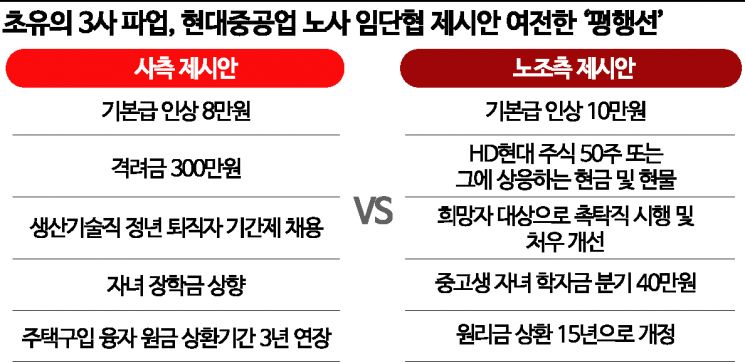
Kim Byungjo, head of policy planning at Hyundai Heavy Industries union, said, "The biggest point of contention with management currently is the basic wage increase." He added, "The union recently lowered its proposed basic wage increase to 100,000 KRW and entered negotiations, but opinions remain far apart." A Hyundai Heavy Industries official stated, "We are conducting focused negotiations with the union to find common ground," and "The company will do its best to communicate openly with the union and prepare an agreement."
On the 25th, Hyundai Heavy Industries management presented its first proposal of the year during wage and collective bargaining negotiations, but the union rejected it, saying it did not meet the expectations of the workers. The proposal included an 80,000 KRW increase in basic wages (including seniority increments), which is the highest level in the industry, and support for dental treatment expenses. The union has recently proposed a compromise plan including a 100,000 KRW basic wage increase.
Hyundai Heavy Industries is facing increased difficulties as it deals with the Cargo Solidarity strike, which raises concerns about the supply of raw materials such as steel plates, alongside the unprecedented strike by the three shipyards' unions. The prolonged Cargo Solidarity strike has made it difficult to procure materials like steel plates for shipbuilding, causing disruptions in shipbuilding processes and increasing the likelihood of delivery delays. An industry insider explained, "Since the Cargo Solidarity strike was anticipated early on, emergency materials were secured in advance, so there is no immediate supply issue," but added, "Starting early this month, inventory materials at shipbuilding subcontractors are expected to run out, raising concerns about the construction schedule."
The reason strikes by unions are occurring consecutively in the shipbuilding industry, which has just ended a long downturn of 7 to 8 years, is that most shipyard workers have faced restructuring and low wages during the period when shipbuilders suffered chronic deficits. The industry consensus is that the solution to this strike is a 'wage increase,' but shipbuilders, having just begun to escape deficit structures, lack the capacity, so they must also consider the possibility of prolonged confrontation. Another industry insider said, "If shipbuilders stop factory operations and delivery is delayed, escaping the deficit structure will become even more difficult," adding, "Negotiations and concessions for mutual growth are urgently needed."
Some view this strike as part of the labor movement's 'Winter Struggle (Dongtu).' The union's demands include difficult-to-accept items for management, such as introducing a labor director system with union nomination rights and providing quarterly 400,000 KRW education subsidies for children in middle and high school. There are also concerns that the labor side is raising demands in line with the overall political and governmental pressure stance of higher-level organizations, especially the Korean Confederation of Trade Unions (KCTU), which is estimated to cost about 250 billion KRW annually, and then negotiating a 'deal,' which is seen as more problematic.
© The Asia Business Daily(www.asiae.co.kr). All rights reserved.
![Clutching a Stolen Dior Bag, Saying "I Hate Being Poor but Real"... The Grotesque Con of a "Human Knockoff" [Slate]](https://cwcontent.asiae.co.kr/asiaresize/183/2026021902243444107_1771435474.jpg)

















