Labor Sector's 'Dongtu' Prolongation
Both Legislative Amendments Passed
Worst-Case Scenario 'Warning'
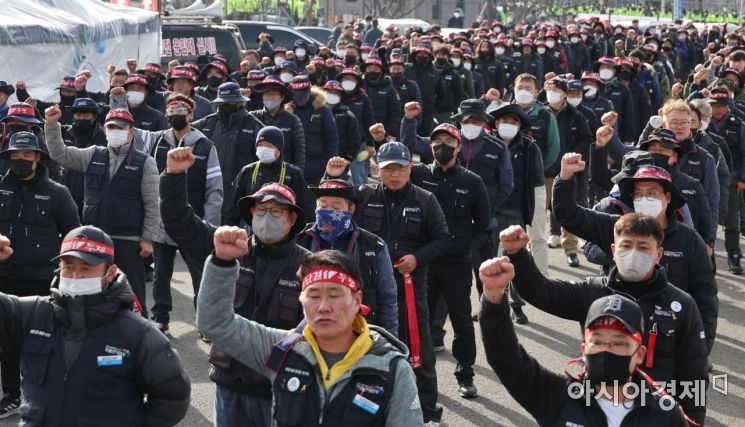 On the 29th of last month, when the government issued a work commencement order against the general strike by the Cargo Solidarity Headquarters of the Public Transport Union under the Korean Confederation of Trade Unions (KCTU), members of the Cargo Solidarity Seoul-Gyeonggi Regional Headquarters held a rally at the Inland Container Depot (ICD) in Uiwang, Gyeonggi Province, shouting slogans condemning the order.
 /Uiwang=Photo by Kim Hyun-min kimhyun81@
[Asia Economy Reporter Moon Chaeseok] As discussions on amending laws to expand the scope of the 'Yellow Envelope Act,' which encourages stronger labor union strike activities, and the 'Safe Freight Rate System,' which increases the cost burden on cargo owners, intensify, concerns within the industrial sector are growing. There are even voices suggesting the worst-case scenario where the 'Yellow Envelope Act + Safe Freight Rate System' bills might be amended simultaneously.
According to the industry on the 1st, the second negotiation between the Ministry of Land, Infrastructure and Transport and the Cargo Solidarity of the Korean Public Service and Transport Workers' Union (KPTU) under the Korean Confederation of Trade Unions (KCTU) broke down after just 40 minutes yesterday, escalating the labor-government conflict into a 'strong vs. strong' confrontation. The KCTU, the upper-level organization of the Cargo Solidarity, held an emergency central committee meeting at 2 p.m. yesterday and announced plans to hold a Safe Freight Rate System cultural event (on the 1st), a nationwide workers' rally (on the 3rd), and a general strike (on the 6th).
Yesterday, the unions of the three shipbuilding companies under Hyundai Heavy Industries Group (Hyundai Heavy Industries, Hyundai Samho Heavy Industries, and Hyundai Mipo Dockyard) also decided to go on strike simultaneously. This is widely viewed not merely as a company-level wage and collective agreement issue but as part of the labor sector's 'Winter Struggle' (Dongtu). The three companies' labor and management have held over 50 rounds of negotiations this year alone but have failed to reach an agreement. The union's demands include introducing a labor director system with union recommendation rights and providing quarterly education subsidies of 400,000 KRW for children in middle and high school?demands that the management finds difficult to accept. The industrial sector sees a bigger problem in the labor side's strategy of raising demands in line with the overall political and governmental pressure stance of the upper-level organization, especially the KCTU, aiming to 'deal' after escalating the level of demands beyond the estimated 250 billion KRW annual 'cost.'
The industrial sector is anxiously concerned whether the labor sector's 'Winter Struggle' will lead to the worst-case scenario of simultaneous enforcement of the 'Yellow Envelope Act + Safe Freight Rate System' amendments. The Yellow Envelope Act has already been pushed forward with the encouragement of Representative Lee Jae-myung, leading to a solo submission of the opposition party's amendment bill. Although the government declared it was 'considering abolition' of the Safe Freight Rate System, it managed to secure agreement from some ruling party members for a 'three-year extension,' achieving a certain level of success. Having achieved their first goal, the labor sector is highly likely to escalate their struggle to achieve the 'expansion of applicable items' through long-term struggle and political pressure. This is a much more advanced outcome than the discussions in June.
The business community was preparing for a 'labor law offensive' after the Daewoo Shipbuilding strike in June, but a sense of helplessness that 'all remedies are ineffective' is being sensed. While the Yellow Envelope Act has shown clear intentions for amendment not only from the KCTU but also from the Federation of Korean Trade Unions (FKTU) and political circles, the Safe Freight Rate System is no longer seen as merely an issue of the Cargo Solidarity under the KCTU by some complacent views. Even Jung Manki, Senior Vice President of the Korea International Trade Association and former Vice Minister of the Ministry of Trade, Industry and Energy, admitted at the 'Emergency Press Conference of Cargo Owners' Associations Regarding the Cargo Solidarity's Collective Transport Refusal' yesterday that "(the extension of the Safe Freight Rate System) involves the other party (labor) and is a matter decided by the political circles, so we cannot ignore this reality." When asked about follow-up measures among the six major economic organizations, he did not provide a clear answer.
© The Asia Business Daily(www.asiae.co.kr). All rights reserved.
![Clutching a Stolen Dior Bag, Saying "I Hate Being Poor but Real"... The Grotesque Con of a "Human Knockoff" [Slate]](https://cwcontent.asiae.co.kr/asiaresize/183/2026021902243444107_1771435474.jpg)
















