[Asia Economy (Sejong) Reporter Jeong Il-woong] Sejong City will implement the seasonal fine dust management system from this month until March next year.
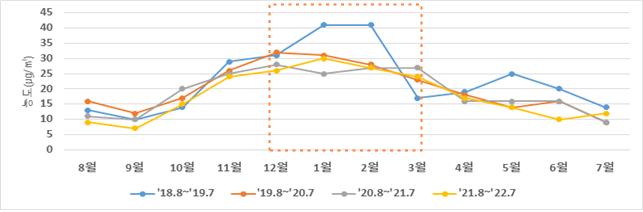
According to the city on the 1st, the average concentration of ultrafine dust in the region from December to March over the past four years was 28.6㎍/㎥, which is 43% higher than the annual average concentration of 20㎍/㎥.
High concentrations of fine dust usually occur due to a complex combination of meteorological conditions, foreign inflow, and domestic emissions.
In particular, from December to March, unfavorable meteorological conditions such as stagnant air cause more frequent days with high fine dust concentrations compared to other times.
Accordingly, the city has prepared and will promote 17 tasks across four sectors to reduce fine dust during the seasonal management period.
First, as a preemptive measure to prevent the increase of fine dust concentration, early reduction and management of fine dust at public workplaces and enhancing the effectiveness of the seasonal management system will be undertaken.
Additionally, to strengthen fine dust reduction by sector, the industrial and power generation sectors will increase voluntary reduction compliance at large-scale workplaces, intensify three-dimensional monitoring and crackdown on illegal emission sites, and strengthen power demand management.
In the transportation sector, pilot enforcement of seasonal management system driving restrictions, strengthened management of vehicles and private vehicle inspection centers, and enhanced enforcement of restrictions on the use of old construction machinery at construction sites will be implemented.
In the agriculture and daily life sectors, measures such as preventing illegal burning in rural areas, reducing dust from construction sites, reducing road dust, and managing fine dust intensive control zones will be carried out.
In the citizen health protection sector, inspections of multi-use facilities and strengthening indoor air quality management, as well as expanding inspections and support for sensitive and vulnerable groups, will be promoted. In the information provision sector, enhanced fine dust monitoring, expanded information provision, and increased citizen participation through promotional activities will be pursued.
Meanwhile, during the seasonal management period, if an emergency reduction measure is issued due to high concentrations of ultrafine dust, the operation of grade 5 vehicles will be restricted.
The driving restriction hours are from 6 a.m. to 9 p.m., excluding Saturdays and public holidays, and a fine of 100,000 KRW will be imposed for violations.
However, even grade 5 vehicles equipped with emission reduction devices or modified with low-emission engines are allowed to operate.
© The Asia Business Daily(www.asiae.co.kr). All rights reserved.

















