Government to Hold Public Hearing on Basic Plan for Space Development Promotion on the 30th
Sets Five Major Missions Including Expanding Space Exploration and Territorial Expansion
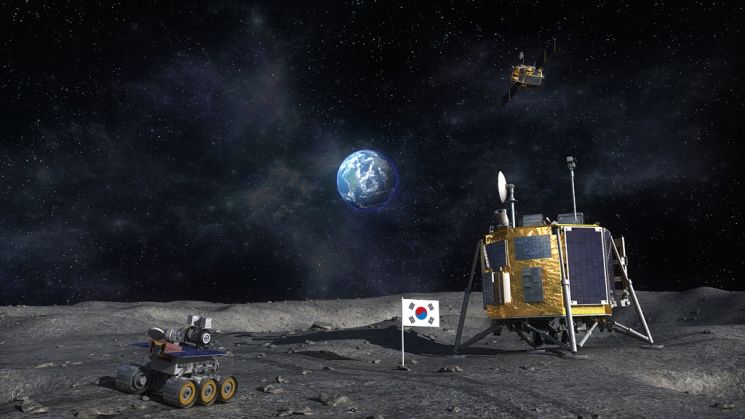
[Asia Economy Reporter Kim Bong-su] "Starting from the 2030s, we will actively explore space territories like King Gwanggaeto the Great of Goguryeo."
The government has unveiled a blueprint for space development plans over the next 30 years. Around 2035, it aims to participate in the lunar base construction led by major space powers, and by the 2050s, it envisions conducting manned space transportation as part of its space economy vision. On the 28th, President Yoon Suk-yeol revealed the 'Future Space Economy Vision,' announcing plans for a moon landing in 2032 and a Mars landing exploration in 2045, followed by discussions on a detailed space development roadmap.
The Ministry of Science and ICT held the 4th Space Development Promotion Basic Plan public hearing at the Korea Research Foundation Daejeon office on the 30th and announced these plans. According to the plan, South Korea has set five major missions: expanding space exploration, completing space transportation, creating space industries, establishing space security, and expanding space science. To achieve this, the space development budget, currently 734 billion KRW this year, will be significantly increased to 1.5 trillion KRW by 2027 and to around 2.1 trillion KRW in the 2030s.
In particular, the government decided to name the space exploration plan within the basic plan the 'Damdeok Plan,' after the conquering monarch King Gwanggaeto the Great of Goguryeo, symbolizing a strong will to actively pioneer space territories. To this end, it will secure foundational technologies and conduct lunar surface research through lunar probes.
Starting in 2035, the plan is to participate in lunar base construction activities as part of the Artemis project led by the United States, utilizing In-Situ Resource Utilization (ISRU) technology.
In the space transportation sector, the goal is to develop unmanned transportation systems by 2030 and establish manned transportation systems by 2050, positioning South Korea as the 'Space Transportation Hub of Asia.' Specifically, public and private launch sites will be established by 2030, and geostationary and manned launch sites by 2040. By 2050, the government aims to elevate the space industry to one of the top 10 key industries by collaborating with the private sector to create an initial space industry market and foster a self-sustaining domestic space industry ecosystem by 2030.
In the field of space security, surveillance and prediction capabilities will be advanced by 2030. By 2040, South Korea plans to enable international cooperation on par with advanced countries. In this process, South Korea also aims to contribute to the expansion of humanity’s space-related knowledge like advanced powers by securing multidisciplinary space science capabilities by 2030 and executing leading space missions by 2040.
Regarding space science research, the government plans to launch space telescopes and build ground-based optical and radio telescopes by 2040. To carry out these missions, the government will shift to a 'Space Development 2.0 Policy' that expands private sector participation and establishes a support system covering the entire industrial cycle to promote a self-sustaining private space industry ecosystem. To cultivate key personnel, space education will be strengthened at elementary, middle, and high school levels, and about 100 university space-focused research labs will be designated.
The government will also actively pursue advanced space technology acquisition. It plans to secure various launch vehicles suitable for diverse demands, including Nuriho, solid small launch vehicles, solid expandable launch vehicles, and next-generation launch vehicles. Launch site infrastructure will also be expanded. The first launch pad at Naro Space Center, previously used for Naroho launches, will be upgraded for next-generation launch vehicles. A new private launch site will be constructed in the Cheongseokgeum area near Naro Space Center to enable launches of solid and liquid small launch vehicles.
Meanwhile, the government sets a new Space Development Promotion Basic Plan every five years. As the highest legal plan in the space sector, it establishes the national mid- to long-term policy goals and directions for space development. The plan will be finalized after review by the National Space Committee by the end of this year.
© The Asia Business Daily(www.asiae.co.kr). All rights reserved.
![Clutching a Stolen Dior Bag, Saying "I Hate Being Poor but Real"... The Grotesque Con of a "Human Knockoff" [Slate]](https://cwcontent.asiae.co.kr/asiaresize/183/2026021902243444107_1771435474.jpg)
















