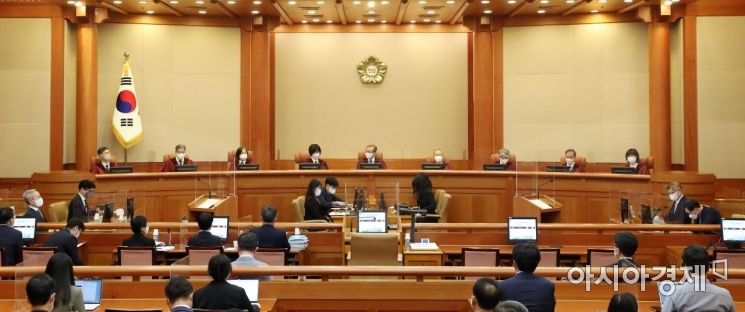
[Asia Economy Reporter Choi Seok-jin, Legal Affairs Specialist] The Constitutional Court has ruled that excluding remarried spouses of national cemetery interment subjects, such as national merit recipients, from joint burial does not violate the Constitution.
On the 30th, the Constitutional Court announced that it decided the constitutional review petition filed by Min, the child of Korean War casualty A, who challenged the proviso of Article 5, Paragraph 3, Subparagraph 1 of the National Cemetery Act, which prohibits remarried spouses from being jointly buried in the national cemetery, on grounds of gender discrimination, with a 5 (constitutional) to 4 (unconstitutional) vote.
A participated in the Korean War as a student soldier and died in action on June 27, 1951, and was interred in the national cemetery. A's wife, B, remarried on April 6, 1962, and died on December 30, 2004.
Min applied to the director of the Seoul National Cemetery to have his mother B buried jointly with his father A, who was already interred there, but the application was rejected on the grounds that B remarried after A's death and thus was not eligible for joint burial.
Subsequently, Min filed an administrative lawsuit seeking to cancel the director's refusal of joint burial. During the ongoing lawsuit, he requested a constitutional review of the National Cemetery Act provision excluding remarried spouses from joint burial, but after the request was dismissed, he filed a constitutional complaint with the Constitutional Court.
Article 5 (Subjects Eligible for Interment in National Cemeteries) Paragraph 1 of the National Cemetery Act states, "The remains or bodies of persons corresponding to the following categories shall be interred in national cemeteries. However, if the bereaved family does not wish for interment in the national cemetery, this shall not apply."
Paragraph 3 of the same article states, "The spouse of a person interred in a national cemetery pursuant to Paragraph 1 may be jointly buried upon the wish of the person or the bereaved family, and the conditions for the spouse are as follows," and Subparagraph 1 specifies, "The spouse at the time of the interment subject's death. However, if the spouse died and the interment subject remarried, the previous spouse is also included, but a spouse who married another person after the interment subject's death is excluded."
Under current law, a spouse who did not remarry after the interment subject's death is included as a joint burial candidate. If the spouse died before the interment subject and the interment subject remarried later, the previous spouse is included as a joint burial candidate. However, a spouse who remarried after the interment subject's death is excluded from joint burial.
Regarding the subject of the review, Min argued in his constitutional complaint that the termination of the marriage relationship between the remarried spouse and the interment subject was not due to divorce intending to end the marital life but due to the death of the interment subject. Therefore, restricting remarriage by depriving rights arising from the marital relationship because of remarriage violates Article 36, Paragraph 1 of the Constitution, which stipulates the state's obligation to guarantee marriage and family life.
However, the Constitutional Court ruled, "Since the provision under review does not prohibit the remarriage of the interment subject's spouse, the issue of violation of Article 36, Paragraph 1 of the Constitution is not relevant in this case."
Min also argued that considering that most interment subjects in national cemeteries have been male, allowing previous spouses to be jointly buried when the interment subject remarried but denying the remarried spouse of the interment subject the right to joint burial constitutes gender discrimination and violates the equality right under Article 11 of the Constitution.
However, the Constitutional Court stated, "The provision under review does not grant joint burial rights differently based on the gender of the interment subject," and thus did not consider the issue of gender discrimination under the equality right as subject to review.
The Constitutional Court concluded that the issue under review was whether the provision excluding remarried spouses of the interment subject after the subject's death from joint burial, thereby treating remarried spouses differently from spouses who did not remarry after the interment subject's death or previous spouses when the interment subject remarried after the spouse's death, constitutes manifestly unreasonable discrimination violating the principle of equality.
The Court stated, "The purpose of allowing joint burial of the interment subject's spouse under the National Cemetery Act is to honor the bereaved family of the interment subject and to commemorate the loyalty and meritorious spirit of the interment subject who sacrificed and devoted themselves to the nation or society," adding, "When defining the scope of those eligible for joint burial in national cemeteries, it is necessary to consider the aspect of honoring the interment subject through joint burial."
The Court explained, "In the case of a spouse who did not remarry after the interment subject's death, although the marriage with the interment subject is legally dissolved due to the interment subject's death, the spouse can be regarded as maintaining the substance of being the interment subject's spouse by preserving the kinship relationship with the interment subject's relatives without forming a new marital relationship until their own death."
It continued, "Also, when the interment subject remarried after the spouse's death, the previous spouse maintained the marital relationship with the interment subject until their own death. In contrast, a spouse who remarried after the interment subject's death formed a new marital relationship, terminating the kinship relationship mediated by the interment subject, and differs from a spouse who did not remarry after the interment subject's death or a previous spouse when the interment subject remarried in terms of maintaining the substance as the interment subject's spouse."
The Court further stated, "Determining eligibility for joint burial in the national cemetery based on the spouse at the time of death aligns with social conventions," adding, "Allowing a remarried spouse to return to the previously bereaved interment subject and be jointly buried, rather than the spouse at the time of their own death, contradicts the purpose of remarriage, which is to form a new marital relationship and terminate existing kinship relations."
In conclusion, the Court ruled, "The legislature had reasonable grounds to exclude remarried spouses after the interment subject's death from joint burial, and the provision under review is not manifestly arbitrary or unreasonable; therefore, it does not violate the principle of equality," and upheld the constitutionality of the provision.
On the other hand, Justices Lee Eun-ae, Lee Jong-seok, Lee Young-jin, and Kim Ki-young dissented, arguing that the provision violates the constitutional principle of equality.
The four justices pointed out, "When the military cemetery was elevated to a national cemetery in 1965, allowing joint burial of spouses for some interment subjects began, and in 1970, joint burial was allowed for all interment subjects, considering the aspect of honoring not only the interment subjects but also their bereaved families."
They added, "The contributions made by the interment subject's spouse by directly or indirectly assisting the interment subject do not retroactively disappear simply because the spouse remarries after the interment subject's death."
The justices stated, "The fact that the spouse contributed to the interment subject's contribution and sacrifice to the nation and society remains unchanged even after remarriage," and "Therefore, it is difficult to view as reasonable the blanket exclusion from joint burial in the national cemetery solely because the spouse remarried after the interment subject's death without considering such contributions."
They concluded, "Thus, excluding remarried spouses from joint burial solely because they remarried after the interment subject's death, without considering their contributions, constitutes unreasonable discrimination against remarried spouses and violates the principle of equality."
However, the justices noted, "Since the provision under review violates the principle of equality, it should, in principle, be declared unconstitutional. However, the scope within which remarried spouses' joint burial should be permitted is a matter for the legislature to decide after sufficient discussion."
For these reasons, the four justices recommended a constitutional discordance decision rather than a simple unconstitutionality ruling. They also stated that if the current law continues to be applied until revision, the unconstitutional ruling might not affect the case that triggered the ruling, and thus the application should be suspended until the law is amended, and the new law should be applied thereafter.
© The Asia Business Daily(www.asiae.co.kr). All rights reserved.

















