Prosecution for Official Violence under Special Act → Guilty Verdict for Official Violence in First Trial → Acquittal in Second Trial
Second Trial Upholds Lack of 'Intent' for Official Violence
Channel A Case Investigation Team Leader: "Some Prosecutors' Wrongful Prosecution... Must Be Held Accountable"
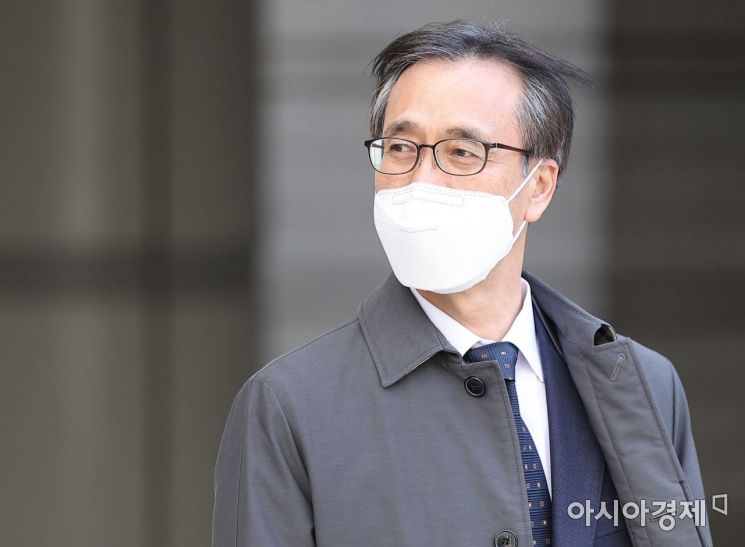 Jung Jin-woong, Research Fellow at the Judicial Research and Training Institute. / Photo by Hyunmin Kim kimhyun81@
[Asia Economy Reporter Choi Seok-jin, Legal Affairs Specialist] The acquittal of Jeong Jin-woong, a research fellow at the Legal Research and Training Institute (54, Judicial Research and Training Institute class 29), who was prosecuted for assaulting and injuring Minister of Justice Han Dong-hoon during a search and seizure operation, has been finalized.
The Supreme Court's First Division (Presiding Justice Park Jeong-hwa) dismissed the prosecution's appeal and upheld the lower court's verdict of not guilty in the final hearing for Jeong, who was charged with official assault under the Act on the Aggravated Punishment of Specific Crimes.
The court stated, "There is no error in the lower court's judgment that the prosecution failed to prove the victim's injury and the defendant's intent regarding official assault beyond a reasonable doubt, nor did it violate the principles of logic and experience or exceed the limits of free evaluation of evidence, nor did it misinterpret the law concerning intent and injury in official assault."
Jeong was non-detained indicted on July 29, 2020, on charges of assault causing injury (official assault under the Act on the Aggravated Punishment of Specific Crimes) for allegedly assaulting Minister Han during the seizure of a newly purchased mobile phone's SIM card following the first search and seizure by the prosecution.
At that time, Jeong, along with another prosecutor and four investigators, conducted the search and seizure on Minister Han. While reviewing the search warrant, Minister Han sought Jeong's permission to call his lawyer to have the lawyer participate in the execution of the search warrant. When Minister Han appeared to be unlocking his phone's password, Jeong mistakenly believed that Han was attempting to destroy evidence by deleting apps like KakaoTalk or Telegram on the phone. Jeong then forcefully tried to seize the phone from Minister Han, who was sitting on a sofa, causing both to fall to the floor, with Jeong pinning Minister Han down.
The prosecution, based on Minister Han's medical certificate, concluded that Han sustained injuries such as a ligament sprain in the neck requiring three weeks of treatment, applying the charge of official assault under the Act on the Aggravated Punishment of Specific Crimes.
Jeong was the chief prosecutor of the Criminal Division 1 at the Seoul Central District Prosecutors' Office, responsible for investigating the so-called 'Channel A coercion attempt' case, also known as the 'prosecutor-media collusion' case. Unusually, he personally went to the Legal Research and Training Institute's Yongin branch, where Minister Han worked, to conduct the search and seizure, which led to the incident.
Notably, then Minister of Justice Choo Mi-ae had stated, "There is more than enough evidence of (prosecutor-media collusion)," and Jeong had said, "We have secured many important pieces of evidence during the investigation, approaching the substantial truth of the (prosecutor-media collusion) case." Shortly after, Jeong, as the head of the investigation team, personally led the search and seizure to obtain additional evidence, leading to speculation within the prosecution that the investigation team had yet to secure decisive evidence.
In the first trial, the court found the prosecution's evidence insufficient to prove that Minister Han was injured, acquitting Jeong of the official assault charge under the Act on the Aggravated Punishment of Specific Crimes. However, the court convicted him of official assault under the Criminal Act, which does not require injury as an element, sentencing Jeong to four months in prison with one year of probation and one year of disqualification.
The court noted, "The defendant assaulted the victim based on a subjective judgment that the victim was attempting to destroy evidence, without exercising minimal caution as to whether the use of physical force during the execution of the search warrant was justified. Physical force against the body of the person subject to seizure must be strictly limited not only during detention but also during the execution of search warrants, making the defendant's actions highly blameworthy."
It added, "Moreover, the defendant has not reflected on his actions, claiming they were justified during the investigation and trial, and has made no efforts to restore the victim."
Article 4-2(1) of the Act on the Aggravated Punishment of Specific Crimes stipulates that if official assault under Article 125 of the Criminal Act causes injury, the offender shall be punished by imprisonment for not less than one year.
Article 125 of the Criminal Act (Assault and Cruel Acts) provides that a person performing duties related to detention, such as prosecutors or police officers, who assaults a criminal suspect shall be punished more severely than ordinary assault, with imprisonment of up to five years and disqualification for up to ten years.
In court, Jeong's defense argued that the 'duty' under Article 125 of the Criminal Act refers to duties related to detention, so it does not apply to acts committed during a search and seizure. They also claimed Jeong lacked intent for official assault, but these arguments were rejected.
They further argued that even if the elements of official assault were met, the act was justified under Article 20 of the Criminal Act, or that there was a mistake of fact regarding justification (a kind of error about the factual premise of justification), which negated intent. These claims were also rejected.
However, the verdict was overturned in the second trial.
The second trial court also rejected Jeong's other claims (related to duty, justification, and mistake of fact), but unlike the first trial, it found it difficult to recognize Jeong's intent or conditional intent for official assault and acquitted him.
The second trial court stated, "Based solely on the evidence submitted by the prosecution, it is difficult to conclude beyond reasonable doubt that the defendant had intent (including conditional intent) for official assault at the time of the incident. Therefore, the lower court's judgment is hard to accept. The defendant's appeal grounds pointing this out are valid."
The court noted that before the search and seizure, Jeong had been informed by investigators that Minister Han was expected to unlock his iPhone using facial recognition and immediately call his lawyer. When Minister Han appeared to enter his password, Jeong mistakenly thought he was deleting KakaoTalk or Telegram conversations or uninstalling apps. Thus, when Jeong first tried to seize Minister Han's phone, his intention was only to secure the phone to achieve the purpose of the search and seizure.
Although Jeong continued to try to seize the phone while both fell to the floor with their bodies overlapping and Minister Han pinned beneath Jeong, considering their positions and the height of the sofa, it was possible that Jeong lost balance while moving in the direction Minister Han was avoiding and fell onto Minister Han's body.
The court stated, "It cannot be ruled out that the force accompanying the defendant's fall combined with the victim's posture, who was reaching out with the opposite hand, caused both to slip from the sofa to the floor."
In conclusion, the court judged, "It is difficult to conclude that the defendant had the internal intention to recognize and accept the risk of causing physical force to the victim's body during the process of securing the phone."
However, the court pointed out, "Objective verification conducted immediately after the incident suggests that there was no attempt by the victim to destroy evidence, so the defendant's actions cannot be considered appropriate."
The Supreme Court also agreed with the second trial court's judgment.
Immediately after the Supreme Court's acquittal, Lee Jeong-hyun, a research fellow at the Legal Research and Training Institute and former first deputy chief prosecutor of the Seoul Central District Prosecutors' Office who led the 'Channel A coercion attempt' investigation team, issued a statement saying, "I express my respect and gratitude to the judiciary for delivering a wise judgment in accordance with law and justice against the wrongful prosecution by some prosecutors as the last bastion of justice."
He said, "The physical contact between former chief prosecutor Jeong Jin-woong and former prosecutor general Han Dong-hoon, the basic fact of this case, was an accidental incident that occurred during the lawful execution of public duties to additionally seize the SIM card of a mobile phone whose password was withheld by former prosecutor Han after being investigated for the Channel A prosecutor-media collusion suspicion case, as he did not cooperate with judicial procedures."
He added, "Nevertheless, former prosecutor Han, who was the suspect, defined the prosecutor's lawful execution of public duties as malicious 'power violence' with intent to undermine the legitimacy of the Channel A case investigation, reported it, and some prosecutors accepted this claim under circumstances difficult to understand and prosecuted it, but the case was acquitted by the judiciary's accurate judgment."
Lee emphasized, "Now is the time for responsible people in the Ministry of Justice and prosecution involved in this prosecution to apologize to former chief prosecutor Jeong Jin-woong and the public. Also, appropriate responsibility must follow for the investigation team that unjustly prosecuted by forcibly changing the lead prosecutor."
Meanwhile, Minister Han, who was investigated in the 'Channel A coercion attempt' case, was cleared of charges, and former Channel A reporter Lee Dong-jae, who was prosecuted, was acquitted in the first trial and is undergoing the second trial.
© The Asia Business Daily(www.asiae.co.kr). All rights reserved.

















