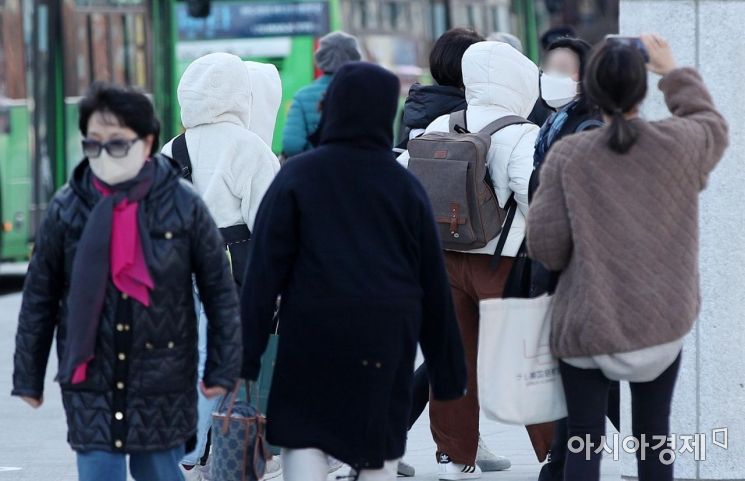
 On the 27th, when the morning low temperature dropped below freezing mainly in the central region, citizens dressed in thick clothes hurried their steps around Gwanghwamun Square in Seoul. Photo by Hyunmin Kim kimhyun81@
[Asia Economy Reporter Kim Young-won] The Korea Disease Control and Prevention Agency (KDCA) will operate a cold-related illness emergency room surveillance system until February next year. According to last year's operation results, about half of the reported cold-related illness patients were elderly aged 65 or older.
On the 30th, the KDCA announced that to monitor health damage caused by cold waves during the winter season, it will operate the cold-related illness emergency room surveillance system from December 1st this year to February 28th next year.
Cold-related illnesses are diseases caused directly by cold temperatures that harm the human body, including hypothermia, frostbite, and chilblains. Every year, the KDCA identifies patients with cold-related illnesses who visit emergency rooms with the help of medical institutions, public health centers, and local governments, and publishes the data on its website. This year, 492 medical institutions nationwide are participating in the surveillance system.
Last year, 300 cold-related illness patients were reported, a 30.7% decrease compared to 2020 (433 patients). By age group, the elderly aged 65 or older accounted for 47.0%, about half, and males (71.3%) outnumbered females.
Among the patients, 77.7% showed symptoms of hypothermia. By region, the highest number of reports came from Gyeongbuk (42 cases, 14.0%), Gyeonggi (35 cases, 11.7%), Gangwon (28 cases, 9.3%), and Gyeongnam (26 cases, 8.7%).
Most cases occurred during outdoor activities on roadsides, around residences, or in mountains, but 12.3% of cases occurred indoors or at home. Cold-related illnesses mainly occurred during the morning hours (0?9 a.m.) when temperatures drop, accounting for 42% of cases.
Additionally, 22.3% (67 patients) of those who visited the emergency room with cold-related illnesses were in a state of alcohol intoxication. There were nine deaths due to cold-related illnesses, all presumed to be caused by hypothermia.
To prevent cold-related illnesses, it is recommended to maintain an appropriate indoor temperature (18?20℃) and, when going outside, check the perceived temperature in advance and wear gloves, scarves, hats, and masks. When core body temperature, which is the temperature of internal organs or muscles, drops below 35℃ causing hypothermia, the person should be wrapped in a blanket or sleeping bag, and wet clothes should be removed. If the person is unconscious, call 119 (emergency services), and if conscious, it is recommended to warm the body with warm drinks.
Baek Kyung-ran, head of the KDCA, said, "This winter, due to large temperature fluctuations and the possibility of a sharp drop in temperature as forecasted by the Korea Meteorological Administration's winter climate outlook, it is necessary to prepare for cold-related illnesses caused by sudden cold spells."
© The Asia Business Daily(www.asiae.co.kr). All rights reserved.

















