After Ghana Match Defeat, Some Netizens Use Abusive Language on Son Heung-min's SNS
Some Famous Stars and Athletes Suffer from Fans' Defamation and Even Take Their Lives
Baseless Defamation and Malicious Comments Can Be Prosecuted as Insult Crimes... Only Light Punishments Given
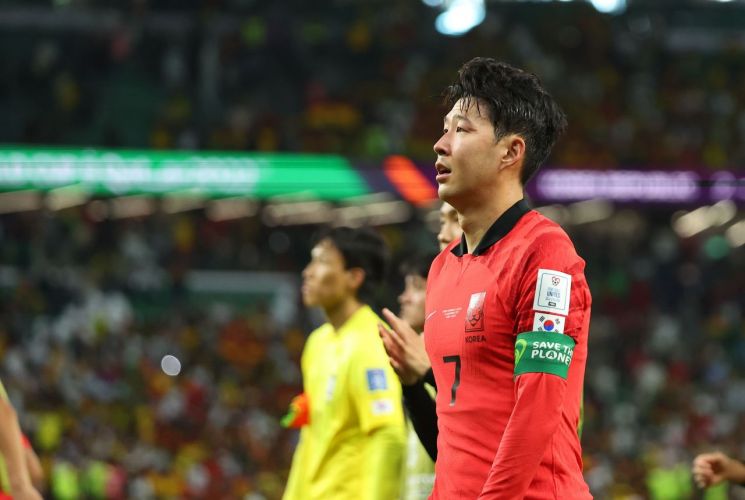 On the afternoon of the 28th (local time), at the Education City Stadium in Al Rayyan, Qatar, during the second match of Group H in the 2022 Qatar World Cup between South Korea and Ghana, South Korea lost 2-3. Son Heung-min of South Korea is showing his disappointment. Photo by Yonhap News
[Asia Economy Reporter Han Seung-gon] "Focus on football!" "Don't you want to score a goal?" "Let's never see you on the national team again!"
Excessive malicious comments are pouring in targeting Son Heung-min (30, Tottenham Hotspur), captain of the South Korean national football team. Experts emphasize that these malicious comments are a form of hate speech rather than legitimate opinions, and urgent measures to regulate them are needed. FIFA has announced that it will request investigations if specific players are targeted with criticism via social media during the World Cup to protect the players.
On the 28th (Korean time), Son Heung-min started as a left winger in the second group stage match against Ghana in Group H of the 2022 Qatar World Cup and played actively, but the team lost 2-3, facing the risk of elimination in the round of 16. After the match, Son said, "I am full of regret and sorry to the fans who cheered for us."
However, some fans flooded Son Heung-min's social media with malicious comments. They criticized him harshly, saying he should not play in the match and blaming the captain for failing to score. In response, Oh Jae-won, former captain of the Doosan Bears, posted screenshots of netizens' malicious comments on his Instagram on the 29th, expressing strong emotions by saying, "Do you want to die, seriously?"
The issue of malicious comments targeting sports players, celebrities, and other public figures has been consistently pointed out as a social problem. Singer Sulli, who suffered from malicious comments, was found dead at her home in Seongnam, Gyeonggi Province, in October 2019. Subsequently, to eradicate malicious comments, comment sections on entertainment and sports articles on portal sites were closed in August 2020.
However, the problem of malicious comments continues, such as indiscriminately attacking players on their personal Instagram accounts. In August last year, volleyball player Kim In-hyeok appealed, "I thought ignoring the misunderstandings I've heard for over 10 years was the answer, but I am tired too. Please stop the malicious comments that have tormented me for years. It's hard to endure." Eventually, he was found dead at his home in February this year. According to the police, there was no evidence of homicide.
In the case of archer An San, who won gold medals consecutively in the mixed team event and the women's team event in August last year, some netizens flooded her SNS with malicious comments simply because they did not like her hairstyle. In some male-dominated online communities, An San was labeled a feminist because of her short hair and attendance at a women's university, although she has never identified herself as a feminist.
Baseless slander or malicious comments can be punished under the Information and Communications Network Act as defamation or insult. However, the penalties are mostly light, such as suspension of prosecution or minor fines, effectively 'soft punishments.' According to police statistics, only 43 people were arrested for cyber defamation and insult crimes from 2017 to June last year. Given this situation, the so-called 'Anti-Malicious Comment Act' was proposed in the National Assembly in 2019 but was discarded due to lack of proper discussion before the term expired. In the 21st National Assembly, a partial amendment to the Information and Communications Network Act, including the introduction of an internet semi-real-name system and strengthening penalties for malicious comments, was proposed but has seen no follow-up discussions.
Experts suggest strengthening penalties for malicious comments and establishing related regulations for platform operators who provide comment spaces. At a forum titled "Neglected Hate: Will We Leave Online Violence As It Is?" held at the National Assembly in Yeouido, Seoul, on February 17, Professor Kim Min-jung of Hankuk University of Foreign Studies (Department of Media Communication) said, "The increase in hate speech is a global phenomenon, but in South Korea, accumulated dissatisfaction and despair due to worsening inequality are expressed as online violence," adding, "Recently, Japan ruled the Hate Speech Ban Law constitutional, so South Korea should also regulate neglected hate speech through legislation like a broken window."
Professor Yoo Seung-hyun, a special professor at Hanyang University Graduate School of Media and Information, emphasized, "As the forms of violence on online platforms diversify into defamation, bullying, etc., the key to stopping this vicious cycle ultimately lies with platform operators," and added, "Platform operators must take social responsibility and actively regulate harmful posts by deleting them and establishing policies to stop economic benefits."
Meanwhile, during the World Cup, those who post malicious comments about football players on social media can be punished. FIFPRO, the International Federation of Professional Footballers, announced on the 17th that it will provide a service to monitor the social media accounts of players participating in the World Cup in real time and report hate speech and other harmful expressions.
FIFA President Gianni Infantino said, "I am pleased to launch a service that can protect players from the mental harm caused by social media posts." FIFPRO President David Aganzo stated, "It is our responsibility to prevent players from facing violence both on and off the field." They said that if insulting remarks toward players are found on social media during the World Cup, they will notify the respective social media platform companies and the police to take legal action. Additionally, users who write malicious comments will be immediately blocked and isolated from the players or teams. Malicious commenters may also face restrictions on using the social media platform. However, it remains uncertain whether FIFA's reporting will lead to substantial punishment for those who write defamatory or insulting comments.
© The Asia Business Daily(www.asiae.co.kr). All rights reserved.

















