Partial Opposition to Using Education Tax Solely for Higher Education
Reaffirming Existing Position on Enacting Higher Education Finance Grant Act
Vocational High Schools to Train 4,050 Semiconductor Experts Over 10 Years
Expansion of Curriculum-Linked Education Including Bicycle Safety Classes
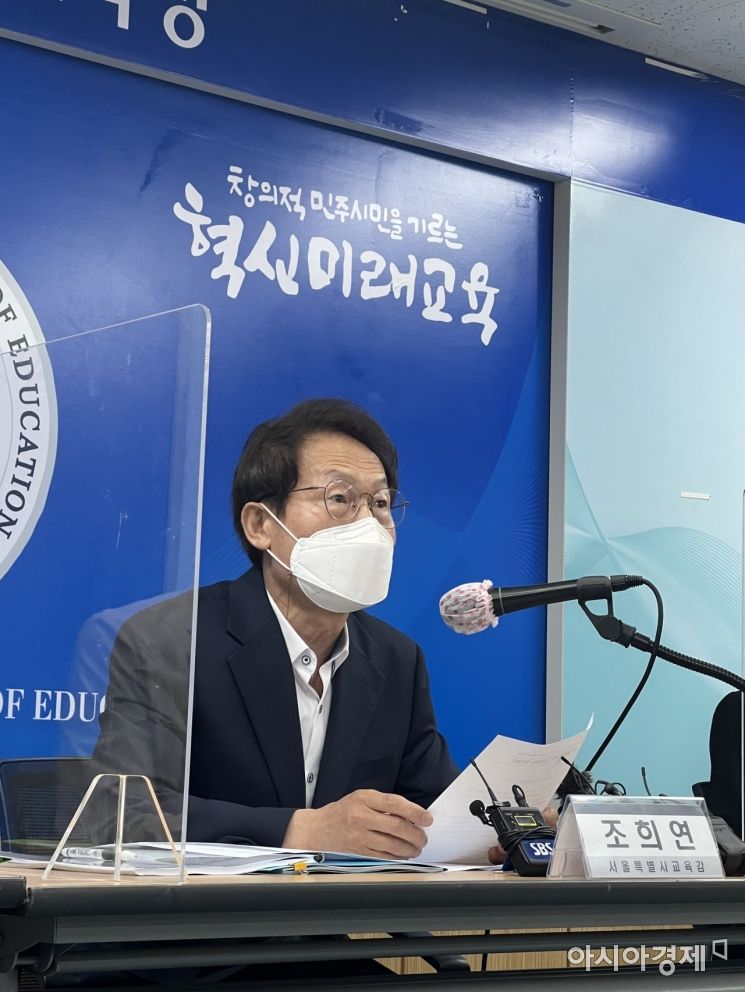
[Asia Economy Reporter Han Jinju] Cho Hee-yeon, Superintendent of Seoul Metropolitan Office of Education, stated on the 30th that he "opposes even temporarily diverting a portion of the Local Education Finance Grants, currently used for elementary and secondary education funding, to support higher education finance through the establishment of a Higher and Lifelong Education Special Account."
At a press conference held at the Seoul Metropolitan Office of Education that day, Superintendent Cho emphasized regarding the establishment of the Higher and Lifelong Education Special Account, "If there is room in the elementary and secondary education budget, I hope it will be invested in making after-school classes and other compulsory elementary and secondary education completely free," adding, "Using it for the actualization of early childhood, elementary, and secondary education and the complete free provision of compulsory education aligns with parents' demands."
The government is promoting a plan to use the education tax transfer portion of the Local Education Finance Grants for higher education accounts to resolve the financial difficulties of higher education. The Local Education Finance Grants are funded by 20.79% of domestic taxes and a portion of the education tax. Except for the transfer to the Early Childhood Education Support Special Account for supporting early childhood education and childcare fees, the rest is the grant resource. The education tax resource amounts to about 5 trillion KRW annually, with 3 trillion KRW per year planned to be incorporated into the special account and invested in university education.
Regarding the discussions in the National Assembly about compromise plans related to the reform of the grants through the ruling and opposition party council, Superintendent Cho said, "There are strong voices of opposition ahead of the budget passage by the weekend, so we are watching what conclusion will be reached during the National Assembly budget agreement process," but also explained, "I consider it somewhat desirable that consideration is being given to diverting the rest of the funds except for the Nuri Curriculum budget." Recently, the National Assembly Education Committee agreed to extend the deadline of the 'Early Childhood Education Support Special Account' (Yuteuk Account), which funds the Nuri Curriculum for ages 3 to 5, by three years.
The Association of Metropolitan and Provincial Superintendents of Education forecasted that from 2023 to 2025, an additional 62 trillion KRW will be required beyond the regular operating expenses such as school operating costs and personnel expenses of metropolitan and provincial offices of education.
In response, Superintendent Cho explained, "The reason why seismic reinforcement, asbestos removal, and reconstruction of aging schools are not being carried out comprehensively and funds are being accumulated in the Financial Stabilization Fund and Environmental Improvement Fund is due to difficulties in recruiting personnel in the construction and facility sectors to carry out these tasks."
He continued, "I wonder if the government could grant administrative autonomy or provide temporary measures to solve the shortage of execution and technical personnel for comprehensive environmental improvements, thereby enabling a full-scale approach to school environment improvement."
Seoul Vocational High Schools to Train 4,050 Semiconductor Talents by 2031
The Seoul Metropolitan Office of Education also announced plans to nurture more than 4,000 semiconductor specialists over ten years through credit system operation and designation of semiconductor hub schools in vocational high schools.
The demand for new semiconductor high school graduates is expected to expand from the current 44,000 to 78,000 by 2031. The Seoul Metropolitan Office of Education aims to train 4,050 students over ten years in vocational high schools. Currently, semiconductor-related departments are established in 19 vocational high schools in Seoul.
The Office plans to expand advanced courses within departments and interdepartmental curricula to cultivate semiconductor talents in vocational high schools. They will operate detailed major courses within departments linked to the NCS (National Competency Standards)-based curriculum to nurture talents. Students from other departments will also be given opportunities to select and complete semiconductor department subjects to foster convergence talents. Support will be provided to allow semiconductor departments to be taken as a minor (24 credits) for advanced study.
Shin Sang-yeol, Director of Career and Vocational Education at the Seoul Metropolitan Office of Education, explained, "Not only bachelor's degree holders are needed to make semiconductors; even at the high school level, assisting in design is possible," adding, "We plan to organize learning modules focusing on NCS levels 3 and 4."
For subjects difficult to open within schools, practical training will be provided using infrastructure outside schools, and the credit recognition system will be expanded to allow up to 32 credits to be earned. Theoretical and basic subjects will be taught at schools, while practical training in materials, parts, equipment, and facilities will utilize infrastructure installed at universities or industries.
The Office will designate a total of six 'Semiconductor Hub Schools' by 2025. They will support the establishment of departments such as Semiconductor Machinery and Semiconductor Electronics, reorganize curricula, and provide consulting on operation plans. Support will also be given for developing student textbooks and utilizing current engineers as industry-academic concurrent teachers or specialized subject part-time instructors. Customized curricula will be shared through mutual joint curricula or consortium campus-type joint curricula among hub schools.
An 'AI (Artificial Intelligence) Convergence Career and Vocational Education Center' will be established to oversee career and vocational education for students, teachers, and parents, concurrently nurturing semiconductor specialists. Basic and foundational semiconductor education will be strengthened, and semiconductor literacy education will be conducted. A provisional Semiconductor Education Support Group composed of current and former field experts will be formed to be utilized by the education office and individual schools.
Expansion of Bicycle Education... 'Bicycle Safety Classes' in Seoul Elementary Schools by 2025
The Seoul Metropolitan Office of Education plans to strengthen bicycle education in elementary, middle, and high schools starting next year ('Integrating Bicycle Riding Education into Public Education' and the Bicycle Riding Education Plan).
Superintendent Cho said, "The reality is that bicycle riding and safety education at schools have not been systematically conducted due to issues such as securing and maintaining educational bicycles," adding, "We will solve these problems and expand bicycle education. We will secure continuous momentum to further activate bicycle education."
By 2025, all elementary schools in Seoul will conduct 'Visiting Bicycle Riding Safety Classes' under instructor guidance, providing bicycles and safety equipment. Middle schools will expand bicycle sports club operations within the curriculum, and high schools will support bicycle club activities. Pilot schools will be operated to promote everyday bicycle riding, and various projects such as indoor cycling activity support and development and certification of bicycle competency indices will be carried out.
Kim Jin-hyo, Director of Physical Education, Health, Culture, and Arts at the Seoul Metropolitan Office of Education, explained, "The plan is to promote projects linked to the curriculum, such as bicycle safety classes for elementary students, sports clubs for middle school students, and creative experiential activity clubs for high school students within public education," adding, "The bicycle safety classes will expand to 160 schools this year, 320 next year, and 640 the year after, targeting all schools. We plan to support 3 to 4 instructors per class to ensure safety while providing education."
© The Asia Business Daily(www.asiae.co.kr). All rights reserved.
![Clutching a Stolen Dior Bag, Saying "I Hate Being Poor but Real"... The Grotesque Con of a "Human Knockoff" [Slate]](https://cwcontent.asiae.co.kr/asiaresize/183/2026021902243444107_1771435474.jpg)
















