Cargo Solidarity Collective Transport Refusal (General Strike) Continues for a Week
Representatives of Each Industry's Principal Organizations Appeal Not Only Against the Expansion of Safety Freight Rate Items but Also for Their Complete Abolition
[Asia Economy Reporters Sunmi Park and Chaeseok Moon] As the Cargo Solidarity's collective transport refusal (general strike) continues for a week, causing industrial losses to soar into the trillions of won, representatives of major shipper organizations across various industries are appealing not only against the expansion of items under the Safe Freight Rate System but also for its complete abolition.
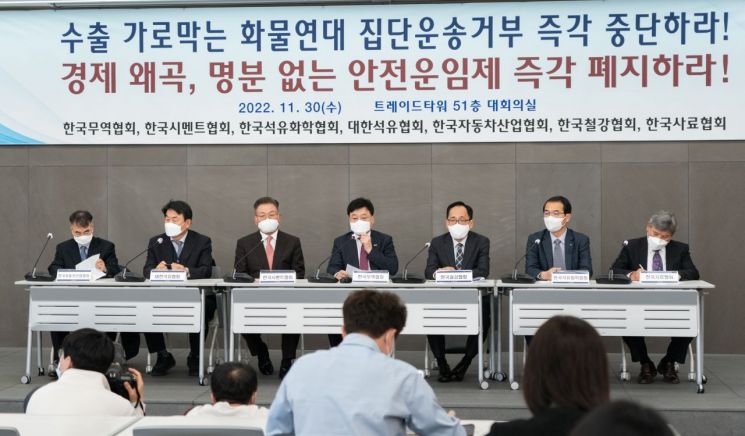
At a press conference on the Cargo Solidarity general strike held on the 30th by the Korea International Trade Association together with various shipper organizations, attendees urged the immediate cessation of the general strike, which is causing direct economic losses amounting to trillions of won, and called for the abolition of the Safe Freight Rate System. Above all, shipper organizations believe that the current Safe Freight Rate System has failed to achieve the intended effects of its introduction.
They argue that despite the system’s original purpose to improve issues such as overwork, overloading, and speeding, it has degenerated into a continuous means of raising freight rates and fails to reflect diverse market conditions, highlighting the need for system reform. In particular, the cement industry calls for a fair composition of the Safe Freight Rate Committee and securing objectivity in cost investigations by structuring the committee (3 shippers, 3 truck owners, 3 transport companies, 4 public interest members) so that the number of members representing service demanders (shippers) and suppliers (truck owners and transport companies) is equal, and for reasonable mediation by public interest members and the government.
They also proposed maintaining only the safe entrusted freight rate paid to truck owners while abolishing the safe transport freight rate to allow freight rates to be determined through market competition among transport operators.
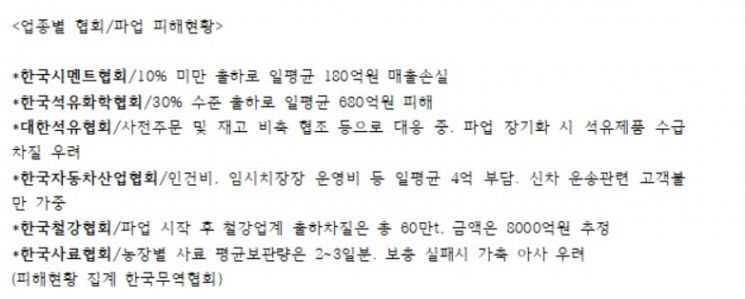
Lee Chang-ki, Vice Chairman of the Korea Cement Association, said at the meeting, "The cement industry, which is subject to the Safe Freight Rate System, has borne a burden of a 35% increase in transportation costs over the past three years since the system’s implementation," adding, "The system should be improved so that the individual intentions of market participants are respected, prices are determined in the market based on consensus, and the price function works positively." The cement industry estimates that due to the current general strike, shipment volumes have fallen to less than 10% of normal weekday levels, resulting in daily sales losses of approximately 18 billion won.
The Korea Automobile Manufacturers Association openly opposed the application of the Safe Freight Rate System to the 'automobile' sector. They expressed concerns that rising direct and indirect costs of automobile exports amid labor rigidity and various regulations weakening production competitiveness could lead to decreased domestic production and exports. Furthermore, frequent strikes due to annual wage and collective bargaining negotiations in the automobile industry could be exacerbated by the Safe Freight Rate System, potentially spreading damage to parts suppliers. The automobile industry estimates that the strike is causing a daily burden of about 400 million won in labor costs and temporary storage operation expenses.
The Korea Iron and Steel Association also strongly argued that applying the Safe Freight Rate System to steel products is difficult. Since logistics costs are much higher for small and medium-sized or micro enterprises that distribute and process steel products than for large manufacturers, the increased logistics costs due to the system could weaken the competitiveness of small and micro steel processing companies. Steel logistics characteristics affecting transportation costs?such as company size, transport units (5?25 tons), and ease of loading and unloading?are diverse, making standardization difficult as the products are divided into at least ten categories, which is another factor complicating the application of the Safe Freight Rate System.
Heo Dae-young, head of the Korea Iron and Steel Association, said, "The steel industry is estimated to have suffered shipment disruptions totaling 600,000 tons and losses amounting to 800 billion won due to the strike," adding, "Since steel is a basic material, shipment disruptions in steel products could spread to related industries such as construction, automobile, and shipbuilding, causing production setbacks. Especially as the industry is still recovering from the typhoon damage in September, the ongoing transport refusal is causing even greater concern."
The Korea Petrochemical Industry Association and the Korea Petroleum Association urged the strike to stop, expressing concerns that shipment disruptions starting on the 28th could expand to reduced operating rates or facility shutdowns over the weekend. Currently, only about 30% of the industry's average daily shipment volume of 74,000 tons (approximately 97 billion won) is being shipped, with estimated daily losses around 68 billion won.
Moreover, due to recent sluggish business conditions, factories are operating at only about 80% capacity, making further adjustments difficult; thus, a complete halt in shipments would inevitably lead to factory shutdowns. Kim Pyeong-jung, head of the Petrochemical Association, pointed out, "Exports are mainly conducted using containers, but container drivers are not shipping, and all ports are blocked," adding, "Exports are not functioning normally, and if this continues, factory operations will also be affected." The Korea Feed Association also expressed concerns about livestock starvation if the Cargo Solidarity's general strike prolongs.
© The Asia Business Daily(www.asiae.co.kr). All rights reserved.


















