Seoul City Deploys Replacement Workers... No Major Disruptions Yet
National Railroad Union Plans General Strike in Two Days... Traffic Inconvenience Expected to Worsen
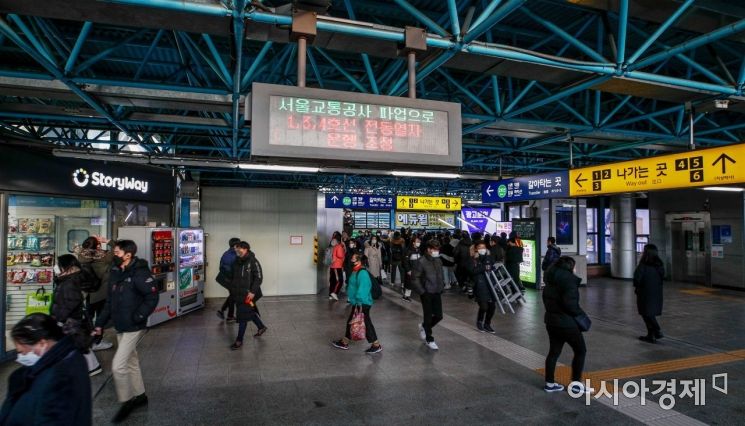 On the 30th, Seoul Metro, operated by Seoul Transportation Corporation, went on strike, causing delays in subway operations. A notice related to the strike is displayed on the electronic board at Sindorim Station in Guro-gu, Seoul. Photo by Kang Jin-hyung aymsdream@
"Due to the strike, train intervals have been adjusted except during rush hours, so citizens are advised to take note." Around 8:30 a.m. on the 30th at Seoul Gongdeok Station, announcements about the total strike by the Seoul Metro Union were continuously broadcast. Commuters transferring from Line 6 to Line 5 started running even on the escalators to avoid missing their trains. However, the total strike did not cause major disruptions during rush hours. Most subway lines maintained their usual intervals of about 5 minutes. Office worker Choi (29) said, "I left about 20 minutes earlier because of the total strike, but I didn't experience much inconvenience," adding, "I'm worried that if the strike continues, it might eventually disrupt commuting."
The Seoul Metro Union announced that they began a total strike from around 6:30 a.m. during daytime working hours. This is the first strike in six years since the 2016 strike opposing the performance-based pay system, covering Lines 1 to 8 operated by Seoul Metro. Approximately 13,000 union members are participating in this strike, including about 11,000 from the Seoul Metro Union and 2,000 from the integrated union. However, as the subway is an essential public service under relevant laws, only about 9,700 members, excluding essential personnel, are participating in the strike on weekdays.
The day before, the Seoul Metro Union engaged in last-minute negotiations with management but failed to narrow differences over the workforce reduction plan. They struggled until 10 p.m., but management stated that there was no option other than a temporary suspension. Seoul Metro had announced a plan to reduce about 1,539 employees, approximately 10% of the total workforce, by 2026. The union criticized the workforce reduction, saying, "It jeopardizes citizen safety," and added, "It goes against the societal demand for strengthened safety measures following the Sindang Station and Itaewon disasters."
Seoul City deployed about 13,000 replacement workers to ensure normal subway operations during rush hours. However, due to limitations in manpower deployment, the city aims to maintain about 72.7% of normal service during less crowded daytime hours and about 85.7% during evening rush hours.
Although there was no major disruption during the morning commute, some citizens reported inconveniences on certain subway sections. Around 7 a.m., the northbound Line 1 (towards Soyosan) was delayed by about 8 minutes, and the southbound Line 1 (towards Cheonan and Incheon) was delayed by about 5 minutes. Office worker Jung (34) said, "I left as usual because I heard normal operations were in place this morning, but the Line 1 subway was late," adding, "I'm upset because I couldn't make it on time for work." However, a Seoul Metro official explained, "The delayed sections are operated by Korea Railroad Corporation (KORAIL), so the nationwide railroad union's legal strike had a significant impact." The nationwide railroad union, which includes KORAIL, has been conducting a legal strike since the 24th, causing some general trains like Mugunghwa and Saemaeul to be delayed by an average of over 30 minutes, with the longest delay reaching 98 minutes.
If the nationwide railroad union joins the total strike as scheduled on December 2, a transportation and logistics crisis is expected to be unavoidable. The nationwide railroad union operates about 80% of Seoul Subway Line 1, 25% of Line 3, and 30% of Line 4, which will inevitably increase inconvenience for commuters during rush hours.
© The Asia Business Daily(www.asiae.co.kr). All rights reserved.
![Clutching a Stolen Dior Bag, Saying "I Hate Being Poor but Real"... The Grotesque Con of a "Human Knockoff" [Slate]](https://cwcontent.asiae.co.kr/asiaresize/183/2026021902243444107_1771435474.jpg)
















