Geonjeongyeon '2023 Construction and Housing Market Outlook Seminar'
'Financialization of Real Estate' Deepens... Domestic and External Uncertainties Increase
Government "Two-Track Response to Financial and Real Economy Complex Crisis"
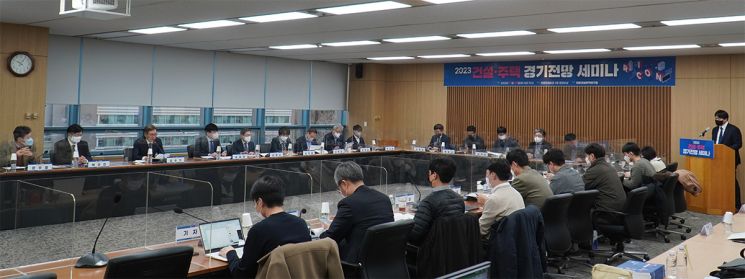 Scene from the '2023 Construction and Housing Market Outlook Seminar' held at the Professional Construction Hall on the 29th / Photo by Korea Construction Policy Institute
[Asia Economy Reporter Noh Kyung-jo] A claim has emerged that the key to gauging next year's construction market will be 'funding procurement.' The government identified the magnitude and pace of interest rate hikes by the U.S. Federal Reserve (Fed) as the biggest variables in the construction and housing markets, stating it will respond to the financial and real economy complex crisis with a two-track approach.
On the 29th, Jang Woo-cheol, Director of the Construction Policy Division at the Ministry of Land, Infrastructure and Transport, attended the '2023 Construction and Housing Market Outlook Seminar' held at the Specialized Construction Hall as a discussion panelist and said, "In the short term, the housing market should closely monitor interest rates; in the medium term, supply; and in the long term, population."
Director Jang explained, "During the process of overcoming the past International Monetary Fund (IMF) foreign exchange crisis, the linkage between finance and real estate was strengthened, and our country's monetary system deepened the financialization of real estate to the extent that it was called an apartment-based system." He added, "Major global economic crises we remember, such as the dot-com bubble and the subprime crisis, differed only in whether the target was stocks or real estate, but they were all part of the 'Boom and Burst' cycle caused by credit expansion and contraction."
He continued, "While risk management of financial institutions regarding real estate exposure is important, project financing (PF) funds must be smoothly supplied to normal construction sites." He added, "According to discussions among government ministries, the financial authorities plan to provide administrative guidance on this matter."
Park Seon-gu, Research Fellow at the Korea Construction Policy Institute, said that if the key word for judging this year's construction market was 'rising construction costs,' next year it will be 'funding procurement.'
In his keynote presentation, Research Fellow Park said, "Due to the decline in non-residential construction investment caused by economic slowdown and the sluggish civil engineering investment resulting from reduced social overhead capital (SOC) budgets, construction investment will continue to be in a recession phase." He added, "Whether the construction market recession will persist or shift to a recovery phase depends on the stability of the funding market." He forecasted that domestic construction investment will decrease by 0.4% next year.
In this regard, Kim Deok-rye, President of the Korean Housing Association, pointed out the fragile construction ecosystem and suggested the need for serious discussions on the timing of recovery. There had been vague expectations that the market would improve once COVID-19 was overcome, but uncertainties have increased due to the prolonged Russia-Ukraine war and interest rate hikes.
She also emphasized the urgency of developing qualitative indicators. President Kim said, "We need to examine whether the current construction and real estate indicators are sufficient as qualitative indicators for future society," adding, "While quantitative indicators are sufficient, they are inadequate for diagnosing the market." She judged that overcoming the crisis would be difficult without preparing systematic measures to reduce volatility in the rising trends of material prices and labor costs.
Some have not given up hope that the rising trend in construction costs such as material prices will turn downward. This is because, statistically, material prices have shown significant periodic volatility since 1980, but it has been rare for such trends to last more than two years.
Han Ho-seop, Head of Management Planning at the Specialized Construction Mutual Aid Association, said, "The increase in material prices has already been reflected in contract prices, and construction companies will respond well to the slowing trend going forward." He pointed out, "More serious than that is the productivity decline caused by construction labor unions."
The government also mentioned that role-sharing among economic agents is important and said it will take measures to enable the construction industry to have crisis response capabilities. Director Jang said, "We plan to expand mortgage guarantees so that developers with unsold units after completion can flexibly adjust sales and rentals," emphasizing, "If the supply base collapses, prices could skyrocket at the time of economic recovery, so we will ensure that at least a minimum supply is maintained."
He added, "There is great uncertainty in domestic and international conditions to the extent that one might question whether outlook seminars like today's are meaningful and whether adapting to rapidly changing variables is more important." He concluded, "We will closely monitor the unprecedented ripple effects of interest rate hikes and, despite the difficult situation, the government and the construction industry will work together to overcome the crisis."
© The Asia Business Daily(www.asiae.co.kr). All rights reserved.
![Clutching a Stolen Dior Bag, Saying "I Hate Being Poor but Real"... The Grotesque Con of a "Human Knockoff" [Slate]](https://cwcontent.asiae.co.kr/asiaresize/183/2026021902243444107_1771435474.jpg)
















