Among 663 Submissions, 214 Cases Were Actually Reviewed
67 Items "No Issues with Questions or Answers"
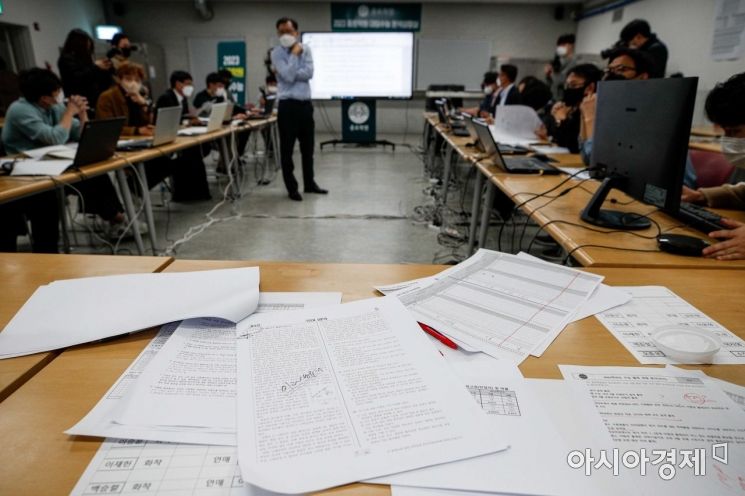 On the 17th, the day of the 2023 College Scholastic Ability Test, academy instructors are operating a problem analysis situation room at the Jongno Academy Gangbuk headquarters in Mapo-gu, Seoul. Photo by Jang Jin-hyeong aymsdream@
[Asia Economy Reporter Han Jinju] The Korea Institute for Curriculum and Evaluation concluded that there were no issues with any of the questions following the review of objections to the 2023 College Scholastic Ability Test (CSAT) questions.
On the 29th, the institute finalized and announced the official answers for the 2023 CSAT and judged that all 67 questions subject to review among those with objections had "no problems with the questions or answers."
The total number of objections received by the institute from the 17th to the 21st was 663. Among these, 449 were unrelated to question errors or answer confirmation or were duplicate contents, and 214 were actual subjects for review.
The institute, through the Objection Review Working Committee, which included external experts not involved in the test creation, and the final deliberation by the Objection Review Committee, judged that all 76 questions had no issues.
The question with the most objections was Mathematics Common Subject question 12 (30 cases), followed by Social and Cultural question 7 (20 cases).
Question 23, which caused controversy for having the same passage as a mock test distributed by a private academy instructor, was excluded from the objection review. Social Studies Social and Cultural question 10, known to have a correct answer rate of around 4%, was also not included in the objection review.
The institute explained, "Although question 23 in English used the same passage as a private mock test, it is not subject to objection review to determine whether there are any issues with the question, problem, or answer."
Following last year's controversy over test creation errors, the institute extended the test creation period by two days and the objection review period by one day. For the social and science areas where objections frequently occur, the institute formed separate Objection Review Working Committees for each area and decided to include additional advisory academic society members in the review process if significant question errors occur. They will request advice from three or more academic societies and disclose the names of the consulted societies and the content of the advice.
So far, there have been a total of nine cases recognized as test creation errors in the CSAT: 2004 Language, 2008 Physics 2, 2010 Earth Science 1, 2013 World Geography, 2015 English, 2015 Life Science 2, 2017 Korean History, 2017 Physics 2, and 2022 Life Science 2.
© The Asia Business Daily(www.asiae.co.kr). All rights reserved.
![Clutching a Stolen Dior Bag, Saying "I Hate Being Poor but Real"... The Grotesque Con of a "Human Knockoff" [Slate]](https://cwcontent.asiae.co.kr/asiaresize/183/2026021902243444107_1771435474.jpg)
















