"Decline in Construction Market and Aging Population Are Factors Lowering Construction Industry Productivity"
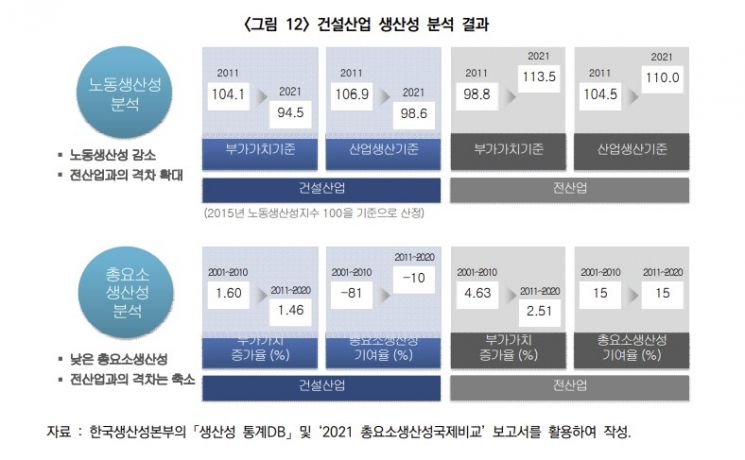 Comparison of Productivity Between Construction Industry and All Industries / Provided by Korea Construction Industry Research Institute
[Asia Economy Reporter Noh Kyung-jo] An analysis has emerged that the labor productivity of the domestic construction industry has sharply declined, necessitating countermeasures.
The Korea Construction Industry Research Institute announced in its "Korea Construction Industry Productivity Analysis Report" published on the 29th that the labor productivity index based on value added in the construction industry decreased from 104.1 in 2011 to 94.5 in 2021. During the same period, the labor productivity index based on industrial production fell from 106.9 to 98.6.
The decrease in labor productivity means that the same workforce is producing less output. This also implies that it is difficult for wages of construction industry workers to increase accordingly.
This contrasts with the labor productivity of all domestic industries excluding agriculture, which increased from 98.8 to 113.5 based on value added, and from 104.5 to 110.0 based on industrial production during the same period.
The gap with advanced countries has widened further. According to the report, among OECD (Organization for Economic Cooperation and Development) countries, South Korea's construction industry labor productivity ranking dropped from 22nd place ($50,214) in 2010 to 26th place ($51,603) in 2019.
During this period, South Korea's overall industrial labor productivity rose one rank from 23rd place ($69,227) to 22nd place ($79,660). This was largely attributed to improvements in manufacturing labor productivity.
Researcher Sung Yu-kyung of the Korea Construction Industry Research Institute explained, "Labor productivity is generally higher in advanced countries. Considering national circumstances, South Korea's construction industry labor productivity is reasonable, but it still falls short of the level of advanced countries."
She added, "Due to the expected downturn in the construction market, aging population, low technological investment in the private sector, and regulation-centered institutional conditions, a decline in construction industry productivity is anticipated going forward. If this continues, the productivity gap between the construction industry and other industries is likely to widen further."
Total factor productivity, which indicates qualitative growth, efficiency improvement, and technological innovation in industries, shows that the gap between the construction industry and all industries is narrowing but remains at a low level. The contribution rate of total factor productivity to the value-added growth rate of the construction industry (2011?2020) was -10%, revealing inefficiencies in the construction industry's production process.
Researcher Sung stated, "Efforts to improve productivity cannot yield results in the short term but will manifest as enhanced efficiency of production systems and increased value added after about ten years. From a mid- to long-term perspective, government policy support and efforts to improve productivity are necessary."
© The Asia Business Daily(www.asiae.co.kr). All rights reserved.
![Clutching a Stolen Dior Bag, Saying "I Hate Being Poor but Real"... The Grotesque Con of a "Human Knockoff" [Slate]](https://cwcontent.asiae.co.kr/asiaresize/183/2026021902243444107_1771435474.jpg)
















