“No Space Closure Without Communication” vs “Few Direct Supports and Overlapping Roles with City and County Centers”
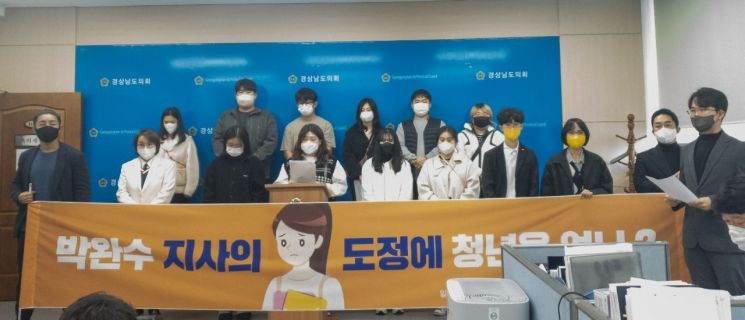 Gyeongnam Youth Solidarity held a press conference opposing the Gyeongnam Provincial Government's decision to abolish the Gyeongnam Youth Center. / Photo by Se-ryeong Lee ryeong@
[Asia Economy Yeongnam Reporting Headquarters Reporter Lee Seryeong] Gyeongsangnam-do recently decided to close 12 of the 99 centers in the province that were operated in a conventional, repetitive, and inefficient manner, prompting opposition from the local youth coalition.
The Gyeongnam Youth Coalition, composed of youth groups active in Gyeongnam and civic coalitions supporting youth activities, held a press conference on the 29th at the provincial council briefing room, urging the maintenance of youth centers.
The coalition stated, “We condemn the provincial government for unilaterally shutting down projects without communicating with the youth.”
“Youth centers serve as an intermediary support organization that communicates with stakeholders to effectively implement youth policies,” they said. “Through club support projects and project support programs operated by the centers, group-specific projects were carried out and solutions to problems were found.”
They added, “These centers have been spaces that cared for youth, expanded opportunities for community participation, provided information for youth, and enabled communication, but they are suddenly being closed in December. Closing them abruptly without communication with youth could set a negative precedent.”
They continued, “There are no regional centers in Geochang, Hamyang, Hapcheon, Sancheong, Changnyeong, Uiryeong, and Hadong,” and asked, “If the Gyeongnam center is eliminated, what real opportunities will be provided to youth who feel regionally marginalized and live in hardship?”
The coalition emphasized, “Youth policies should not be evaluated solely on efficiency, and discussions should be based on qualitative indicators that confirm changes in life beyond job-centered efficiency,” urging the securing of budgets and maintenance of youth centers.
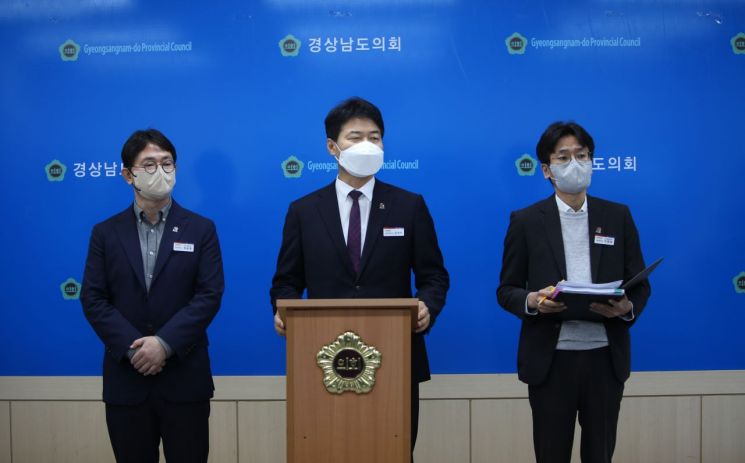 Kim Tae-hee, Head of the Youth Policy Promotion Team (center), is announcing Gyeongnam Province's position on the closure of the Gyeongnam Youth Center. / Photo by Ryeong Lee
Gyeongsangnam-do announced its position at the same location immediately after the coalition’s press conference.
Kim Tae-hee, head of the Youth Policy Promotion Team, emphasized, “Although the Gyeongnam Youth Center will be closed, support for youth will actually be strengthened.”
Kim cited ▲high operational cost ratio ▲low usage performance ▲overlapping roles with city and county youth centers as reasons for closing the youth centers.
According to the province, 61.8% of the youth center budget was for operations, while only 38.2% was directly spent on supporting youth.
The province pointed out a structural problem where the youth centers, established to support youth, spent more on operational budgets to maintain the centers than on directly supporting youth.
As of the end of September, a total of 4,113 people visited the centers this year, averaging about 15 people per day, with the majority of youth users living near Changwon.
It was also noted that roles overlapped with youth centers established in cities and counties, reducing the necessity of operating a metropolitan-level youth center.
Kim said, “We will eliminate youth centers that fail to properly perform their roles and reinvest the costs into youth support budgets to strengthen support for youth,” adding, “We plan to concentrate 54.9 billion KRW in the job sector, where youth demand is high.”
The province allocated 102.7 billion KRW in the initial budget for next year, increasing by 21.5 billion KRW from this year’s youth support budget of 81.5 billion KRW.
Starting next year, regional youth hub spaces will be created mainly in the western region, where there were limitations in using the metropolitan center due to the absence of youth centers in some cities and counties and physical distance.
In December, a group in-depth interview survey targeting youth in the province will be conducted to gather opinions on youth support policies, and next year, a 100 million KRW research project will be carried out to establish a Gyeongnam youth policy roadmap.
New projects for next year include youth culture activation contest projects and youth hub space creation projects, each with a budget of 2 billion KRW.
Kim said, “Programs that satisfied youth at existing centers will continue at the hub spaces, and customized socialization and job search education programs will be supported for youth who have given up job searching and those preparing for independence.”
He added, “We judged that it is more necessary to create youth hub spaces in each region where youth live rather than maintaining centers that cannot provide sufficient practical support,” and said, “We will enable local youth to gather and enjoy themselves in their regions and fully collect diverse demands and voices of youth to prepare support policies that youth can truly feel.”
© The Asia Business Daily(www.asiae.co.kr). All rights reserved.
![Clutching a Stolen Dior Bag, Saying "I Hate Being Poor but Real"... The Grotesque Con of a "Human Knockoff" [Slate]](https://cwcontent.asiae.co.kr/asiaresize/183/2026021902243444107_1771435474.jpg)












